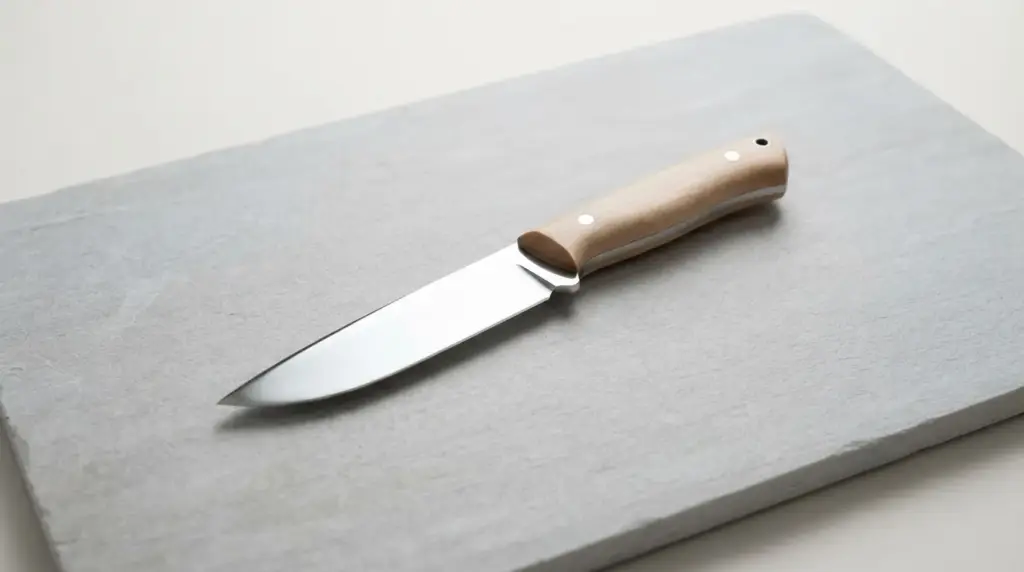
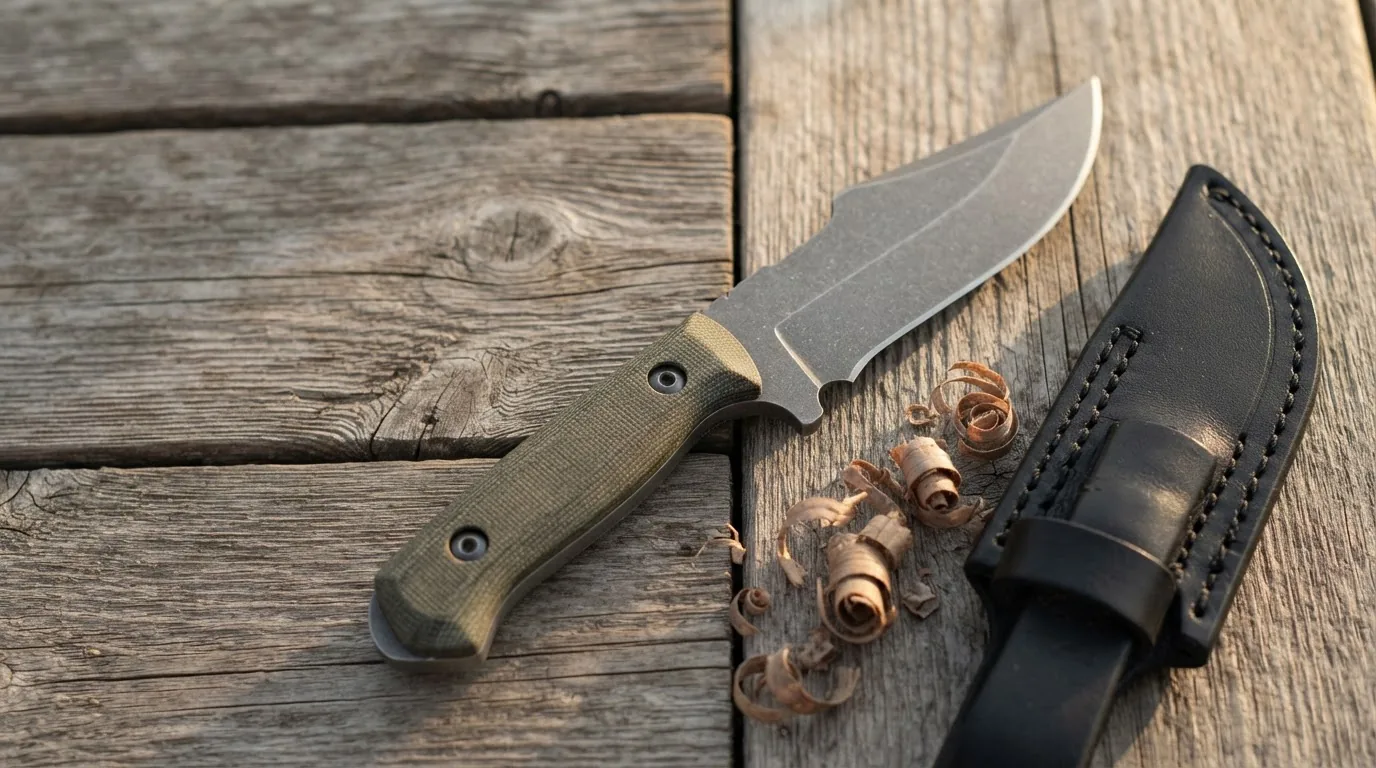
Short answer. A tracker knife is a thick, short, heavy fixed blade whose edge is split into two working zones: a deep curved chopping belly at the front and a straight fine work section behind it, with a sawback along the spine. It was designed by the tracker and survival instructor Tom Brown Jr. in the early 1980s as a single tool that could do everything, and it became famous through the 2003 film The Hunted rather than through fieldcraft. It is genuinely good at notching, batoning and heavy wood work. It is mediocre at slicing, poor at fine point work, and heavier than the two knives that would do its jobs better. We sell twelve of them and we are telling you this anyway.
What a tracker knife actually is
Strip away the mythology and a tracker is defined by four features that appear together.
A divided edge. The front third or so is a deep, aggressive curve. Behind it the edge runs straight and flat. The two are separated by a distinct change in direction rather than blending, which is what gives the profile its unmistakable silhouette.
A stubby, dropped point. The point sits low and is not fine. It is more of a corner than a tip. This is deliberate and it is the source of most of the criticism the design attracts.
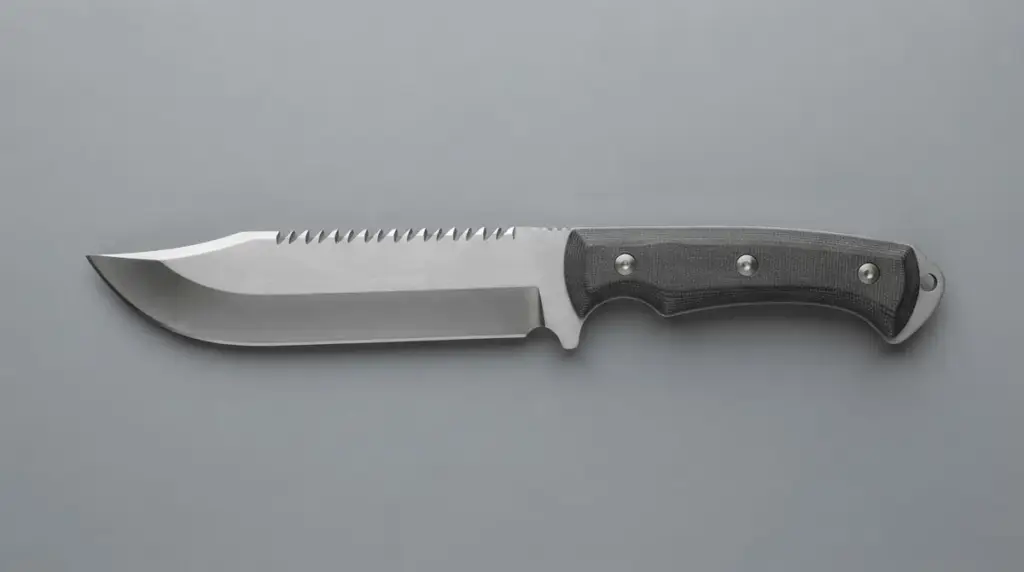
A sawback spine. Coarse teeth along part of the spine, intended for notching wood rather than for cutting through it. It is not a saw in any useful sense and nobody who owns one claims otherwise.
Thickness. A quarter of an inch of spine is standard, which is roughly twice what a normal hunting knife carries and is the main reason the knife weighs what it does.
Put those together and you have a tool that behaves more like a small handaxe with a knife edge attached than like a knife with extra features. That framing is the most useful one for deciding whether you want it.
Where the design came from
Tom Brown Jr., who runs a tracking and wilderness survival school, sketched the design in the early 1980s. The account that circulates, and that his school has not disputed, is that he was asked why no perfect survival knife existed and answered that he had not designed it yet. He commissioned the knifemaker Robb Russon to make a prototype in 1981. Ed Lombi later made a small batch, reportedly eleven knives, with wood handles instead of micarta, and David Beck produced handmade versions after that. When Beck stopped, the knife was effectively unavailable.
Brown then worked as technical advisor on the film The Hunted, which was released in 2003 with Benicio del Toro and Tommy Lee Jones. The knife is central to the film. The film was not a commercial success on release, and the tracker's popularity grew afterwards, on cable and home video, over a period of years. Brown partnered with TOPS Knives to produce a commercial version, and that is the knife most people picture when they hear the name.
The honest reading of that history is that the tracker is a design by a survival instructor, popularised by a film, and sold ever since on the strength of both. Whether it is the best fixed blade for the outdoors is a separate question from whether it is the most recognisable, and the answer to the second question is much clearer than the answer to the first.
The zones of the edge, and what each one does
This is the part that actually matters, because the divided edge is the whole design.
| Zone | Where it sits | What it is for | Where it falls down |
|---|---|---|---|
| Chopping belly | Front of the blade, deep curve, mass concentrated forward | Chopping, batoning, splitting kindling, limbing. The forward weight does the work | Too short to be a real chopper. A hatchet with a 12 inch handle beats it comfortably |
| Straight section | Behind the belly, closest to the handle | Push cuts, feather sticks, carving, controlled slicing with the hand close to the work | Only a few inches long, and set back so far you cannot use it on anything wide |
| Sawback spine | Rear of the spine | Notching, cutting square shoulders into wood for traps, shelters and tools | It will not saw through a branch. Owners are unanimous on this |
| The point | Front, low and blunt | Drilling, prying, digging, scraping a ferro rod | Cannot do fine point work. Drilling a small hole or piercing hide is awkward |
The design logic is sound: you carry one tool, you move your grip along it, and each part of the edge takes the job it suits. The problem is that a knife has to be thick and heavy to chop, and thin and light to slice, and no amount of clever profiling reconciles those two requirements in a blade of this length. The tracker does not solve that tension. It splits the difference and asks you to accept a compromise at both ends.
What it is genuinely good at
Three things, and they are real.
Notching. The combination of the sawback and the straight section is the best tool for cutting square notches into green wood that most people will ever hold. If you build traps, figure four triggers, pot hangers, tripods or shelter frames, this is where the design earns its reputation.
Batoning. A quarter inch spine and a flat area to strike is exactly what you want when driving a blade through a round with a stick. The knife is very hard to damage doing it, which is not true of a thin bushcraft knife.
Heavy, careless work. Digging, prying at a rock, scraping bark, opening things that should not be opened with a knife. The tracker takes abuse better than almost anything of similar length because there is so much steel in it.
What two lighter knives do better
Here is the position we would rather not put in writing on a page that exists to sell trackers.
For nearly every job on a tracker's list, a small hatchet plus a four inch bushcraft knife does it better, and the pair weighs about the same. The hatchet chops properly because it has a handle long enough to generate speed. The bushcraft knife slices properly because it is thin behind the edge. The tracker chops adequately and slices adequately and does neither well.
| Task | Tracker | What beats it |
|---|---|---|
| Notching and trap building | Best in class | Nothing, this is its job |
| Batoning kindling | Very good | Nothing much, though a thick 4 inch blade is close |
| Felling or limbing anything above wrist thickness | Adequate and tiring | A hatchet or a folding saw, by a wide margin |
| Feather sticks and fine carving | Workable with practice | Any thin bushcraft knife with a scandi grind |
| Field dressing and skinning game | Poor | A drop point hunter or a skinner. The belly is too deep and the point too blunt |
| Food prep in camp | Poor | Almost anything, including a folder |
| Everyday carry | No | Weight and profile rule it out. See our EDC guide |
| Looking like nothing else on the belt | Unmatched | Nothing, and this is a real reason people buy it |
That last row is not a joke. A large part of the tracker market is people who want this specific object because of what it is and what it looks like. That is a legitimate reason to buy a knife and we are not going to pretend otherwise. It is just a different reason from the one the marketing usually gives.
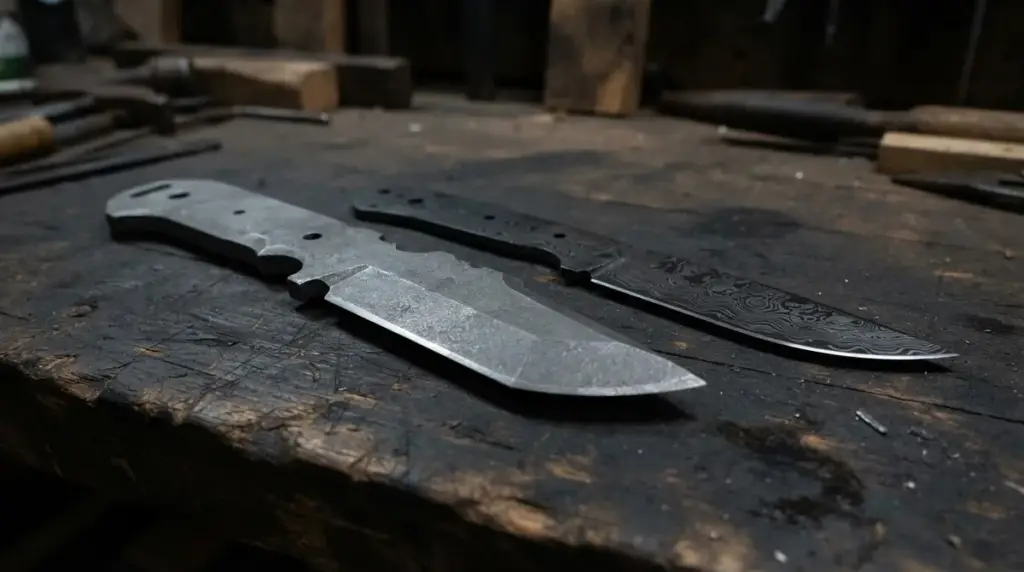
Steel, and why almost no tracker is Damascus
The original TOPS production knife uses 1095 at 56 to 58 HRC by their published figures. Ours use D2, which we hold to 58 to 62 HRC. Almost every tracker on the market is a plain carbon or tool steel and there is a reason for that.
A tracker is a batoning and prying tool. The loads it takes are impact loads applied to a thick blade with abrupt changes in edge direction, which is exactly the geometry that concentrates stress. Pattern welded steel is not the material you want for that job. As we cover in our steel comparison, combining a tough steel with a less tough one in a billet tends to give you toughness closer to the weaker constituent, not the average, and every forge weld is a potential defect if it was not made cleanly.
So here is the awkward number. We publish 320 Damascus knives. Not one of them is a tracker. A shop whose whole identity is Damascus does not make its trackers in Damascus, and the reason is that we do not think it would be the right steel for the job. You will find tracker shaped Damascus blades elsewhere. Ask the seller how they expect the billet to behave under a baton, and see what answer you get.
Weight and balance, and a number we do not publish
Weight is the single most divisive thing about this design and it is the one specification you should insist on before buying any tracker from anyone.
TOPS lists the Tracker #1 at 21 ounces, which is 26 ounces with the sheath. For comparison, a typical four inch bushcraft fixed blade runs 5 to 8 ounces. So a tracker weighs roughly three times what a normal camp knife weighs, and with a sheath it is well over a pound and a half on the belt.
The balance point sits forward, which is what makes it chop at all, and which is also what makes fine work tiring. Holding a forward balanced 21 ounce blade steady for detailed carving is a wrist exercise.
Now the inconvenient part. We do not publish a weight for any of our twelve trackers. We checked the database on 30 August 2026 and the field is empty on all of them, and the specification block in the product copy does not carry it either. Given that ours share the same published overall length, blade length and spine thickness as the TOPS original, and are made in D2 rather than 1095, the weight is very likely to be in the same territory. But we have not measured and published it, so we are not going to state one here as though we had. If weight matters to your decision, and it should, write and ask us before you order rather than assuming.
What we stock, and what it measures
Twelve tracker knives, pulled from the catalogue on 30 August 2026.
| Figure | Value |
|---|---|
| Products in the tracker category | 12 |
| Steel | D2 tool steel on all twelve, none in Damascus |
| Hardness we hold D2 to | 58 to 62 HRC |
| Overall length | 11.88 inches on every single knife |
| Blade length | 6.38 inches on every single knife |
| Spine thickness | 0.25 inches on every single knife |
| Price range | 179 dollars to 245 dollars |
| Median price | 201 dollars |
| Handle materials | G10 on three, micarta on four, wood on four, and one set of five in mixed materials |
| Blade finishes | Mirror polished on six, stone washed on five, mixed on the set |
| Sheath | Black leather on all twelve |
| Published weight | None |
Read that table properly and you will notice something. Every one of our trackers is the same blank. The geometry does not vary at all across the range. What varies is the handle material, the screws, the blade finish and the price. If you are choosing between our twelve, you are choosing a look and a feel in the hand, not a different tool. That is worth knowing before you spend an hour comparing them.
You can see the range on the tracker knives category page, and the wider D2 range in D2 tool steel.
Prices across the market
Prices checked on 30 August 2026 and correct at that date only.
| Knife | Overall | Blade | Spine | Steel | Price seen |
|---|---|---|---|---|---|
| TOPS Tom Brown Tracker #1 | 11.88 in | 6.38 in | 0.25 in | 1095 at 56 to 58 HRC | 365 dollars list on the maker's site, 229.99 dollars at one US dealer |
| TOPS Tracker #2 | 9.5 in | about 5 in | 3/16 in | 1095 | 239.99 dollars at the same dealer |
| TOPS Mini Tracker | 6.5 in | not published there | not published there | 1095 | 156.99 dollars at the same dealer |
| BMK trackers, all twelve | 11.88 in | 6.38 in | 0.25 in | D2 at 58 to 62 HRC | 179 to 245 dollars |
The gap between the maker's list price and the dealer price on the same knife is worth noticing. It tells you that the tracker market has room in it, and that a headline price on any tracker, ours included, is a starting point for comparison rather than a statement about quality.
Who should buy one
Buy a tracker if you spend real time building things out of wood in the field, if you value one tool that will survive anything over two tools that each do their job better, or if you simply want this particular object and are honest with yourself that the reason is that you want it.
Do not buy one as a first fixed blade, as a hunting knife, as a camp kitchen knife or as anything you have to carry a long way on foot. A four to five inch drop point does more of what a general outdoors user needs, weighs a third as much and costs less. Our hunting knife guide covers that ground, and knife blade shapes explains why a drop point does so much with so little.
One last practical note. A blade of this size and shape is a fixed blade with a sawback, and both of those attributes are treated differently in different places. Please check your local law before ordering.
Questions people ask
What is a tracker knife used for?
Notching and shaping wood, batoning kindling, light chopping, digging and prying, and general heavy field work where you do not want to worry about damaging the blade. It is a wood processing and camp construction tool first, and a cutting knife second.
Is the tracker knife from a movie?
The design predates the film by about twenty years. Tom Brown Jr. designed it in the early 1980s and had prototypes made by Robb Russon and later Ed Lombi and David Beck. The 2003 film The Hunted, on which Brown was technical advisor, is what made it famous, and demand grew mostly after the film's cinema run.
Does the sawback actually saw?
No. It cuts notches into wood, which is what it was designed for. Owners who expect it to cut through a branch are consistently disappointed. If you need to cut through wood, carry a folding saw.
How much does a tracker knife weigh?
The TOPS Tracker #1 is listed by its maker at 21 ounces, or 26 ounces with the sheath. That is roughly three times a normal four inch camp knife. We do not publish a weight for our own trackers, which is a gap in our listings rather than a secret, so ask us if it matters to your decision.
Can you skin an animal with a tracker knife?
You can, but it is the wrong tool. The belly is very deep, the point is blunt, and the knife is heavy enough to be tiring for the sort of controlled work skinning demands. A dedicated skinner or a drop point hunter will do the job faster and with less risk of punching through hide.
What steel is best for a tracker knife?
A tough carbon or tool steel. The original uses 1095 and ours use D2, which we hold to 58 to 62 HRC. What you want is impact resistance and a blade that does not chip when you drive it through a knot with a baton, not maximum edge retention.
Are Damascus tracker knives any good?
They exist and some are beautifully made, but we do not make one and we would not recommend a pattern welded blade as a batoning tool. Combining steels in a billet tends to give toughness nearer the weaker constituent, and every weld line is a place a defect could sit. If you want one anyway, ask the seller about the billet and the heat treatment before buying.
Is a tracker knife good for beginners?
No. It is a specialist tool with an unusual profile that is harder to sharpen than a straight edge, heavier than a beginner expects and poorly suited to most of the tasks a new outdoors user actually faces. Start with a four inch drop point fixed blade and buy a tracker later if the jobs it does turn out to be jobs you have.
How do you sharpen a tracker knife?
In sections. The deep chopping belly, the straight section and the point all sit at different angles to the stone, so you sharpen each separately rather than trying to run the whole edge in one stroke. Many owners use a rod or a small pocket stone for the belly because it fits the curve better than a bench stone does.
Why are your twelve trackers all the same size?
Because they are the same blank in different dress. All twelve are 11.88 inches overall with a 6.38 inch blade and a quarter inch spine, in D2, with a black leather sheath. The differences are handle material, hardware, finish and price. We would rather tell you that than let you spend an evening comparing specifications that do not differ.
More guides
For how a blade profile decides what a knife can do, read knife blade shapes. For the alternative most tracker buyers should probably consider first, the best hunting knife guide covers four and five inch fixed blades. Fixed blade bevels explained deals with the grinds, the steel comparison puts D2 next to the alternatives, and the tracker category is where our twelve live.
More from the workshop
How to Tell Real Damascus from a Printed Pattern
Four checks that separate forge-welded steel from a surface-etched imitation.
Carbon vs Stainless Kitchen Knives
Carbon is better to cut with, stainless is better to own. Pick by your habits.