
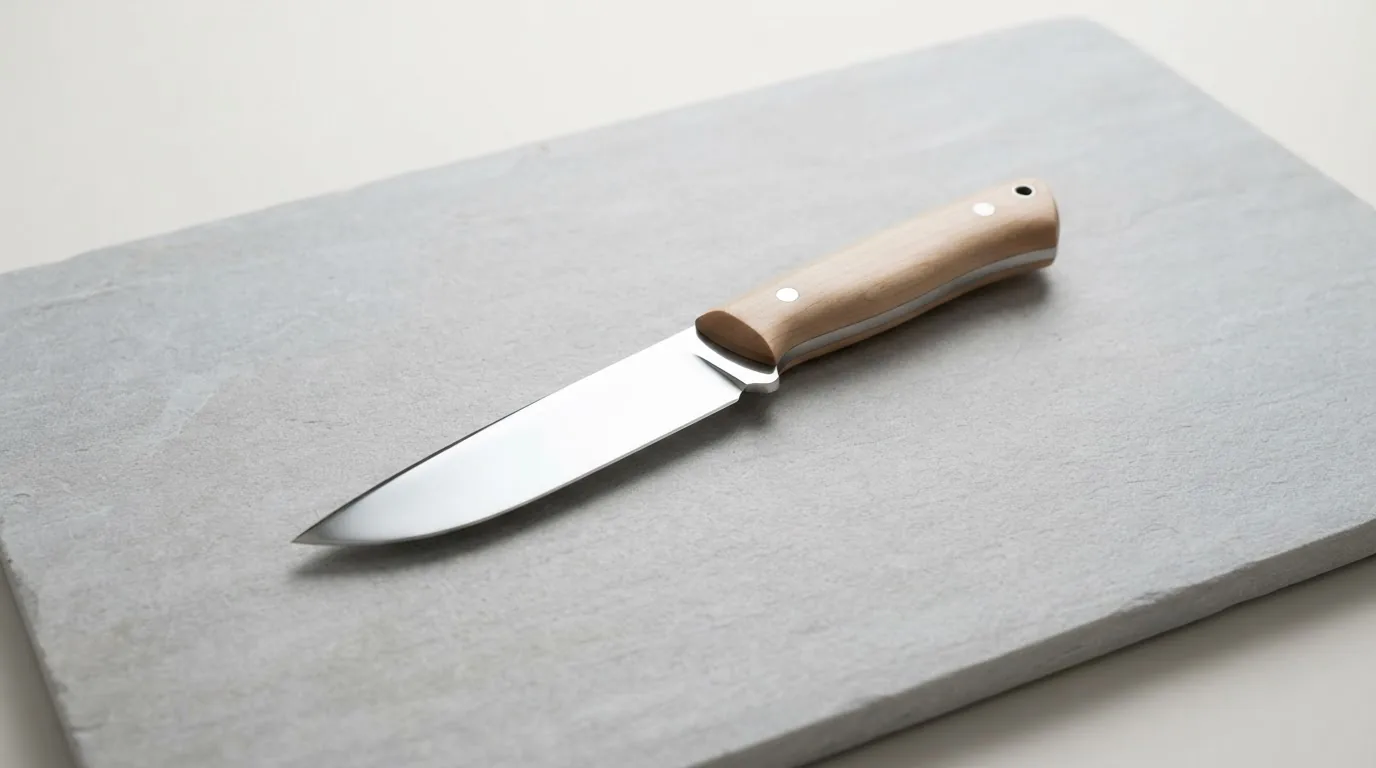
Short answer: 440C is a good knife steel. It is a high carbon stainless with enough chromium to shrug off rust and enough carbon to take a proper edge, and at 58 to 60 HRC it will hold that edge through a full day of work. It is not a super steel and it was never meant to be. It is the steel you choose when the knife is going to get wet, get dirty, and get used by someone who is not going to baby it.
What 440C actually is
440C is a martensitic stainless steel with roughly 1.0 percent carbon and 17 percent chromium, plus a little molybdenum. The carbon is what lets it harden. The chromium is what stops it rusting. Getting both in one alloy is the whole trick, and 440C has been doing it since the 1960s, which is why it turns up in everything from dive knives to surgical instruments to bearing races.
The number is part of a family, and the family is where most of the confusion starts.
| Steel | Carbon | What it means in the hand |
|---|---|---|
| 420 | ~0.3% | Very rust resistant, very soft. Fine for a dive knife you pry with. Will not hold a fine edge. |
| 440A | ~0.7% | Budget stainless. Easy to sharpen, dulls quickly. Common in mass produced knives. |
| 440B | ~0.8% | The middle child. Rarely specified by name any more. |
| 440C | ~1.0% | The one worth buying. Hardens to 58 to 60 HRC and keeps a working edge. |
This matters because a listing that says 440 stainless steel without a letter is almost always 440A. If a seller has 440C, they say 440C. The letter is the product.
Is 440C good for knives?
Yes, with a condition attached: 440C is only as good as its heat treat. That is true of every steel, but 440C is unusually sensitive to it. Run properly it comes out around 58 to 60 HRC with fine carbides spread evenly through the matrix. Run badly, with a soak that is too short or a quench that is too slow, you get large carbides, retained austenite and a blade that chips instead of rolling. Same steel, same certificate, completely different knife.
 Black Scorpion 8″ Long 3.5″ Blade” 5.6 Oz 440c High Mirror Polished Pocket Knives Handmade Damascus Pocket Folding Knife Hand Made World Class Knives | BMK-402
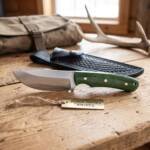 Green Fish Knife 9″ Long 4.5″ Blade 9oz 440c Stainless Steel Fixed Blade Hunting Bowie Skinner Handmade Knife Black Mamba Hand Made World Class Knives USA Made | BMK-144
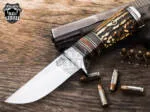 C Hyena Knife 8.5 Long 4″ Blade 7oz Fixed Blade Hunting Knife USA | BMK-100-440
This is why 440C has a mixed reputation online. Half the people writing about it are describing a properly heat treated blade and half are describing a cheap import that says 440C on the box and was never soaked long enough to become it.
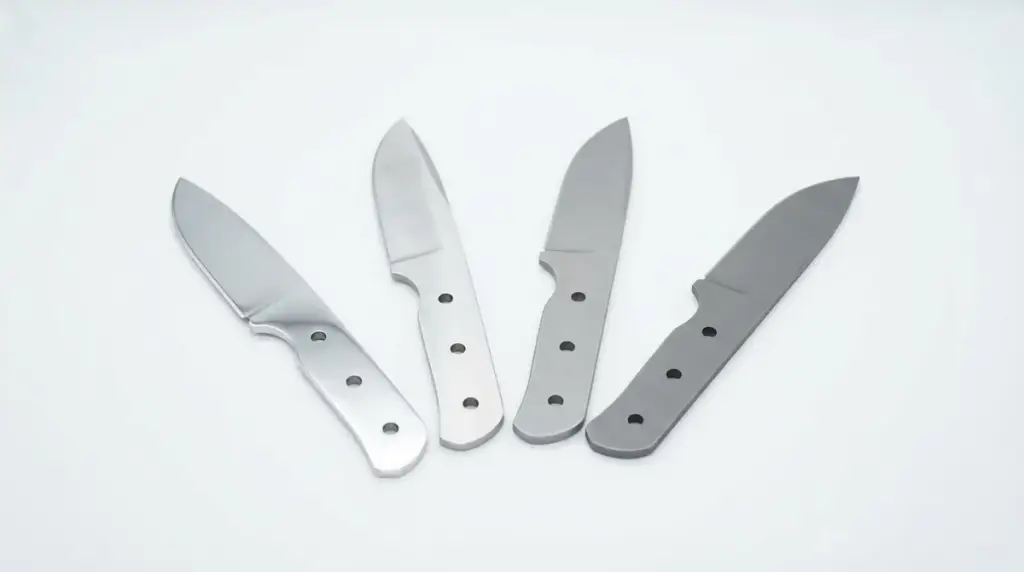
440C against the steels you are comparing it to
| Comparison | Edge retention | Corrosion resistance | Ease of sharpening | Buy 440C when |
|---|---|---|---|---|
| 440C vs 1095 | 1095 slightly better | 440C much better | 1095 easier | The knife will be wet, salty or left in a sheath. |
| 440C vs D2 | D2 better | 440C better | 440C much easier | You sharpen your own knives and want low maintenance. |
| 440C vs VG10 | VG10 slightly better | Roughly equal | 440C easier | Toughness matters more than a very fine edge. |
| 440C vs Damascus | Depends on the core | 440C better | 440C easier | You want function over pattern, or a knife for hard use. |
| 440C vs 8Cr13MoV | 440C better | Roughly equal | Roughly equal | Almost always. 8Cr is the budget substitute. |
The honest summary: 440C loses on paper to every modern powder steel and wins on the bench against most of them, because it sharpens back to shaving sharp in ten minutes with a stone you already own.
What 440C is best used for
- Hunting and skinning knives. Blood is salty and corrosive, field cleaning is wet, and a 440C blade forgives being wiped rather than washed. This is the single best argument for the steel.
- Fishing and dive knives. Salt water eats carbon steel. 440C is the classic answer and has been for sixty years.
- Kitchen knives. Dishwasher abuse, acidic food and a wet sink. A 440C chef knife will not stain the way a carbon blade does.
- Everyday carry folders. Pocket lint, sweat and neglect. 440C tolerates all three.
- Working knives for people who do not sharpen often. When it does go dull, it comes back fast.
Where it is the wrong choice: competition cutting, long unsupported chopping, and anyone who wants to go a month between touch-ups. Those are jobs for a tougher tool steel or a powder metallurgy steel, and they cost accordingly.
How to sharpen and care for 440C
440C sits in the sweet spot where a normal stone still works. A 400 grit diamond or ceramic plate to set the bevel, 1000 grit to refine, and a strop to finish. Hold around 20 degrees per side for a working knife, or 17 for a kitchen blade. You do not need diamond abrasives the way you do with D2 or S90V, though diamond is faster if you have it.
Care is close to nothing. Rinse and dry it, keep it out of a damp leather sheath for long storage, and oil it if it is going in a drawer for a year. Stainless is not stain proof, and 440C will still spot if you leave it wet in salt for a week, but it takes real neglect to get there.
Buying 440C without getting burned
Three things separate a real 440C knife from a listing that borrowed the name.
- The letter is printed. If it says 440 stainless with no letter, assume 440A and price it accordingly.
- A hardness figure is given. A maker who heat treats their own blades will tell you the HRC. Ours run 58 to 60. A listing with no number has usually not measured one.
- The price makes sense. 440C bar stock is not expensive, but a full tang knife that has been ground, hardened, tempered, finished and fitted with a real handle has a floor. Well under that floor, something in the description is not true.
Our own 440C stainless steel knives are ground and heat treated in our workshop in Memphis, Tennessee, run 58 to 60 HRC, and ship with a hand-stitched leather sheath on every fixed blade. If you want the same corrosion resistance in a folder, the folding pocket knives collection carries 440C alongside D2 and VG10, and the hunting knives collection is where the steel earns its keep.
Questions people ask
Is 440C stainless steel good for knives?
Yes. Properly heat treated 440C runs 58 to 60 HRC, holds a working edge through a full day of cutting, resists rust well enough for hunting and salt water, and sharpens back quickly on an ordinary stone. It is outperformed on paper by modern powder steels and outperforms nearly all of them on ease of maintenance.
What is the Rockwell hardness of 440C?
Between 58 and 60 HRC for knife use. It can be pushed higher, but above 60 it starts trading toughness for edge retention and becomes more likely to chip. Below 56 it will not hold an edge properly and the heat treat has gone wrong somewhere.
Is 440C better than 1095?
Different, not better. 1095 is a simple carbon steel that takes a very fine edge and is easy to sharpen, but it rusts if you look at it wrong. 440C gives up a little edge retention for a great deal of corrosion resistance. For a hunting or fishing knife, 440C. For a chopper or a knife you will maintain carefully, 1095.
Is 440C better than D2?
D2 holds an edge longer. 440C resists rust better and is far easier to sharpen, because D2 needs diamond abrasives to cut properly. If you sharpen your own knives with a normal stone, 440C is the more pleasant steel to own.
What is the difference between 440 and 440C?
The letter. 440A, 440B and 440C differ mainly in carbon content, from about 0.7 percent up to about 1.0 percent. More carbon means more hardness and better edge retention. A listing that says only 440 stainless steel is almost always 440A.
Does 440C rust?
It can, but it takes neglect. Roughly 17 percent chromium makes it stain resistant rather than stain proof. Left wet in salt water, or stored damp in a leather sheath for months, it will spot. Rinse it, dry it and it will outlive you.
Is 440C good for kitchen knives?
Very good. It tolerates acidic food, wet hands and a sink better than carbon steel, and it takes a keen enough edge for everyday prep. A thin grind behind the edge matters more than the alloy for how it feels on a board.
Can 440C be made into Damascus?
It can be layered, and stainless Damascus exists, but it is difficult and expensive because stainless needs a controlled atmosphere to forge weld cleanly. Most Damascus you will see, including ours, is layered 1095 and 15N20 carbon steels, which is why Damascus and 440C sit in different parts of our catalogue rather than the same knife.
More reading. Damascus vs D2 vs 440C vs VG10 puts the four side by side, and the knife steel chart has the numbers in one table.
Shop the knives
Black Scorpion 8″ Long 3.5″ Blade” 5.6 Oz 440c High Mirror Polished Pocket Knives Handmade Damascus Pocket Folding Knife Hand Made World Class Knives | BMK-402Green Fish Knife 9″ Long 4.5″ Blade 9oz 440c Stainless Steel Fixed Blade Hunting Bowie Skinner Handmade Knife Black Mamba Hand Made World Class Knives USA Made | BMK-144C Hyena Knife 8.5 Long 4″ Blade 7oz Fixed Blade Hunting Knife USA | BMK-100-440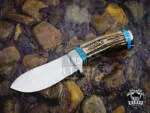 440c PERSIAN YUMA Knife 9.5" Long 4.5" Blade" 10.5 Oz Hunting Fixed Blade 440C Mirror Polished Turquoise Handle Knife Black Mamba Hand Made World Class Knives | BMK-111-B
More from the workshop
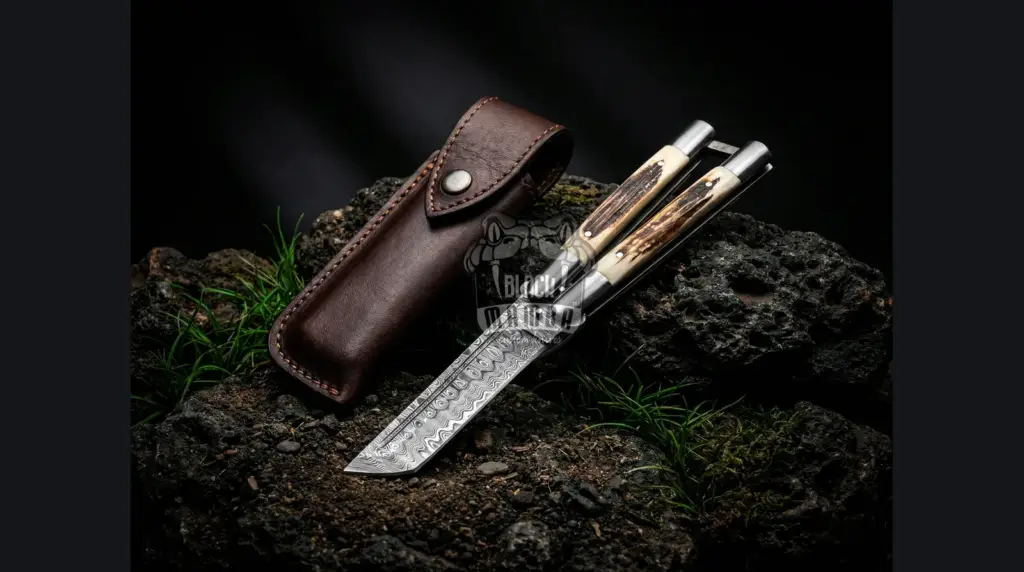
Butterfly Knife Laws in the US: How to Check Your State
Why federal law rarely applies, and how to check your own state properly.
Steak Knives: Serrated, Straight and What a Forged Set Costs
Straight edge against serrated, how many you need, and the real arithmetic of a forged set of four.
Do Damascus Knives Rust?
Damascus is carbon steel and it rusts. Why the nickel does not help, what causes it, and how to stop it.
