
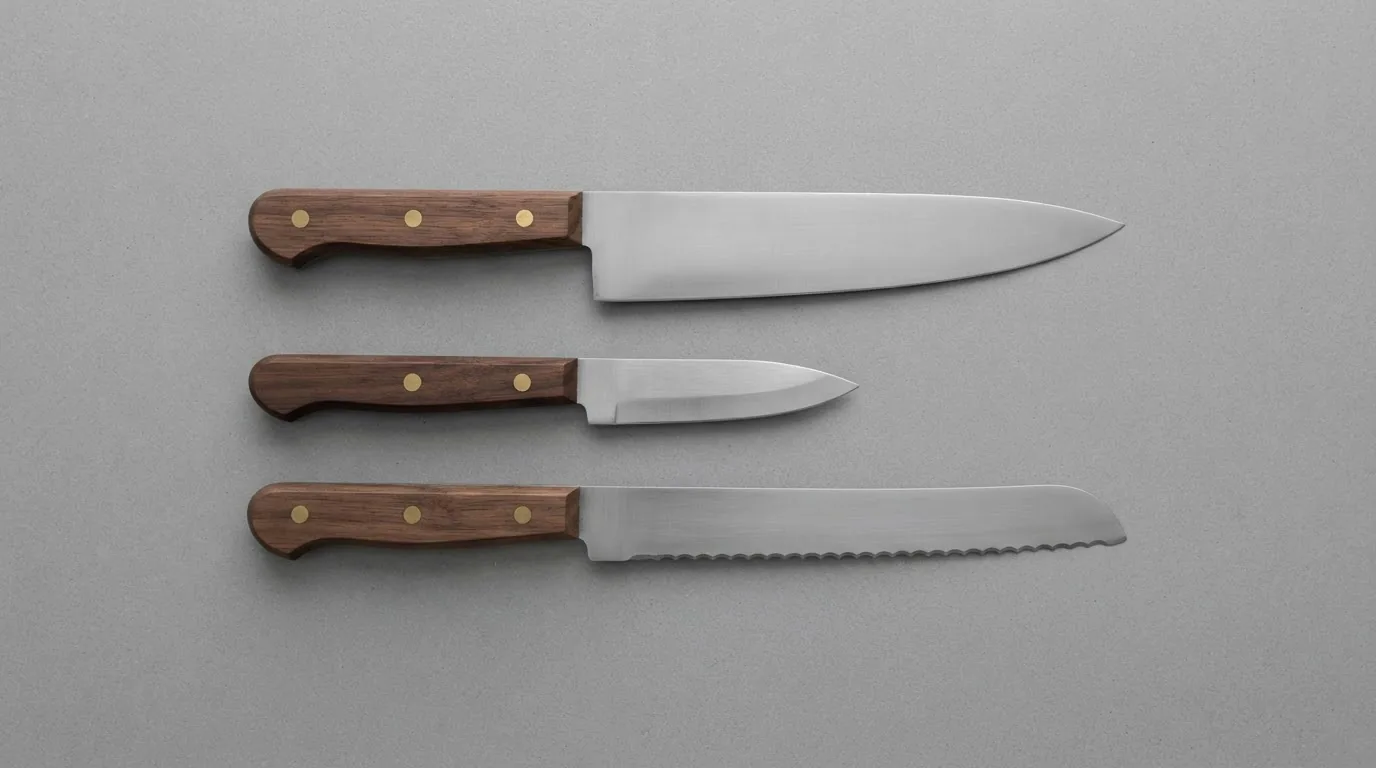
Short answer. Three. A chef knife between 7 and 8 inches, a paring knife around 3 inches, and a serrated bread knife around 9 inches will do more than 95 percent of what a home kitchen asks. Everything past those three is a convenience, not a necessity. A boxed set of twelve or sixteen costs more than three good knives, fills a block with pieces you will never use, and hides the price of the two you actually reach for. This is an inconvenient page for us to publish, because sets are where the money is in kitchen cutlery and we would rather sell you three knives than one.
The three knife kitchen
The case for three is not minimalism for its own sake. It is that every job on a domestic board falls into one of three mechanical categories, and each category needs a different blade.
The first is board work: reducing large things to smaller things while the food sits on a flat surface and your other hand holds it. That wants length, height for knuckle clearance, and enough weight to fall through an onion. A chef knife, or a santoku if you push cut rather than rock.
The second is in hand work: peeling, coring, hulling, deveining, segmenting a citrus, taking the eye out of a potato. The food is held in the air, the cut is short and controlled, and length is a liability. A paring knife, 3 to 4 inches, and the smaller the better for anything you do against your thumb.
The third is anything with a crust or a skin that a smooth edge slides off rather than biting into. Bread, obviously, but also tomatoes past their best, melons, and a cooked joint with a set crust. That wants a serrated edge, which works by concentrating force on the tips of the scallops. There is no substitute. A very sharp straight edge does bread badly and a blunt one does it disastrously.
Three jobs, three tools. Notice that a boning knife, a cleaver, a carving set, a santoku and a nakiri all belong to the first category. They are refinements of board work, not additional categories. That is why a twelve piece set is mostly one category repeated.
What a block actually contains
Pick up almost any boxed set and count the pieces honestly. A typical fifteen piece set is not fifteen knives. It is somewhere between six and eight knives, plus a block, plus a honing steel, plus a pair of kitchen shears, plus four to eight steak knives counted individually.
| Item in a typical 15 piece set | Count | Actually a knife? | Honest usage |
|---|---|---|---|
| Chef knife | 1 | Yes | Daily |
| Paring knife | 1 | Yes | Daily |
| Bread knife | 1 | Yes | Weekly |
| Utility or sandwich knife | 1 | Yes | Rarely, duplicates the paring |
| Santoku | 1 | Yes | Rarely, duplicates the chef knife |
| Boning or carving knife | 1 | Yes | A few times a year |
| Steak knives | 6 | Yes | Only when you serve steak |
| Honing steel | 1 | No | Misunderstood, see below |
| Kitchen shears | 1 | No | Genuinely useful |
| Wooden block | 1 | No | Storage, with a cost |
Six of the fifteen are steak knives. Two are not knives at all. Three of the remaining seven duplicate the work of one of the other three. The set is sold on the count because the count is the only number that flatters it.
Why the fourth knife is usually the wrong one
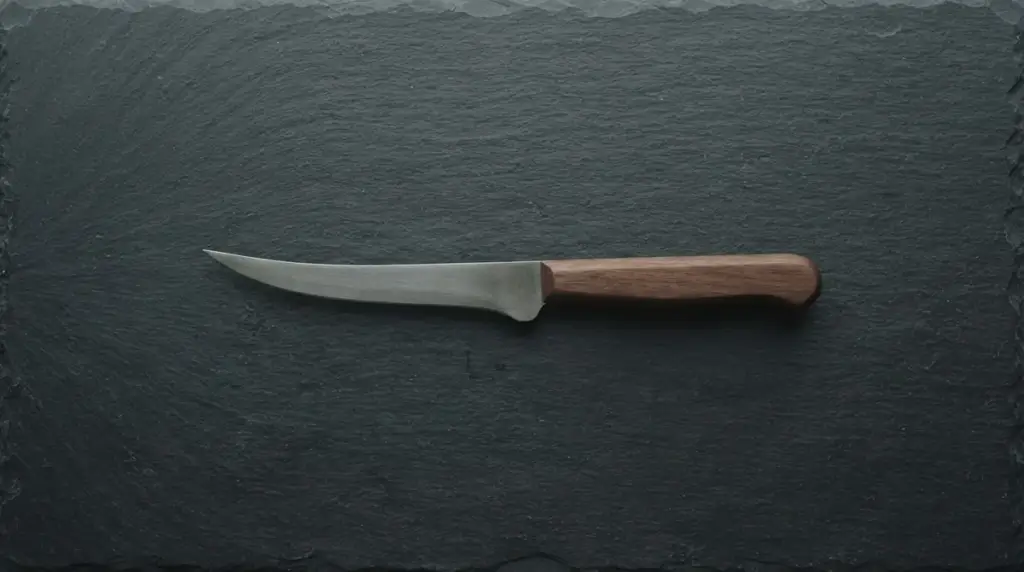
People who add a fourth knife almost always add a santoku or a second chef knife in a different length. Both are board work knives, and you already have one. The blades that would genuinely extend what your kitchen can do are the ones nobody puts fourth.
If you break down whole chickens, a boning knife with a narrow flexible blade earns its slot immediately, because a chef knife cannot get around a joint. If you cook a lot of large vegetables, squash and cabbage and swede, a cleaver or a heavy chef knife with a thick spine will stop you flexing a thin blade. If you fish or you buy whole fish, a fillet knife with real flex is not optional. If you carve a roast every Sunday, a long thin slicer with no belly gives you clean slices that a chef knife cannot.
Each of those is a real fourth knife because each does a job the first three cannot. A second chef knife is a preference. Buy it if you want it, but know that it is not extending your capability.
The economics, set against singles
Here is where the maths runs against the boxed set, and against us.
A boxed set spreads its budget across the count. If a fifteen piece set costs $300, the two knives you use daily got maybe $70 of that between them, because the block, the steel, the shears and the six steak knives had to come out of the same money. Buy three knives for $300 and each daily knife got $100.
Now run it against our own shelf, which is not a flattering comparison for us. Our kitchen and chef category holds 44 knives. The floor is $90, the median is $142, and the ceiling is $694. Three knives at our median comes to $426 before you have a block, a stone or a pair of shears. A competent factory three knife kit in decent stainless can be had for well under half that. What you get for the difference is hand grinding, a real distal taper, a forged blade rather than a stamped one, and a handle fitted to that specific tang. What you do not get is three times the cutting.
| Approach | Spend | Money in the daily knives | Trade |
|---|---|---|---|
| Fifteen piece boxed set | One payment | Roughly a quarter of it | Count over quality, block included |
| Three factory knives bought singly | One payment | All of it | Best value per cut, no ceremony |
| Three hand forged knives | Three payments, ours from $90 each | All of it | Geometry and repairability, at a real premium |
| One good knife now, add later | Spread | All of it | Slowest, and the one we would actually advise |
Catalogue figures pulled live on 30 August 2026: 44 products in the kitchen and chef category, priced $90 at the floor, $142 at the median and $694 at the ceiling.
The honest case for buying a set
There is one, and most anti set articles skip it because it is inconvenient for their argument.
A set from a single maker gives you consistent handle geometry. Every knife sits in your hand the same way, which sounds trivial until you own three knives from three makers and find that you grip each one differently and your accuracy suffers on the two you use less. It also gives you consistent steel and one sharpening angle across the whole kit, which halves the time you spend at the stone and means one grit progression works for everything.
The second real argument is a gift. If you are furnishing a first kitchen for someone, a set that arrives complete removes a decision they are not equipped to make. It is a worse use of money and a better present.
The third is steak knives specifically. Steak knives are the one item in a set that genuinely wants to match, because they sit on the table where six mismatched knives look wrong. Our own steak knives run $102 to $164 with a median of $126, and there are 15 of them. Four of those at the median is $504, which is more than most people expect and is the reason matched steak knives are the most commonly regretted line item on this whole page.
Storage, and what a block does to an edge
A wooden block stores knives edge down in a slot narrower than the blade. Every time you insert or withdraw a knife, the edge drags across wood fibre. That is not catastrophic, and it is not nothing either. Over a year of daily use it costs you sharpness you paid for.
Worse, blocks trap moisture. A knife put away slightly damp sits in an unventilated wooden tube, which is exactly the condition under which a carbon steel blade develops rust and a stainless one develops pitting at the tang joint. Blocks with the slots angled upward are better than horizontal ones. Blocks with removable inserts you can actually wash are better still. Most blocks are neither.
| Storage method | Edge contact | Moisture | Space | Verdict |
|---|---|---|---|---|
| Wooden block, slots | Edge drags on wood | Traps it | Counter space | Convenient, costs edge |
| Magnetic strip | Spine contact only | Air dries | Wall | Best for edges, exposed to children |
| In drawer tray | None if slotted | Trapped if lidded | Drawer | Good, needs the right tray |
| Blade guards, loose drawer | None | Trapped in the guard | Any | Fine short term, dry first |
| Loose in a drawer | Constant, against other steel | Fine | Any | The worst option there is |
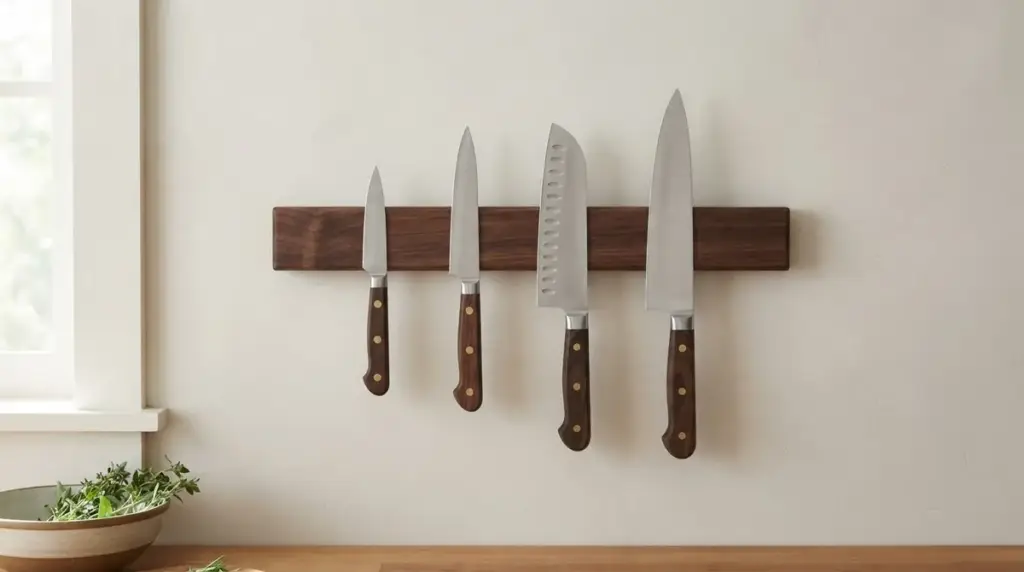
Our own view, which costs us a block sale we do not make anyway: a magnetic strip is better for the steel than any block, provided the wall is somewhere small children cannot reach. Put the knife on it dry, spine first, and roll it onto the magnet rather than slapping the flat against it.
The steel in the block is not a sharpener
The long round rod that comes in almost every set is a honing steel, and it does not sharpen anything. It realigns an edge that has rolled over microscopically during use. That is genuinely useful and it is not sharpening. A honing steel removes almost no metal. Once the edge is actually worn away, no amount of honing brings it back.
The consequence is that a set sold with a steel and no stone leaves the owner honing a dead edge for two years and concluding the knives were bad. If you buy three knives, budget for a stone, a combination waterstone around 1000 and 3000 grit, before you budget for anything else. It will do more for your cooking than a fourth knife.
Sizes, slot by slot
| Slot | Size to buy | Why |
|---|---|---|
| Chef knife | 8 in, or 7 in for smaller hands | Long enough for a cabbage, short enough to control |
| Paring knife | 3 to 3.5 in | In hand work, anything longer is unsafe against the thumb |
| Bread knife | 9 to 10 in, offset handle if you can | Must cross a loaf in one stroke |
| Optional: boning | 5 to 6 in, some flex | Poultry and joints |
| Optional: slicer | 10 to 12 in, no belly | Clean roast slices |
| Optional: cleaver | 7 to 8 in, thick spine for bone | Large vegetables, or bone if it is a bone cleaver |
One warning on the cleaver slot. A thin patterned Damascus cleaver is a vegetable cleaver whatever the listing calls it, and it must never meet bone. That is covered properly in our cleaver guide and it is the mistake that generates the most avoidable damage we see.
Steel and hardness across a kit
Mixing steels across three knives is fine and is often smart. The bread knife barely matters, because a serrated edge is rarely sharpened and works by geometry. Put the money in the chef knife. The paring knife wants to be cheap enough that you do not mind it living in a drawer with other things.
Where hardness matters is the chef knife. Below about 56 HRC it goes blunt too fast for daily use. Around 58 to 61 it holds an edge and a home cook can still bring it back on a stone. Above 62 the edge retention is excellent and the blade will chip if you twist it in a squash. Our own pattern welded Damascus is held to 58 to 60 HRC, which is a deliberate compromise toward being sharpenable at home rather than toward record edge retention.
What our own shelf can and cannot supply
If you took the three knife advice on this page and tried to fill it entirely from our catalogue, you would fail at the third slot.
As of 30 August 2026 our kitchen and chef category holds 44 knives. Two of the 609 products on this site are named as paring knives, priced $90 and $113. Six are utility knives, $78 to $140. Thirty five products carry chef in the title, from $90 to $694. There is not a single bread knife on this site, and not a single carving knife. We forge; we do not cut serrations, and a serrated bread knife is a milling job rather than a forging one.
So the honest instruction is: buy the chef knife here if you want a hand forged one, buy the paring knife here or anywhere, and buy the bread knife somewhere else. We would rather you had a working three knife kitchen than an incomplete one bought entirely from us.
The other admission: of those 44 kitchen listings, only 3 currently state the tang construction. All 44 mention a leather sheath, which is a hunting habit that has followed the kitchen line and is not what a kitchen knife wants. Leather holds moisture against steel. Keep the sheath for transport and store the knife on a strip.
The five year plan
If you are starting from nothing, buy in this order. One chef knife, as good as your budget allows. A combination waterstone. A cheap paring knife. A bread knife, also cheap, because it will not be sharpened. A cutting board of end grain wood or soft plastic, never glass or bamboo, both of which destroy edges. Then stop for a year and see what you actually reach for.
After that year, the gap in your kitchen will be obvious and specific, and you will buy the right fourth knife instead of the one that came in the box. That is the whole argument. Sets solve a decision you have not yet earned the information to make.
Questions people ask
How many kitchen knives do I actually need?
Three. A chef knife of 7 or 8 inches, a paring knife of about 3 inches, and a serrated bread knife of 9 or 10 inches. Those three cover board work, in hand work and crusted food, which is every mechanical category a domestic kitchen presents. A fourth knife is a convenience.
Is a knife set worth buying?
Usually not, unless you want consistent handles and one sharpening angle across the kit, or you are buying a complete kitchen as a gift. A fifteen piece set is typically six or seven knives, six steak knives, a block, a steel and a pair of shears, and the two knives you use daily received about a quarter of the money.
Are wooden knife blocks bad for knives?
They are not ideal. The edge drags on wood fibre every time you insert or withdraw a knife, and the slot traps moisture, which is how tang joints pit. A magnetic strip is better for the steel. A slotted in drawer tray is a reasonable middle ground.
What is the honing steel in a knife set for?
Realigning an edge that has rolled during use. It is not a sharpener and removes almost no metal. Once the edge is genuinely worn, honing does nothing. Budget for a combination waterstone around 1000 and 3000 grit before you budget for a fourth knife.
What is the fourth knife I should buy?
Whichever one matches a job you actually do. A boning knife if you break down poultry, a fillet knife if you buy whole fish, a long slicer if you carve roasts, a heavy cleaver if you cook large vegetables. Not a santoku and not a second chef knife, because both duplicate board work you already have covered.
How much should three good kitchen knives cost?
A competent factory kit is achievable for well under $200. Three hand forged knives cost considerably more: our own kitchen category has a median of $142, so three at the median is $426. What the premium buys is grinding, taper and repairability. It does not buy three times the cutting.
Do you sell a bread knife?
No. There is no bread knife and no carving knife anywhere on this site. Serrations are a milling operation rather than a forging one and we do not cut them. If you are following the three knife advice, buy the bread knife elsewhere.
Are steak knives worth including in a set?
They are the one item that genuinely wants to match, because six mismatched knives look wrong on a table. They are also the most commonly regretted line item. Our 15 steak knives run $102 to $164 with a median of $126, so a matched four at the median is $504. Most people do not expect that number.
What hardness should a kitchen knife be?
Between about 58 and 61 HRC for a chef knife you intend to sharpen yourself. Below 56 it dulls too quickly. Above 62 it holds a superb edge and chips if you twist it. Our own Damascus kitchen blades are held to 58 to 60 HRC.
Should I buy a matching set from one maker or mix?
Mix, unless consistent handle geometry matters to you. Mixing lets you put the money where it does work: a serious chef knife, a cheap paring knife and a cheap bread knife. Matching gives you one grip and one sharpening angle, which is a real convenience and a real cost.
More guides. Read santoku against chef knife before you fill the first slot, carbon against stainless kitchen knives for the steel decision, how to store knives for the storage detail, our cleaver guide before you buy a cleaver, and our steak knife guide before you buy a matched four. Or browse kitchen and chef knives. Please check your local law before ordering.
More from the workshop
How to Choose an EDC Knife
Weight is why people stop carrying. Buy for Tuesday, not for the emergency.
Corporate Knife Gifts: Engraved Logo Knives for Employees and Clients
Gift ideas for employees and clients, logo engraving that survives the blade, volume tiers and the dates to order by.
Sharpening a Serrated Edge Without Ruining It
The one procedure a general sharpening guide cannot cover, scallop by scallop with a tapered rod.
