
Short answer: a boning knife is stiff and works around bone. A fillet knife is flexible and follows bone. If you break down chicken and beef, buy the boning knife. If you clean fish, buy the fillet knife. They look similar and they are not interchangeable.
The one real difference: flex
A boning knife is stiff. You are separating meat from bone, working the tip into joints, and levering slightly. Flex there means the blade wanders and you lose control against a hard surface.
A fillet knife is flexible. You are running the blade along a fish's spine and over the ribs, and the blade has to bend to stay in contact with the bone instead of cutting up through the flesh. Stiffness there costs you yield on every fish.
Shape and length
| Boning | Fillet | |
| Flex | Stiff or semi-stiff | Medium to very flexible |
| Length | 5 to 6 inches | 6 to 9 inches, up to 12 for big fish |
| Blade | Narrow, some curve, strong tip | Long, narrow, upswept, fine tip |
| Built for | Poultry, beef, pork, lamb | Fish, and skinning fillets |
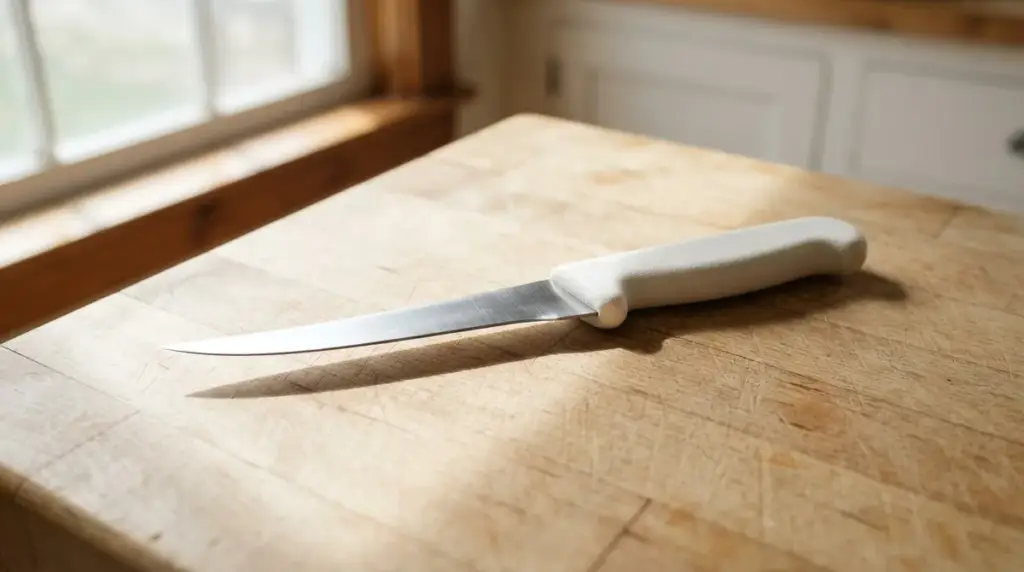
What a boning knife is actually used for
Removing bones from a cut of meat with as little waste as possible. Breaking down a chicken at the joints. Taking the silverskin off a tenderloin. Trimming fat and connective tissue. Frenching a rack of lamb.
The narrow blade is about access, not about cutting force. You are steering a point around a bone you can feel but cannot see, so a knife that is too wide simply will not fit.
What a fillet knife is used for
Running the length of a fish behind the head, down the spine, and out at the tail in one pass. Then laying the fillet skin down and separating flesh from skin at a shallow angle. Both jobs need the blade to bend.
Flex by fish size: soft for panfish and trout, medium for walleye and bass and most inshore, stiff for salmon, big catfish and offshore work.
Can you use one for the other?
A stiff fillet knife will bone meat adequately. A boning knife will not fillet fish well, because it cannot follow the ribs, and you will leave meat on the frame.
If you truly want one knife for both, choose a semi-flexible boning knife around 6 inches. It is a compromise, and it is honest to say that it is worse at both jobs than the right tool.
Steel and handle for wet work
Both knives spend their life wet, often in salt or blood. Our Damascus is 1095 and 15N20 at 58 to 60 HRC, which takes an extremely fine edge and comes back on a stone quickly, but it is carbon steel and it will spot if you leave it in a sink overnight. For a boat or a busy fish house, 440C stainless is the more forgiving choice.
Handle matters more here than on any other knife. Wet hands and fish slime defeat smooth wood. Micarta and textured G10 hold grip when everything else is slick.
Stiff, semi-flexible and flexible: which grade you need
Flex is sold in three grades, and the grade decides the job. Stiff is a boning blade proper: it holds its line against bone and tolerates a small amount of levering at a joint. Semi-flexible gives a few degrees at the tip and is the compromise blade, good on poultry and light trimming, adequate on a thick fish. Flexible and extra flexible are fillet grades. The blade follows a rib line under almost no pressure and springs back straight.
Test it in the hand. Press the tip on a board with the spine flat. A stiff blade barely moves. A semi-flex bends over roughly the first quarter of its length. A true fillet blade curves along most of the blade and returns dead straight the moment you let go. If it holds a bend, the heat treatment is wrong and no care will correct that later.
Blade length by task
| 5 in boning | Poultry, rabbit, trimming, tight joint work |
| 6 in boning | The general answer for beef and pork primals |
| 6 to 7 in fillet | Panfish, trout, perch, bream |
| 7 to 9 in fillet | Walleye, bass, snapper, most inshore fish |
| 9 to 12 in fillet | Salmon, big catfish, offshore work |
The working rule for fish is that the blade should clear the fillet in a single pass. Sawing back and forth is what tears flesh and costs you yield. For meat the rule is the opposite: shorter is better, because the work happens within an inch or two of the tip.
Boning poultry, beef and pork
Each animal asks something different of the blade. Poultry is joint work — you are finding the gap and cutting cartilage, never bone, so a 5 inch blade with a fine tip does the whole bird. Beef means long ribs, a shoulder blade and dense connective tissue, which wants a 6 inch stiff blade you can lean on. Pork sits between the two, with more fat and a softer bone, so the edge loads up and needs wiping and stropping more often than you would expect.
Keep the flat of the blade riding the bone throughout. Meat left on the bone usually means the blade drifted off it, not that the knife was blunt.
Filleting round fish and flat fish
A round fish — trout, bass, salmon, snapper — gives you two fillets. Cut behind the pectoral fin down to the spine, turn the blade flat, and run tail-ward with the edge riding the backbone, letting the flex carry the blade over the pin bones rather than through them.
A flat fish — plaice, flounder, halibut, sole — gives four, two from each side. Cut down the lateral line to the frame, then work outward in shallow sweeps toward the fin, keeping the blade almost parallel to the board. Flat fish need more flex and a narrower blade than most people bring to them, which is why a first attempt leaves half the fish behind.
Curved or straight boning blade
A curved boning blade suits work around a round bone: chicken thighs, a leg of lamb, a shoulder. The belly of the edge stays in contact as you rotate the knife, so you cut with a sweep instead of a poke.
A straight boning blade suits flat, long work: trimming silverskin off a loin, squaring a primal, taking fat caps down. It is easier to keep flush against a board and easier to sharpen. If you only buy one, a slight curve is the more forgiving choice. More on profiles in blade shapes explained.
Grip and safety with a flexible blade
A flexible blade behaves differently from a chef's knife and it catches people out. Pinch the blade between thumb and forefinger just ahead of the handle rather than gripping the handle alone, because that is the only way to feel where the tip has gone once the blade is inside a fish.
Never put your guide hand in front of the edge. On fish, hold the head or the tail down with a cloth for grip. On meat, hook your fingers behind the bone. A blade that flexes can also skip when it comes off a rib, so keep the cutting stroke slow at the point where the blade leaves the frame.
Why a granton edge helps on fish
The oval scallops ground into the side of a blade — a granton or kullenschliff edge — break the suction between wet flesh and flat steel. On a fillet that means the slice releases instead of clinging and folding as you lift it, and on skinning passes it means less drag along the length of the cut.
It does nothing for sharpness or edge retention. It is a release feature, worth having on a long fillet blade and pointless on a 5 inch boning knife.
Caring for a flexible blade
A flexible blade is thin, and thin steel is unforgiving of misuse. Never pry with it, never use it on frozen fish, and never twist it to pop a joint. Those three things account for almost every snapped fillet tip we see.
Wash and dry it the same day, especially after salt water, and store it in a guard, a roll or on a rack rather than loose in a drawer where the thin edge will roll against other steel. The full method is in how to store knives, and a light film of oil on a carbon blade is covered in the knife oil guide.
Buying a hand forged fillet or boning knife
A hand forged fillet knife is a harder thing to make than a hand forged chef's knife, because the smith has to hold a consistent thin cross-section and an even temper along the whole blade. Ask what steel it is and what hardness, and be wary of an answer that is only a pattern name.
A Damascus fillet knife or Damascus boning knife made from 1095 and 15N20 at 58 to 60 HRC takes an exceptionally fine edge and comes back on a stone quickly, which matters on a knife you will touch up every session. The trade is that it is carbon steel and will spot if it is left wet. If the knife lives on a boat or in a fish house, 440C stainless is the more sensible buy. If you want a custom fish fillet knife built to a length that suits the water you fish, that is worth specifying before it is forged rather than settling for the nearest stock size.
Questions people ask
Which should I buy first?
Whichever matches what you do every week. A home cook who buys whole chickens wants a boning knife. Anyone who fishes wants a fillet knife.
How sharp does it need to be?
A fillet knife should be the sharpest thing you own. A dull one tears flesh and costs yield. Strop before every session, and see how to sharpen a knife.
Is an electric fillet knife better?
Faster on volume, and that is all. It is a saw. It tears rather than slices, gives a rougher edge on the fillet, and cannot follow a rib line the way a hand blade can.
Are boning and fillet knives the same?
No. A boning knife is not the same as a fillet knife, even though they sit next to each other in every shop and look alike from a distance. A boning knife is stiff, usually 5 to 6 inches, and works around bone in meat. A fillet knife is flexible, usually 6 to 9 inches, and follows the bone in fish. Same silhouette, opposite jobs.
What length fillet knife should I buy?
Match it to the fish you actually clean. Six to seven inches for panfish and trout, seven to nine for walleye, bass and most inshore species, nine to twelve for salmon, big catfish and offshore fish. The blade should clear the fillet in one pass. If you are sawing, the knife is too short for the fish or too blunt for the job.
Can I bone a chicken with a fillet knife?
You can, and it works acceptably if the blade is on the stiffer end. What you lose is control at the joint, because a flexible tip wanders when it meets cartilage instead of steering through it. What you risk is the tip, since fillet blades are thin and snap if you twist them to pop a joint. A semi-flexible blade handles both.
Is a Damascus fillet knife a good idea for fishing?
It takes a finer edge than stainless and comes back on a stone in minutes, which suits a knife you touch up every session. Our Damascus is 1095 and 15N20 at 58 to 60 HRC, and it is carbon steel, so it will spot if you leave it wet after salt water. Dry it and oil it the same day, or choose 440C for boat work.
What should I look for in a fillet knife made in the USA?
Ask the same questions you would of any knife: what steel, what hardness, what grind, and who did the heat treatment. Country of origin tells you where it was assembled, not how well the blade was tempered. If provenance matters to you, ask directly and expect a straight answer about where the steel was forged and finished.
Why does my fillet knife have dimples along the blade?
Those scallops are a granton or kullenschliff edge. They break the suction between wet flesh and flat steel so the fillet releases instead of clinging to the blade as you lift it. They help on long fish blades and on skinning passes. They do nothing for sharpness, and on a short boning knife they are decoration.
More from the workshop
Trapper, Stockman and Barlow: Traditional Pocket Knife Patterns
Frame shapes, blade shapes and bolsters decoded, with the pattern numbering system and an honest note on what we do not make.
How to Remove Rust from a Knife
Surface rust comes off. Pitting does not. Know the difference before you start.
How to Sharpen a Knife on a Whetstone
Angle, burr and strop: the three things that decide whether a knife gets sharp.
