
Short answer: a factory knife is cut from a sheet of finished steel by a machine and is consistent by design. A hand-forged knife is shaped hot under a hammer by a person, and is consistent only as far as that person is good. Neither is automatically better. They are different products at different prices.
How a factory knife is made
Blades are stamped or laser cut from rolled sheet, ground on jigs, heat treated in batches in a computer-controlled oven, then assembled with machined handle parts. Tolerances are tight, output is high, and the hundredth knife is identical to the first. That consistency is genuinely valuable, and it is why a good factory knife at a fair price is often the sensible buy.
What you do not get is any accommodation for the individual piece. The grind is the grind. The handle is the handle. Natural materials are mostly avoided because they vary.
How a hand-forged knife is made
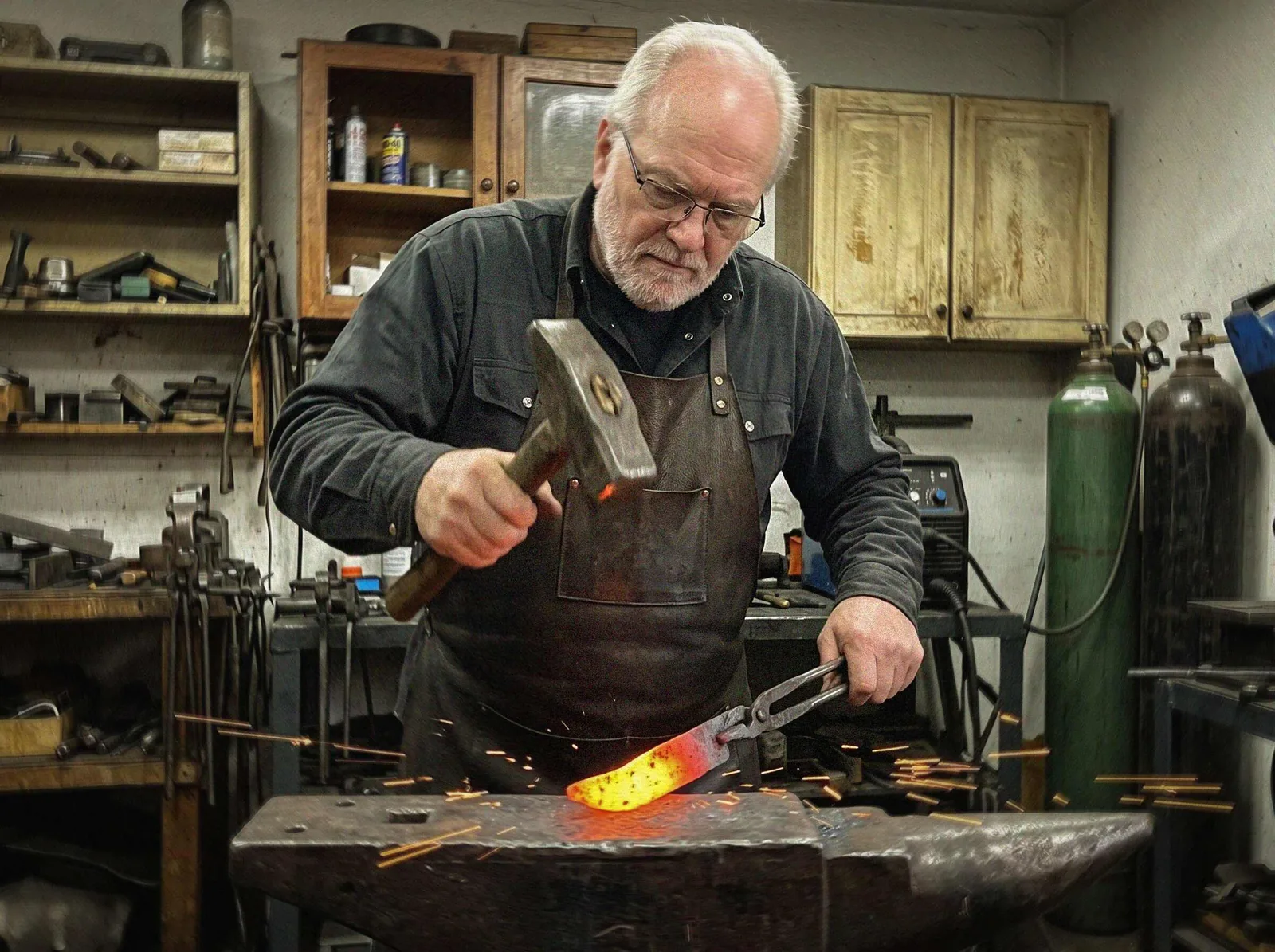
The steel is heated to welding temperature and moved with a hammer. Forging changes the shape of the bar rather than removing material, which is why a forged blade can be thick at the spine and thin at the edge without a great deal of grinding. The smith watches colour, listens to the sound of the hammer, and stops when the piece is right rather than when a timer says so.
Then it is normalised, hardened, quenched in oil and tempered, ground, fitted with a handle cut for that blade, and finished. On our benches that is several days of work spread across a batch, and every stage is judged by eye.
What you actually get for the difference
- A blade that is one of one. With Damascus this is literal: the pattern is made in the fire and cannot be repeated.
- Natural handle materials. Stag, buffalo horn, camel bone, kamagong, burl. A factory cannot use these at scale because no two pieces are the same size and colour.
- Fit done by hand. Bolsters, pins and scales fitted to that blade, not to a tolerance band.
- A person who can answer for it. If something is wrong, the people who made it can fix it. That is what a lifetime workmanship warranty means when the shop is small.
The honest case for the factory knife
If you need three identical knives for a crew, or a knife you will lose, or a folder with a precisely machined lock and bearing pivot, buy the factory knife. Machining beats hand fitting on repeatable mechanisms every time, and there is no romance in paying more for less function.
Where hand work does not help
Two myths worth retiring. Forging does not align the grain in a way that makes a modern steel meaningfully stronger; modern steel arrives with a fine, even grain already. And hand forging does not improve edge retention, because that comes from the alloy and the heat treatment, both of which a factory can control very well.
Forging and stock removal: what actually happens to the steel
Forging moves the steel. Stock removal takes steel away. That is the whole difference in forming, and it is worth understanding because most of what gets said about it online is wrong.
In forging, a bar is brought up to a bright orange heat and hammered. The steel is plastic at that temperature, so the mass stays the same and only the shape changes. The smith draws the bar longer and thinner towards the edge, leaves it thick at the spine, and can push a distal taper or a curved belly into the blank before a grinder ever touches it. A hand forged bowie knife with a deep clip and a heavy spine gets there by moving metal, not by grinding half a bar into sparks.
In stock removal, the maker starts with flat bar stock at the finished thickness and grinds the profile and bevels out of it cold. Nothing is heated until the heat treat.
Stock removal is not the poor relation. Many respected individual makers work that way, and for a stainless or high-carbide tool steel it is usually the correct choice, because those alloys are unforgiving at forging heat and gain nothing from being hammered. A stock removal blade that is properly heat treated will out-cut a badly forged one every day of the week.
What forging genuinely changes, and what it does not
Forging changes three things you can actually measure, and one thing it does not change at all.
- Grain refinement. Working steel hot and then normalising it can produce a fine, even grain. This is real. What it is not is an advantage, because modern bar stock already arrives with a fine, even grain from the mill. Forging can restore what forging itself disturbed; it does not add something the bar lacked.
- Scale. Every heat in an open forge burns a layer of iron oxide off the surface. That scale has to be ground away, which is why a forged blank is left oversize.
- Decarburisation. At forging heat, carbon migrates out of the surface. A skin of low-carbon steel a few thousandths deep will not harden. A competent smith grinds past it; a careless one leaves it, and the customer gets a blade that never holds an edge however it is sharpened.
- Strength. Unchanged. This is the myth worth killing: hammering does not make a blade tougher than the same steel ground from bar and heat treated the same way. Toughness comes from alloy and heat treatment. Nothing else.
The exception is pattern welding, where forging is the only method. A forged damascus knife exists because layers of two steels were welded and folded in the fire; there is no way to grind that out of a plain bar. We cover it step by step in how Damascus steel is made.
The heat treat sequence, and why it matters more than the hammer
Ask a maker about heat treatment before you ask about forging. It is the stage that decides whether the knife works.
| Normalising | Heat to critical, cool in still air, usually two or three cycles at falling temperatures. Relieves forging stress and refines grain before hardening. |
| Hardening quench | Heat to the austenitising temperature, hold, then quench in oil (or plate quench, for air-hardening steels). This traps carbon and makes the steel glass-hard and brittle. |
| Tempering | Two or more low-temperature cycles that trade a little hardness for the toughness that stops the blade snapping. This is where the final hardness number is set. |
A factory oven runs this to a logged schedule and does it very well. A small shop runs controlled cycles and tests the result. Either can be excellent; either can be botched. Refuse any knife whose seller cannot tell you the steel and the hardness. Our knife steel chart has the numbers to expect.
How to tell a hand forged blade from a factory one by looking
Look for controlled variation, not for flaws.
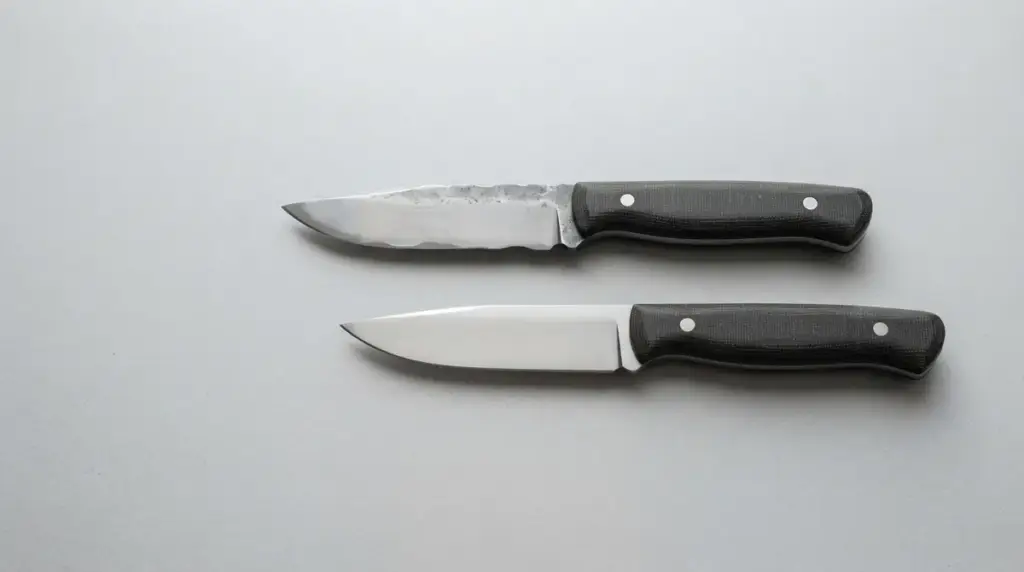
- Hammer marks. Left on a rustic finish, ground out on a clean one. Shallow and even means hand work; absent tells you nothing on its own.
- Grind symmetry. Hold the blade edge-on under a light. Factory bevels match to a fraction of a millimetre because a jig cut them; hand grinds are close, not identical.
- Plunge lines. The step where the bevel stops near the handle. Machine plunges are sharp and mirrored; hand plunges vary slightly side to side, and on a good knife they are still crisp.
- Finish consistency. Factory satin runs one direction at one grit across the whole flat. Hand finishing shows small scratch-pattern changes near the ricasso and spine.
- Tang shape. A forged tang is often tapered and slightly irregular where it was drawn under the hammer. A stamped tang is a flat rectangle. If it matters to you which you are getting, read full tang vs partial tang.
"Handmade", "custom" and "artisan": what those words actually mean
Almost nothing, legally. None of the three is a protected term in the knife trade, so a listing for a handmade forged damascus steel hunting knife may mean one person made it start to finish, or an imported blade with scales fitted in a shed. Use them as prompts, not proof.
- Handmade should mean hand-ground and hand-fitted. Ask which stages were done by hand.
- Custom properly means made to your specification. If you did not specify anything, it is stock.
- Artisan is marketing. Ignore it and ask for the steel, the hardness and the shop.
Why hand forged knives cost more
Time, mostly. Hand forged knives made in USA shops carry a maker's hours at every stage: forging, normalising, quench, temper, grinding, fitting natural handle material to that blade, finishing. Pattern welded stock adds welding and folding heats before the blade is even a blade. A factory spreads its setup across thousands of units; a small shop cannot. That is why comparing a hand forged hunting knife to a mass-produced one on price alone tells you very little.
Where our knives sit
Our Damascus is forged, heat treated and finished in Memphis from 1095 and 15N20, hardened to 58–60 HRC. That covers the hand forged bowie knives, hand forged damascus steel knives, hand forged skinning knife patterns, the hand forged dagger shapes, the cleavers and the fillet and steak blades. Our D2 and 440C knives are ground from bar stock and heat treated here, because those steels are better unforged. For a starting point, the Damascus bowie knives and Damascus skinning knives show what the process produces.
Questions people ask
How can I tell which one I am looking at?
Look for variation. Natural handle material, a pattern that differs blade to blade, small asymmetries in the plunge line. Then look at the listing: a maker who forges will tell you the steel, the layer count and the hardness.
Is stock removal the same as factory made?
No. Plenty of respected individual makers grind blades from bar stock rather than forging. That is still one person making one knife.
Do you forge everything you sell?
Our Damascus is forged and folded in house. Our D2, 440C and VG10 blades are ground from bar stock and heat treated in house, because those steels are best left unforged.
Is a hand forged cleaver better than a factory one?
Not automatically. A hand forged cleaver wins on mass distribution: the smith can leave weight forward and behind the edge where a chopper wants it, rather than accepting the thickness a sheet happens to be. A factory meat cleaver is flatter, cheaper and perfectly serviceable. If you buy a forged cleaver, buy it for the geometry and the heat treatment, not for the hammer marks.
Can a folding knife be hand forged?
The blade can be. The mechanism should not be. A hand forged folding knife usually means a forged blade fitted into a frame with machined liners, pivot and lock, and that is the sensible split, because repeatable machining beats hand fitting on anything that has to move. Treat any hand forged pocket knife claim as a statement about the blade only, and ask who cut the lock face.
Are hand forged fillet knives and steak knives worth the money?
For thin, flexible blades the forming method matters less than the grind and the heat treatment. A hand forged fillet knife earns its price if the distal taper is right and the temper leaves it springy rather than brittle. Hand forged steak knives are mostly bought for the look and the fact that no two are identical, which is a fair reason as long as you know that is what you are paying for.
What makes a custom hand forged Damascus steel hunting knife actually custom?
Your specification. If you chose the blade length, the grind, the handle material or the sheath, it is custom. If you picked a finished knife from a shelf, it is a stock hand forged Damascus hunting knife, however the listing words it. Both are fine to buy. Just do not pay a bespoke premium for something that was already made before you saw it.
How do I judge the best hand forged knives made in USA?
Ask four questions and ignore the adjectives. What steel, stated by name. What hardness in HRC, with a number not a range of ten points. Where the heat treatment was done. Who to contact if it fails. A shop that forges and heat treats its own work answers all four without hesitating. A reseller of imported blanks usually cannot answer the third.
Is a hand forged railroad spike knife a real working knife?
It is a real forging and usually a poor knife. Railroad spike steel is low carbon, so it will not harden to a usable cutting hardness no matter how carefully it is quenched and tempered. A hand forged railroad spike knife is a decorative piece and a good exercise for a smith. Buy one for the shelf, not for the field.
Is a hand forged karambit different from a stamped one?
Mainly in the spine and the ring. Forging lets the smith curve the blade and thicken the spine through the arc, where a stamped karambit is uniform because it came off a flat sheet. The difference you will feel is balance rather than cutting power. Edge holding still comes down to the steel and the heat treatment, exactly as it does on a straight blade.
More guides
- What 352 Layers Actually Means
- Damascus vs D2 vs 440C vs VG10: Which Steel
- Damascus Knife Care and Sharpening
- How to Tell Real Damascus from a Printed Pattern
More from the workshop
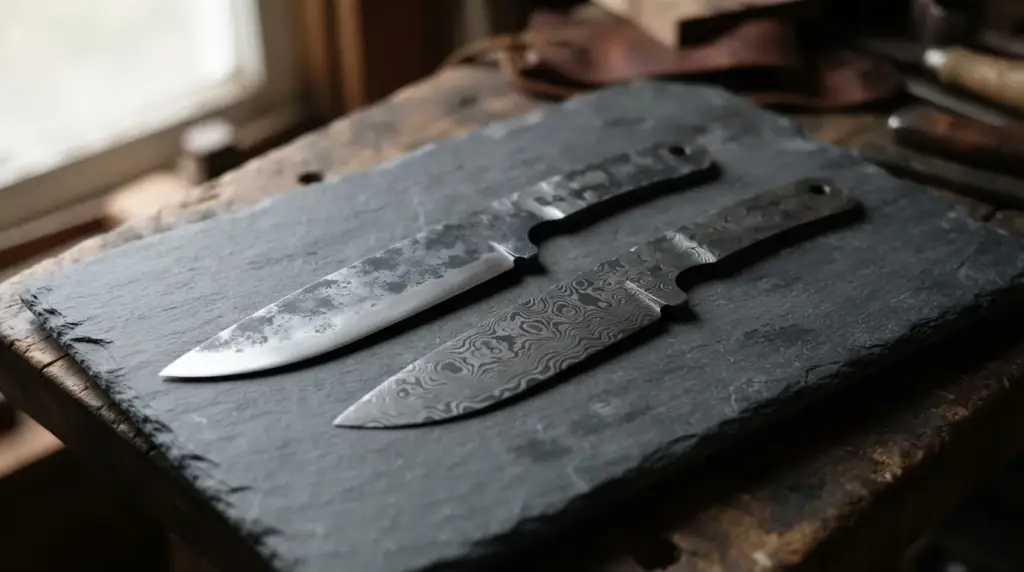
San Mai and Damascus: Two Different Laminates
A three layer core and jacket against a stack of hundreds, and what each one really does.
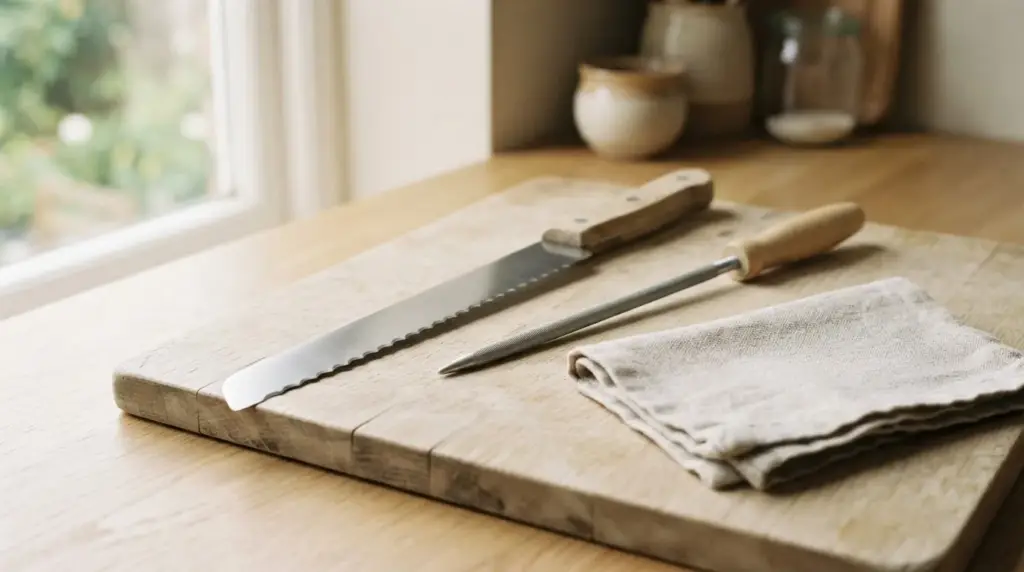
Sharpening a Serrated Edge Without Ruining It
The one procedure a general sharpening guide cannot cover, scallop by scallop with a tapered rod.
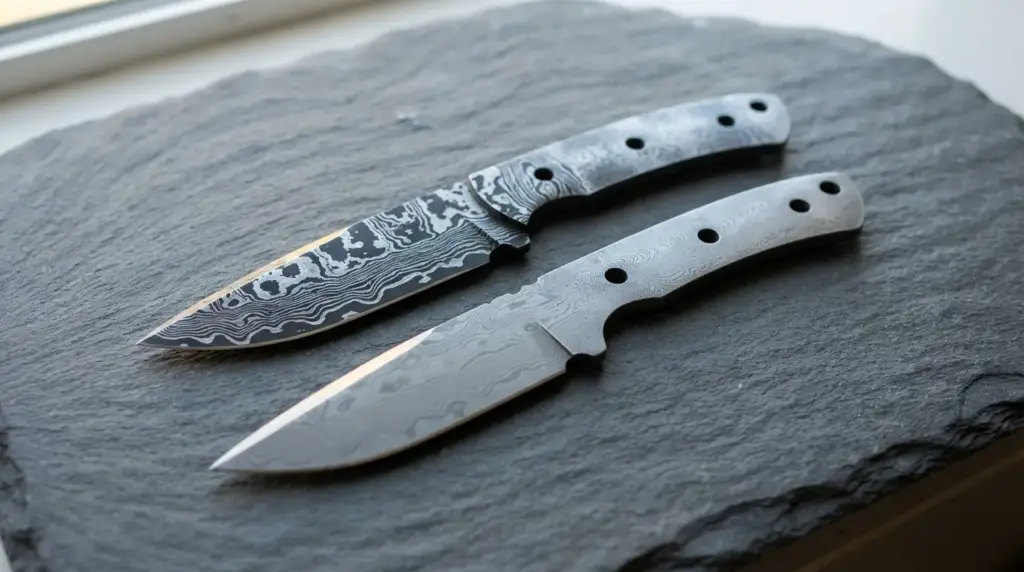
Stainless Damascus and Carbon Damascus: Which Steels Are in the Billet
The steels in each billet, why the contrast comes from the etchant, and what we actually stock.
