
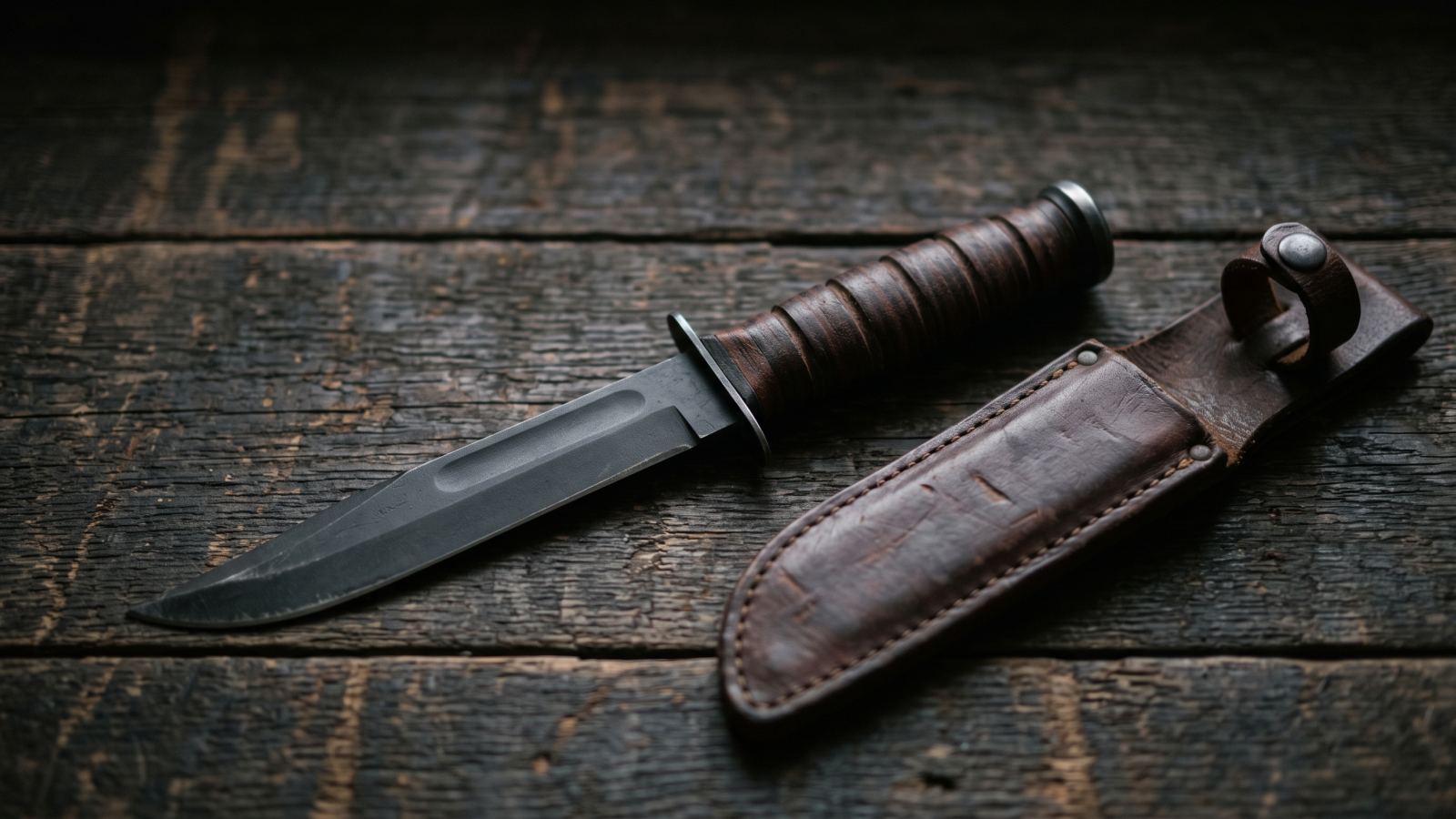
Short answer: the KA-BAR is the 7 inch clip point fighting and utility knife the Marine Corps adopted in November 1942 as spec 1219C2. It has a stacked leather handle, a flat ground carbon steel blade and a pinned pommel. If yours is marked on the blade rather than the guard it is probably from before 1944. A genuine wartime example with its scabbard trades for roughly $250 to $400. A new one from the current maker lists at about $155. Anything with an Eagle, Globe and Anchor stamped on it, or the words U.S. ARMY, is not from the war.
What a KA-BAR actually is
It is a fighting and utility knife, and the second half of that phrase is the half people forget. Marines opened crates with it, dug with it, cut wire with it and pried things they should not have pried. The design is a compromise between a weapon and a tool, and the reason it is still in production eighty odd years later is that the compromise was a good one.
Here is the current production knife, from the maker's own specification sheet, because the internet is full of numbers that nobody has checked.
| Specification | Current production (model 1217) |
|---|---|
| Blade length | 7.0 in |
| Overall length | 11.875 in |
| Blade thickness | 0.165 in |
| Blade shape | Clip point, with a shallow fuller to lighten it |
| Steel | 1095 Cro-Van, 56 to 58 HRC |
| Grind | Flat, 20 degrees per side |
| Handle | Stacked leather washers |
| Guard | 12 gauge carbon steel crossguard |
| Weight | About 11 oz without the sheath |
| Finish | Black epoxy powder coat |
| List price | $154.75, commonly street priced $110 to $125 |
One point of order that trips up a lot of buyers. 1219C2 was the wartime government specification number, not a model number. The modern catalogue numbers are separate things: 1217 is the plain edge USMC knife, 1218 the serrated version, and 1219 is the U.S. ARMY marked knife, which did not exist during the war at all. If a listing tells you a knife is a "1219C2" and it is stamped U.S. ARMY, the seller has stitched two facts together that do not belong to each other.
Where the name came from
The company that became KA-BAR was Union Cutlery of Olean, New York. Their account is that in 1923 they received a letter from a fur trapper who had used one of their knives to finish a wounded bear after his rifle jammed. The letter was water damaged and only partly legible, and the fragment that could be read looked like "ka bar", from the phrase "kill a bear". They liked it enough to make it the trademark.
 Ka-bar 12″ Long 7″ Blade 13.5oz Damascus Steel Fixed Blade Hunting Bowie Handmade Knife Black Mamba Hand Made World Class Knives Limited Luxury Edition | BMK-1001-LQ
 Desert Storm USMC Damascus KA-Bar Knife Fiber Stacks Handle Limited Edition | SL-026
 USMC KA-Bar Knife Damascus Hunting Knife Leather Stacks Handle Limited Edition | SL-024
That is the company's own story, and it is worth saying plainly that nobody outside the company has ever produced the letter. We are not calling it false. We are saying it is a corporate origin story rather than a documented one, and the difference matters if you are the sort of person who likes knowing which is which. What is documented is that the trademark was in use from 1923, that the military knife made the name famous, and that after the war the company renamed itself after its own trademark. Today KA-BAR Knives, Inc. is based in Olean, New York and owned by Cutco.
Who actually made them
This is the part collectors care about, because "a KA-BAR" in the war was a specification, not a brand. Several cutlery companies built to it simultaneously, and the maker's mark is the first thing that determines what a knife is worth.
| Maker | Typical marking | Notes |
|---|---|---|
| Union Cutlery (KA-BAR) | USMC one side, KA-BAR over OLEAN, N.Y. the other | The address line disappears on late war production, which is itself a dating clue |
| Camillus Cutlery | USMC / CAMILLUS, N.Y. | Shipped the first production run in January 1943; the largest producer |
| PAL Cutlery | PAL / USMC | |
| Robeson (ShurEdge) | Robeson / USMC, or U.S.N. MARK 2 with R.C.C. | Navy contract examples are common |
| Utica, Conetta, Ontario | Various | Later and post war government production |
Note the Navy. The knife was adopted by the Marine Corps and the Navy together, the Navy calling it the U.S. Navy Utility Knife, Mark 2. What did not exist in 1943 was an Army version. We will come back to that.
How to date a KA-BAR
There is one tell that does most of the work, and a handful of secondary ones that confirm it.
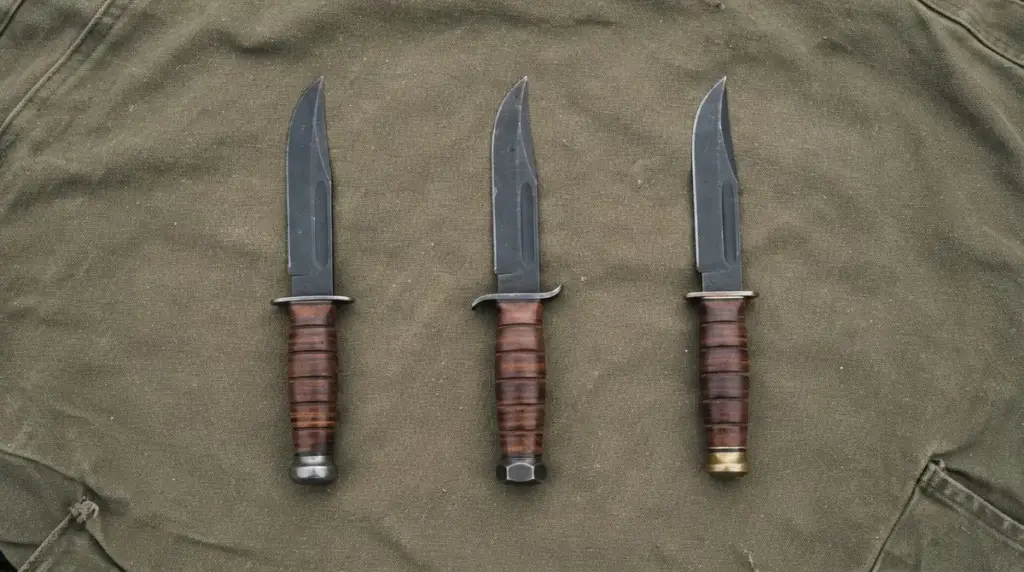
The big one: where the markings sit. Blades were breaking in the field, and the government concluded the stamping on the ricasso was part of the problem. In 1944 the order went out to move the markings off the blade and onto the face of the crossguard. So:
- Marked on the blade ricasso — roughly 1942 to 1944. Earlier, scarcer, worth more.
- Marked on the crossguard — after 1944.
The secondary tells, in rough order of usefulness:
| Feature | What it points to |
|---|---|
| Blued blade, high polish | Early wartime production |
| Parkerized blade, coarser finish | Later wartime production |
| Baked enamel finish | 1977 or later. Not wartime. |
| Thin pommel, about 1/4 in, cross pinned | Genuine wartime |
| Thick pommel, about 3/8 in, pinned | 1976 reproduction onward |
| Peened tang, peen left rough | Earliest Union Cutlery production |
| Welded or screwed on pommel | Outright fake |
| Thick black spacers at guard and pommel | Reproduction. Wartime knives did not have them. |
Two markings settle the question on their own, and both are common on knives being sold as wartime pieces. An Eagle, Globe and Anchor was never applied during the war; it is a modern production feature. U.S. ARMY markings on a Mark 2 pattern are a late 1990s commemorative idea, not a 1943 one. Scratched on Vietnam dates and hand cut saw teeth on the spine are the other two things people add to ordinary knives to make them into stories.
What a wartime one is worth
Honest, complete, used condition with the correct scabbard, from dealers currently listing:
| Example | Asking price |
|---|---|
| Camillus USMC Mark 2, guard marked, original scabbard | $250 |
| Robeson USN Mark 2, guard marked, correct scabbard | $295 |
| Camillus USN Mark 2, blade marked, original scabbard | $300 |
| USMC knife with marked sheath and veteran provenance | $400 |
So call the working range $250 to $400. Two caveats we would rather state than hide. These are asking prices from dealer and auction listings, not confirmed hammer prices, and the specialist dealers who handle the genuinely rare variants — early blade marked Union Cutlery with a blued blade, red spacer examples, anything mint — sell them with the price withheld. We can tell you those command a premium. We cannot tell you how much, and neither can anyone else who has not seen the invoices.
The scabbard matters more than people expect. A correct, marked, period leather scabbard is a meaningful part of that number, and a wartime blade in a modern sheath is worth noticeably less than the same blade in its own.
What Marines carry now
The current issue blade is the OKC-3S bayonet, contracted in December 2002 and in distribution from January 2003, replacing the M7 and M9. It has an 8 inch partially serrated carbon steel blade, 13.25 inches overall, a tan grooved handle and a MOLLE sheath with a sharpening rod built in. It looks a lot like a KA-BAR on purpose, and it is not fullered.
Is the KA-BAR still issued? The careful answer is that it is still in the system. The 1217 holds an active National Stock Number, 1095-01-581-9100, assigned in 2010, which means units can requisition it. What we could not find is any official statement from the Marine Corps or the Defense Logistics Agency confirming routine individual issue, and Marines writing about it describe buying their own. So: the OKC-3S is the issue blade, the KA-BAR remains procurable and is still widely carried by Marines who bought it themselves. Anyone telling you it is "still standard issue" is repeating something they have not checked.
Living with carbon steel and a leather handle
1095 Cro-Van is a plain carbon steel with small additions of chromium, vanadium, molybdenum and nickel. Steel only becomes genuinely corrosion resistant at around 10.5% chromium, where the chromium forms a self healing oxide film that keeps oxygen off the metal. The trace chromium in 1095 Cro-Van is nowhere near that, so no film forms and bare steel rusts when it gets damp. The powder coat protects the flats. The sharpened edge is bare, and that is where rust starts.
The maker's own instructions are short and worth following. Wipe the blade dry with a soft cloth after use. Rinse with tap water and dry thoroughly; after salt water, wash with mild dish detergent first. Before storing, put a light coat of mineral oil on a clean blade — our notes on choosing a knife oil cover what to use. And store the knife out of its sheath. Leather holds moisture against steel in a closed space, which is exactly the condition rust wants. If it has already started, removing rust from a blade is straightforward if you catch it early.
The stacked leather handle is sealed at the factory. Oil it lightly and occasionally. Do not soak it in leather conditioner, which puts moisture back into the material you have been trying to keep dry. If the sheath gets wet, dry it in air. No ovens, no hair dryers.
A word about the name, since we sell knives
KA-BAR is a registered trademark of KA-BAR Knives, Inc. of Olean, New York. We are not them, we do not make their knives, and nothing we sell is a KA-BAR. What we make are hand forged fixed blades in the same 7 inch clip point pattern, in Damascus and D2, because the pattern has been public property since 1942 and it is a good pattern. If you want the original, buy the original from an authorised dealer. If you want a hand forged blade in that shape, that is what we do. Our military knife buying guide goes into what to look for either way, and our military inspired collection is the shortest route to the shapes themselves.
Questions people ask
What does a KA-BAR knife look like?
A 7 inch clip point fixed blade with a shallow fuller along the spine, a straight steel crossguard, a handle of stacked leather washers, and a flat pinned steel pommel. Overall length just under 12 inches. Modern ones are matte black; wartime ones are blued or parkerized grey.
How do you date a KA-BAR knife?
Start with where the marking is. On the blade ricasso means before 1944; on the crossguard means after. Then check the pommel: thin and cross pinned is wartime, thick at about 3/8 inch is a 1976 or later reproduction. Baked enamel finish, an Eagle Globe and Anchor, or U.S. ARMY markings all rule out wartime production.
How much is a 1942 KA-BAR knife worth?
Genuine wartime examples in honest used condition with the correct scabbard are listed by dealers at roughly $250 to $400. Early blade marked pieces with blued blades go higher, but the specialist dealers who sell them do not publish the figures, so treat any specific number you are quoted for a rare variant as an opinion.
What knife do the Marines use?
The current issue blade is the OKC-3S bayonet, adopted in 2003. The KA-BAR is no longer the universally issued knife but remains in the federal supply system under an active stock number and is still very widely carried by Marines who buy their own.
Is the KA-BAR still made in the USA?
The knives are made in Olean, New York. The leather sheaths that come with them are made in Mexico. That is stated openly by the manufacturer.
What steel is a KA-BAR made of?
1095 Cro-Van, hardened to 56 to 58 HRC. It is a plain carbon steel, so it sharpens easily and rusts easily. Our knife steel chart shows where that sits against D2, 440C and Damascus.
Do KA-BAR knives rust?
Yes, and quickly if stored in the sheath. The blade coating protects the flats but the edge is bare steel. Dry it, oil it lightly, store it out of the leather.
Can you baton or throw a KA-BAR?
The manufacturer's own warranty guidance advises against both unless a knife is specifically designed for it. A 0.165 inch blade with a pinned pommel is a cutting tool, not a splitting wedge.
More reading. Buying a military style knife, full tang versus partial tang, and the knife steel chart.
Shop the knives
Ka-bar 12″ Long 7″ Blade 13.5oz Damascus Steel Fixed Blade Hunting Bowie Handmade Knife Black Mamba Hand Made World Class Knives Limited Luxury Edition | BMK-1001-LQDesert Storm USMC Damascus KA-Bar Knife Fiber Stacks Handle Limited Edition | SL-026USMC KA-Bar Knife Damascus Hunting Knife Leather Stacks Handle Limited Edition | SL-024 Limited Edition Ka-Bar Style Damascus Knife - 12" Feather Pattern Blade with Camel Bone Handle | BMK-1006-L1
More from the workshop
Carbon vs Stainless Kitchen Knives
Carbon is better to cut with, stainless is better to own. Pick by your habits.
How to Choose an EDC Knife
Weight is why people stop carrying. Buy for Tuesday, not for the emergency.
Knives and Swords as Wedding Gifts: Groomsmen, Cake and Budget
Why a set of swords is usually the wrong call, what a party of eight actually costs, and the engraving rules in full.
