
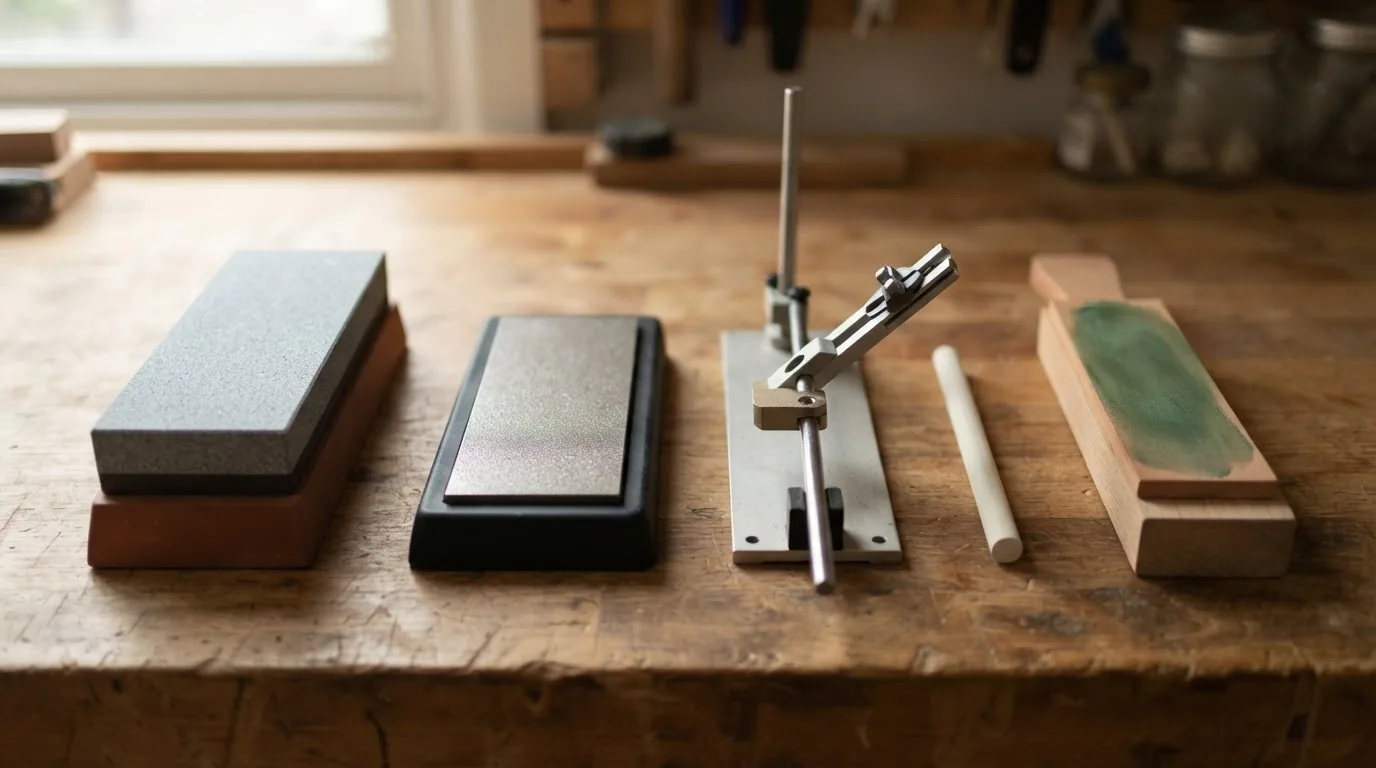
Short answer. For most people the right buy is a two sided waterstone in roughly 1000 and 6000 grit, because it costs the least over a lifetime and produces the best edge available at any price. Buy a diamond plate instead if your knives are D2 or another high carbide steel. Buy a guided rod system if you have tried freehand twice and hated it. Buy a rolling sharpener if you want repeatable results in two minutes and will accept a slightly less refined edge. Do not buy a pull through sharpener for any knife you care about.
This page is about the equipment decision, not the technique. If you have already chosen your gear and want the method, our how to sharpen a knife guide covers the stroke, the angle and the burr in detail. What follows is how each system works, how aggressively it removes steel, what it costs, and who it actually suits.
We should get the conflict of interest out of the way immediately. Black Mamba Knives forges blades. We do not sell sharpeners, we do not carry an affiliate arrangement with anyone who does, and the recommendation above is the cheapest option on the list. Take that for what it is worth.
The six systems at a glance
| System | Steel removed per session | Skill needed | Time to sharpen one knife | Best edge it can produce |
|---|---|---|---|---|
| Freehand stones | Low to moderate, fully under your control | High at first, then low | 10 to 20 minutes | The best of any system |
| Diamond plates | Moderate to high, cuts fast | Same as freehand, less patience needed | 5 to 12 minutes | Very good, slightly coarser |
| Guided rod system | Low, precisely controlled | Low, setup is the only skill | 15 to 30 minutes including setup | Excellent, extremely consistent |
| Rolling sharpener | Low to moderate | Very low | 3 to 6 minutes | Good, occasionally very good |
| Pull through | High and uncontrolled | None | Under 1 minute | Poor, and it worsens over time |
| Electric or belt | Very high | Low to use, high to use well | 2 to 5 minutes | Very good on a belt, mediocre on a wheel |
Steel removed per session is the number that should decide this
Every sharpening shortens the life of the knife. A blade is a finite amount of steel and sharpening is the process of throwing some of it away to expose fresh edge underneath. A knife sharpened carefully on stones twice a year for thirty years will still have most of its blade height. The same knife run through a carbide pull through every month will be visibly narrower in five years and unusable in fifteen.
Nobody selling sharpeners frames it this way, because the framing does not favour the fast devices. But it is the only frame that matters for a hand-forged knife you intend to keep. We publish it because our customers keep their knives for decades and we would rather they still had a blade at the end.
The ranking is straightforward. Carbide scrapers in cheap pull throughs remove the most steel and remove it by tearing rather than abrading, which leaves a torn edge that dulls faster and needs sharpening sooner. Motorised wheels remove a lot because they run fast and you cannot feel what is happening. Belt grinders remove a lot but the operator can control it. Stones, plates and guided systems remove the least, because you are moving the abrasive by hand and you stop when you decide to.
Freehand stones: the cheapest thing to own and the hardest thing to learn
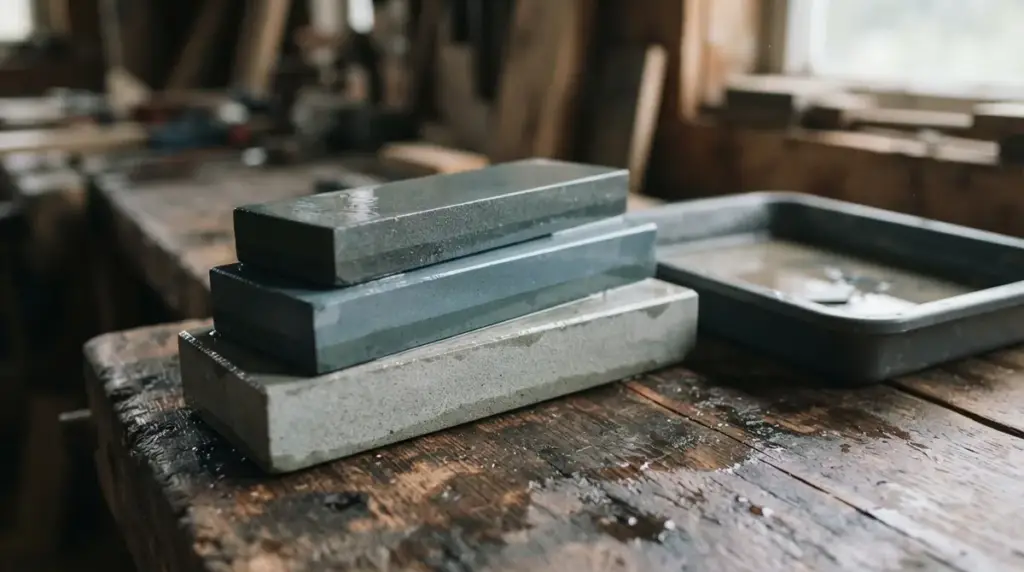
A waterstone is a bonded block of abrasive that releases fresh grit as you use it, which is why it cuts faster than a hard oil stone and why it needs flattening periodically. A combination stone with a coarse face around 1000 grit and a fine face around 6000 is enough for every knife most households own.
What you get: complete control over angle, pressure and how much steel comes off. The ability to put a convex edge or a microbevel on deliberately. The finest apex any method produces, because you can work up through fine grits and finish on a strop. The lowest lifetime cost by a wide margin.
What you give up: your first three attempts will produce a worse edge than the knife started with. Holding a consistent angle freehand is a motor skill and it takes repetition. Stones dish in the middle and need flattening with a lapping plate or a coarse diamond plate. Waterstones need soaking or splashing and they make a mess.
Who should buy one: anyone with more than four knives, anyone who owns a knife they intend to keep for life, and anyone who suspects they might enjoy the process. Also anyone on a tight budget, because this is the cheapest good answer.
Diamond plates: the correct answer for hard, high carbide steels
A diamond plate is a steel or composite plate with industrial diamond bonded to the surface, usually in a perforated pattern. It is dead flat, it stays flat, and diamond is harder than every carbide found in knife steel.
That last point is the whole reason to own one. Ordinary aluminium oxide stones are softer than the vanadium carbide in D2. On a D2 blade a normal stone cuts the soft matrix around the carbides and eventually plucks them out rather than cutting through them, which is slow and leaves a ragged apex. A diamond plate cuts the carbides cleanly. Our 69 knives in the D2 tool steel category run 58 to 62 HRC and a diamond plate is genuinely the right tool for all of them.
What you give up: diamond plates cut fast, and fast is easy to overshoot on a softer blade. Our Damascus at 58 to 60 HRC will lose more steel than you intended if you treat a diamond plate like a waterstone. The abrasive also breaks in, so a new plate is more aggressive than the same plate a year later. And a good one is not cheap.
Who should buy one: anyone whose knives are D2, and anyone who owns waterstones and needs something to flatten them with. A coarse diamond plate doubles as your lapping plate, which quietly makes it the best value item in the whole category.
Guided rod systems: paying money to remove the angle problem
A guided rod system clamps the blade and runs a stone on a rod through a fixed pivot, so the angle is set by the machine rather than by your wrist. Set it to 20 degrees and every stroke lands at 20 degrees, every time, on the first attempt.
What you get: repeatability that a beginner cannot match freehand and that most experienced sharpeners cannot match either. Precise, symmetrical bevels. The ability to set a different angle for a kitchen knife and a working outdoor knife and reproduce both exactly next year. Very low steel removal, because you are not correcting mistakes.
What you give up: setup time. Clamping the blade, choosing the angle and swapping stones takes longer than the sharpening. Clamps struggle with very short blades, very tall blades and recurved profiles. And there is a real limitation nobody mentions in the reviews: a clamped system produces a flat bevel, so if your knife came with a convex grind you are converting it to a flat one whether you meant to or not.
Who should buy one: people who have tried freehand and did not get on with it, people who want documented repeatable angles across a large set of knives, and anyone sharpening for other people who needs consistency more than speed.
Rolling sharpeners: fast, consistent, and not quite a stone
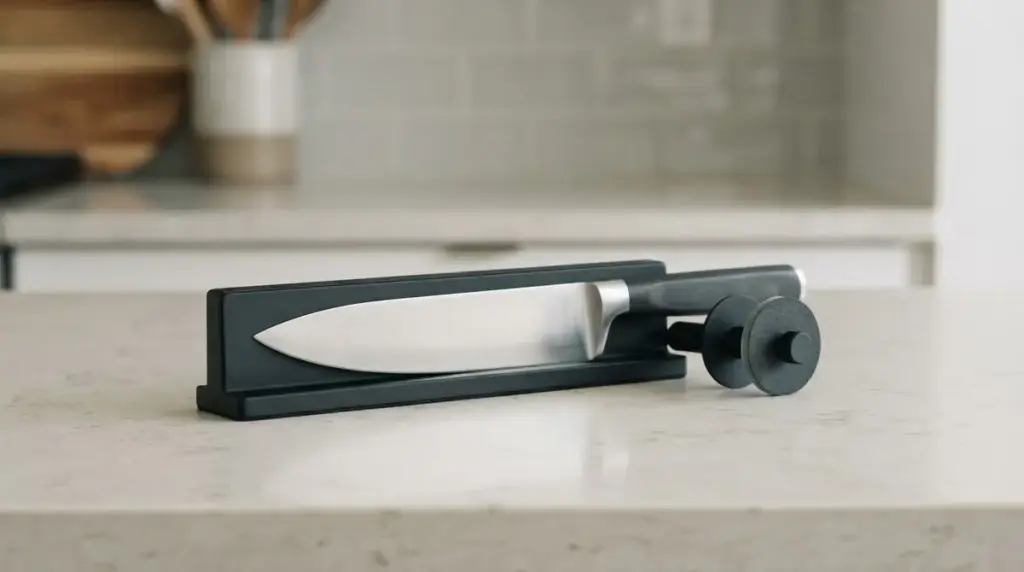
A rolling sharpener is a magnetic base that holds the knife flat and a weighted abrasive disc on an axle that you roll along the edge. The geometry of the disc and base fixes the angle. They have become the fastest growing category in home sharpening and the demand for them is now larger than for several of the traditional systems.
What you get: a repeatable angle with almost no skill, in three minutes, with a much better result than any pull through. Very little steel removed. Nothing to learn. Small enough to store in a drawer.
What you give up: the angle options are whatever the manufacturer built, usually two or three fixed settings. Abrasive discs are consumable and proprietary. The disc rolls along the edge rather than being dragged across it, which is efficient but gives a slightly different scratch pattern to a stone, and on the finest finishes a stone plus strop still wins. Blades that are very tall, very short or heavily recurved sit awkwardly on the base.
Who should buy one: a household with six to twelve kitchen knives, nobody who enjoys sharpening, and a real desire for those knives to be sharp on a Tuesday evening. That is a very large number of people and this category deserves its growth.
Pull through sharpeners: what they actually do to a blade
A pull through has two hardened carbide scrapers or two crossed ceramic rods set in a V. You drag the blade through and the fixed geometry cuts a new edge.
Carbide versions do not abrade. They shear. Look at an edge that has been through one under any magnification and you will see torn metal and a lip rather than a ground bevel. That torn edge feels sharp for about a week and then fails faster than a properly ground edge, so you use the device again, and each pass takes another visible amount of steel. Ceramic versions are gentler and closer to honing, but they still force one fixed angle onto every knife you own.
The specific harm to a hand-forged blade is worth naming. Our Damascus at 58 to 60 HRC is soft enough that a carbide scraper bites deeply. It also removes the etched surface layer along the bevel shoulder, which is where the pattern contrast is thinnest, so the pattern near the edge fades in a way that is difficult to restore. If you own a patterned blade, the honest advice is to keep it away from these entirely and read our how to sharpen a Damascus knife guide instead.
Who should buy one: someone with a drawer of cheap stamped kitchen knives who genuinely does not intend to keep them and wants them cutting tonight. That is a legitimate use case. It is just not the same use case as anything we make.
Electric sharpeners and belt grinders
These are two very different machines that get grouped together because both are powered.
An electric wheel sharpener runs abrasive wheels in a fixed V. It is a motorised pull through with better abrasive, and it shares the same core problem: high steel removal, one fixed angle, and no feedback in your hands. Some models are genuinely good and will re-profile a whole knife block in an afternoon. All of them cost blade height doing it. The first pass on a new knife on a machine that regrinds to its own angle can remove a startling amount of steel.
A belt grinder is what we and every other maker use to grind bevels in the first place. It is the most capable sharpening tool there is and the most dangerous to a knife in unskilled hands. A belt removes steel very fast and generates heat, and heat above roughly 400 degrees Fahrenheit at the edge will draw the temper and leave you with a permanently soft blade that will never hold an edge again. That damage is invisible until the knife will not stay sharp.
Who should buy one: an electric wheel unit suits a restaurant kitchen with a rotating cast of staff and knives treated as consumables. A belt grinder suits somebody who is going to learn to use it properly, with variable speed, fine belts and water cooling, and who accepts a learning curve measured in ruined knives.
Ceramic rods and strops are not sharpeners
A honing rod, whether steel, ceramic or diamond coated, mostly realigns an edge that has folded over rather than removing steel to create a new one. A strop, which is leather charged with abrasive compound, refines and polishes an apex that is already there. Neither will bring back a genuinely dull knife, and treating either as your only sharpening tool is why a lot of people believe their knives cannot be sharpened.
The one exception is the diamond coated rod, which does abrade and is closer to a sharpener than to a hone. Our honing versus sharpening guide covers where the line sits and which rod is secretly doing which job.
Both belong in the kit alongside whichever system you buy. A strop in particular is the highest value accessory in sharpening: cheap, quick, and it will extend the working life of an edge substantially between real sharpenings.
Matching the system to your steel and your knives
| Your knives | Hardness we hold | First choice | Avoid |
|---|---|---|---|
| D2 tool steel | 58 to 62 HRC | Diamond plate, or guided system with diamond stones | Aluminium oxide stones alone |
| Damascus, 1095 with 15N20 | 58 to 60 HRC | Waterstones and a strop | Pull through, coarse belts, aggressive diamond |
| 440C stainless | 58 to 60 HRC | Waterstones or a rolling sharpener | Nothing in particular, it is forgiving |
| Soft stamped kitchen knives | not ours, typically softer | Rolling sharpener or a cheap stone | Nothing, they are consumables |
| Serrated edges of any steel | varies | Tapered rod, one scallop at a time | Every flat system on this page |
And the same decision framed by who you are rather than by what you own.
| You are | Buy this | Indicative retail band | Add later |
|---|---|---|---|
| Buying your first sharpener, patient | Combination waterstone, around 1000 and 6000 grit | Under $50 | Leather strop with compound |
| Buying your first sharpener, impatient | Rolling sharpener | $50 to $120 | Ceramic rod for touch ups |
| Owner of D2 or other hard steel | Coarse and fine diamond plate | $60 to $180 | Strop, and it flattens stones too |
| Owner of a large mixed knife collection | Guided rod system | $70 to $400 | Diamond stones for the hard blades |
| Restaurant or high volume kitchen | Electric wheel unit plus a steel | $120 to $300 | Accept the knives are consumables |
| Maker, or repairing damaged blades | Variable speed belt grinder | Several hundred and up | Fine belts and a water pot |
Those retail bands are indicative market ranges rather than prices we have verified this session. We do not stock sharpeners, so we have no price data of our own to give you. Treat the bands as a rough sense of tier and check current pricing yourself before buying.
Questions people ask
What is the best type of knife sharpener?
For edge quality and lifetime cost, a combination waterstone with a strop. For results with no learning curve, a rolling sharpener. For hard high carbide steels such as D2, a diamond plate. There is no single winner because the systems optimise for different things.
Are rolling knife sharpeners any good?
Yes, genuinely. They fix the angle mechanically, remove little steel and produce a far better edge than any pull through in about three minutes. The limits are the fixed angle options, proprietary consumable discs, and awkwardness with very tall, very short or recurved blades.
Do pull through sharpeners ruin knives?
Carbide ones do real harm over time. They shear metal rather than abrading it, they remove a lot of steel per pass, and they force one angle onto every blade. On a hand-forged or patterned blade the damage includes the etched surface along the bevel shoulder. Ceramic V sharpeners are much gentler but still impose a fixed angle.
Do I need a diamond plate?
If your knives are D2 or another high vanadium steel, yes, it makes an enormous difference. If your knives are plain carbon or Damascus at 58 to 60 HRC, no, ordinary stones cut them perfectly well. A coarse diamond plate is still useful for flattening waterstones.
Is a guided system better than freehand?
It is more consistent and much easier to learn. It is not capable of a better edge than a skilled freehand sharpener, and it cannot produce a convex edge. If you have tried freehand and disliked it, a guided system solves the problem you actually have.
Can a belt grinder ruin a knife?
Yes, in two ways. It removes steel very quickly, so an inattentive pass changes the blade profile permanently. More seriously, friction heat at the edge can draw the temper and leave the steel soft forever. Keep the speed low, the belt fresh and the edge cool.
How often should I sharpen versus hone?
Hone whenever the knife starts feeling less crisp, which for a working kitchen knife may be weekly. Sharpen when honing stops restoring the bite, which for most households is once or twice a year. Sharpening more often than needed just shortens the knife.
What grit stones do I actually need?
Two. Something around 1000 grit to set the edge and something around 5000 or 6000 to refine it. A coarse stone below 400 grit is only needed for repairing chips, and grits above 8000 are for people who enjoy the process rather than for people who need a sharp knife.
Which sharpener is best for Damascus?
Waterstones and a strop, with light pressure. Damascus made from 1095 and 15N20 at 58 to 60 HRC responds well to ordinary abrasives and does not need diamond. What it needs is restraint, because aggressive sharpening widens the bright band along the edge and changes the look of the pattern.
Do you sell sharpening equipment?
No. We forge and grind knives and that is all we sell. Everything recommended here you will buy from someone else, which is also why the top recommendation on this page is the cheapest thing on it.
More guides
Once the equipment is chosen, how to sharpen a knife covers the actual technique, and honing versus sharpening explains what the rod in your drawer does. For patterned blades specifically, how to sharpen a Damascus knife and Damascus knife care deal with the etch and the polish. If you are choosing a steel before you choose a sharpener, the knife steel chart is the place to start.
More from the workshop
Boning Knife vs Fillet Knife
Stiff works around bone, flexible follows it. They are not interchangeable.
