
Short answer. A knife is only Native American in the legal sense if the person who made it is an enrolled member of a federally or officially State recognised tribe, or an artisan certified by a tribe. Under the Indian Arts and Crafts Act of 1990 it is a federal offence to market a product in a way that falsely suggests it is Indian made. Almost everything sold online as a "Native American knife" is a style piece made by someone with no tribal enrolment, and that includes ours. This page explains what the real tradition looked like, what the law allows a seller to say, and how to find work by an actual Native maker if that is what you want.
What the law actually says about the words Native American
The Indian Arts and Crafts Act of 1990 is a truth in advertising law with criminal teeth. It makes it illegal to offer or display for sale, or sell, any art or craft product in a manner that falsely suggests it is Indian produced, an Indian product, or the product of a particular Indian or Indian tribe. The Act covers Indian and Indian style arts and crafts produced after 1934, which is every knife you will find in a search result.
The definition of "Indian" in the Act is narrow and specific. It means a member of any federally or officially State recognised tribe of the United States, or an individual certified as an Indian artisan by an Indian tribe. Descent, family stories and DNA test results are not part of that definition. Neither is living on or near tribal land.
The implementing regulations at 25 CFR Part 309 go further. Section 309.24 treats the unqualified use of the words "Indian", "Native American" or a tribal name in connection with an art or craft product as a representation that the maker is an enrolled member or a certified artisan and that the item is a genuine Indian product. Section 309.9 says a non Indian may make and sell items in the style of Indian art or craft only if the seller does not falsely suggest to buyers that they were made by an Indian. Part 309 also defines an Indian product as one where an Indian supplied the artistic or craft labour, and it states that the labour component must be entirely Indian.
Penalties are not symbolic. The Department of the Interior states that a first time offence by an individual carries up to a 250,000 dollar fine or a five year prison term or both, and that a business can face civil penalties or be fined up to 1,000,000 dollars. Prosecutions do happen. The Indian Arts and Crafts Board publishes cases involving counterfeit Native American jewellery, and convictions have been reported in several states.
| Phrase on a listing | What it legally implies | Who may use it |
|---|---|---|
| Native American knife | Made by an enrolled member or certified Indian artisan | Only a qualifying maker or a seller of that maker's work |
| Navajo knife, Cherokee knife, Lakota knife | Made by a member of that named tribe | Only work by a member of that specific tribe |
| Indian made | Entirely Indian craft labour under 25 CFR 309 | Only a qualifying maker |
| Native American style | A style reference, not an origin claim | Anyone, provided the listing does not otherwise suggest Native origin |
| Inspired by Plains beadwork | A design influence | Anyone, if the wording stays clearly descriptive |
Where we stand, plainly
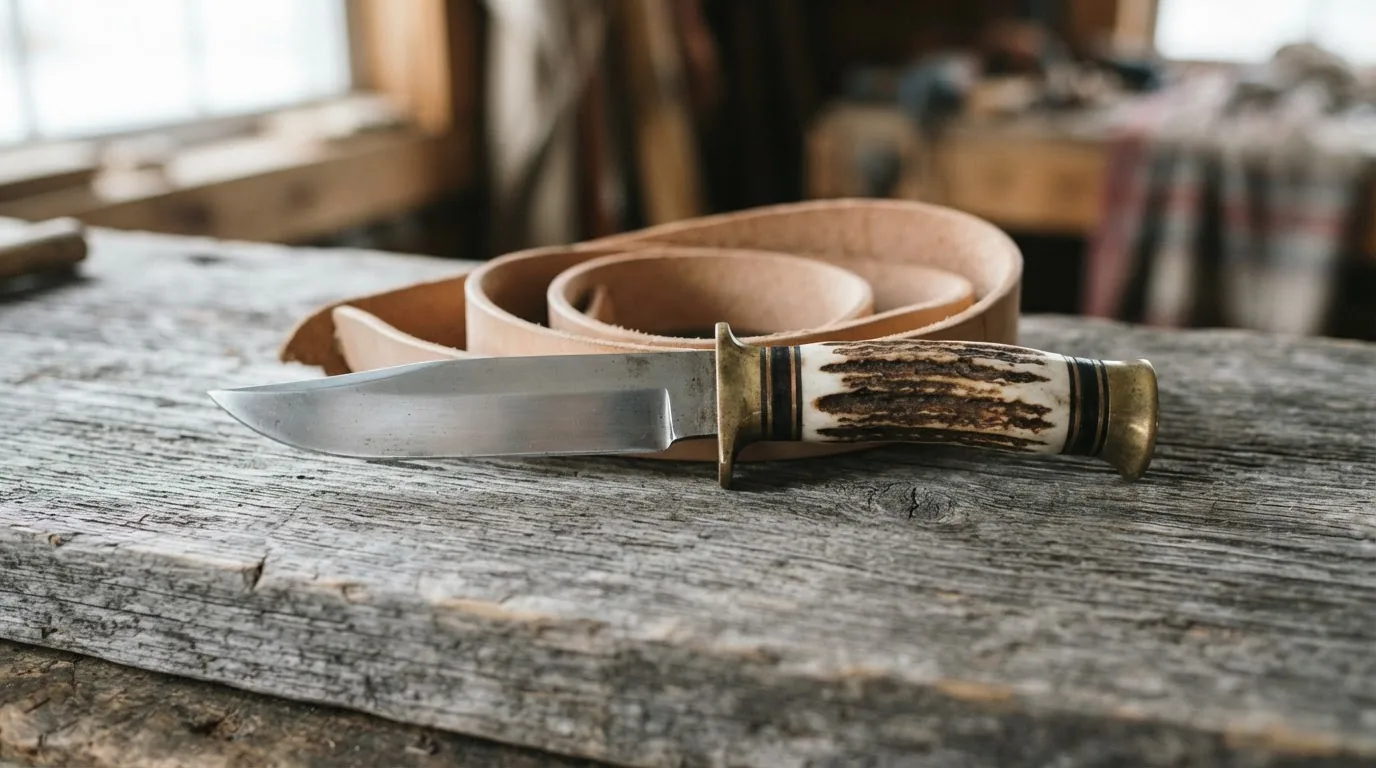
Black Mamba Knives is not a Native owned business and none of our smiths hold tribal enrolment or artisan certification. So we cannot sell you a Native American knife, and we will not describe one of ours that way. If you buy an antler handled hunter from us because a search for "native american knives" brought you here, you are buying a hand forged knife that borrows materials and a general silhouette from a tradition we have no claim to.
 Plains Hawk Native American Custom Hunting Skinner Knife Twist Damascus Stag Antler Brass Guard Camping Knife Gift USA Made | BMK-230
 PERSIAN YUMA Knife 9" Long 4.5" Blade" 10.5oz Hunting Fixed Blade Knife Damascus Steel Real Turquoise Stag Handle Knife Black Mamba Hand Made World Class Knives USA Made | BMK-111
 440c PERSIAN YUMA Knife 9.5" Long 4.5" Blade" 10.5 Oz Hunting Fixed Blade 440C Mirror Polished Turquoise Handle Knife Black Mamba Hand Made World Class Knives | BMK-111-B
That is an awkward thing for a shop to publish on a page it wants to rank. We are publishing it because the alternative is to let the phrase do quiet work in the background, which is exactly what the Act was written to stop. If authenticity is the point of your purchase, we are the wrong supplier and the rest of this page tells you where to go instead.
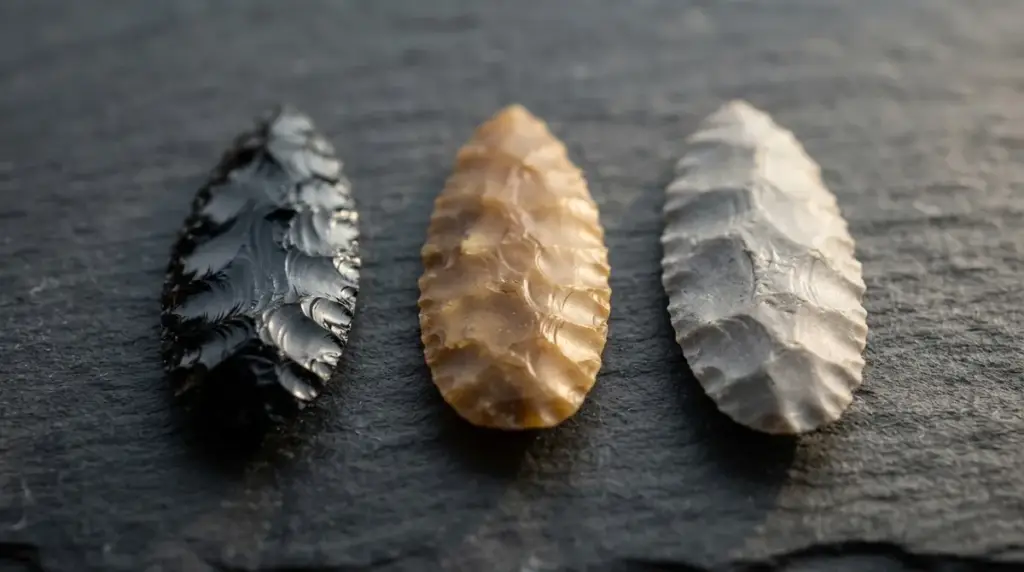
What Native made blades actually were before contact
The pre contact cutting tool across most of North America was stone. Flint, chert and obsidian were worked by percussion and pressure flaking into bifacial blades, then hafted into wood, antler or bone with sinew and pitch. Obsidian in particular takes an edge finer than any steel, because a conchoidal fracture in volcanic glass can terminate at a couple of molecules wide. It is also brittle, which is why obsidian tools appear in the archaeological record in large numbers: they were used, they broke and they were replaced.
In the Arctic the picture is different again. Slate was ground rather than flaked, and copper was cold worked and annealed in the Great Lakes region and parts of the Canadian north long before European contact. Antler, walrus ivory, muskox horn and whale baleen all served as handle stock depending on what the region offered.
Two points follow from this that matter to a buyer. First, a Damascus billet has nothing to do with pre contact Native technology. Pattern welded steel is a European and Asian tradition. Second, the shapes people associate with "Native American knives" today, meaning a long clip point with a stacked antler handle and a beaded sheath, are almost entirely post contact.
If the European side of that story interests you, the Norse seax is a good place to start, and the seax knives at Ransack Viking give you a feel for the shape. Just do not let anyone sell you one as a Native American knife.
The trade knife era changed everything
From the seventeenth century onward, European steel arrived through the fur trade and displaced stone very quickly. The best documented example in the United States is the Green River knife, made by J. Russell in Greenfield, Massachusetts from the early 1830s. Roughly 60,000 Russell Green River knives a year were shipped west for a period, in butcher, skinner and hunter patterns with blades from about 3.25 to 8 inches and plain beechwood handles. The phrase "up to Green River" entered mountain man slang as a marker of quality.
Alongside it ran the beavertail dag, a broad leaf shaped blade set into an antler or wood grip, associated with the Northern Plains and the Columbia River trade. These are the objects most "Native American knife" listings are actually gesturing at, and they were made in industrial quantity by non Native factories, then traded, rehandled, resheathed and decorated by Native owners.
That last step is the interesting one. The Native contribution in the trade knife era was very often the handle, the sheath and the decoration rather than the blade. A commercially forged butcher blade with a hand fitted antler grip and a quilled or beaded sheath is a genuinely Native object in every sense that mattered to the person who carried it, even though the steel came off a Massachusetts production line.
| Period | Blade material | Typical handle | Who made the blade |
|---|---|---|---|
| Pre contact, most regions | Flint, chert, obsidian | Wood, antler, bone, sinew wrapped | Native knapper |
| Pre contact, Arctic and subarctic | Ground slate, cold worked copper | Caribou antler, muskox horn, walrus ivory | Native maker |
| Fur trade, roughly 1650 to 1850 | European and American carbon steel | Beechwood, then rehandled in antler or horn | European or American factory |
| Late nineteenth century Arctic | Steel saw blade reworked | Antler, ivory, later wood | Native maker reworking traded steel |
| Today, certified Native work | Modern carbon or stainless, sometimes flaked stone revival | Antler, bone, hardwood, inlay | Enrolled or certified Native maker |
The ulu, and why it is shaped that way
The ulu is the one Native blade form that survived contact intact and is still made and used. It is a semi lunar knife used by Inuit, Inupiat, Yupik and Aleut women for skinning, butchering, cutting food, trimming skins and shaping snow blocks. Examples have been dated to around 2500 BCE.
The geometry is not decorative. Because the handle sits directly above the centre of the edge, force goes straight down through the cut instead of being levered around a pivot at the end of a straight handle. That makes it efficient for rocking cuts on a board and for working a hide flat. Blade sizes tracked the job: about 5 cm for cutting sinew and skin patterns, around 15 cm for general use, occasionally up to 30 cm.
Materials tracked what was available. Early blades were ground slate. By the 1880s in Alaska, Inupiat makers were routinely cutting ulu blades out of steel saw plate obtained from whalers. If you want one object that shows Native tool making as an adaptive tradition rather than a museum tableau, it is the ulu.
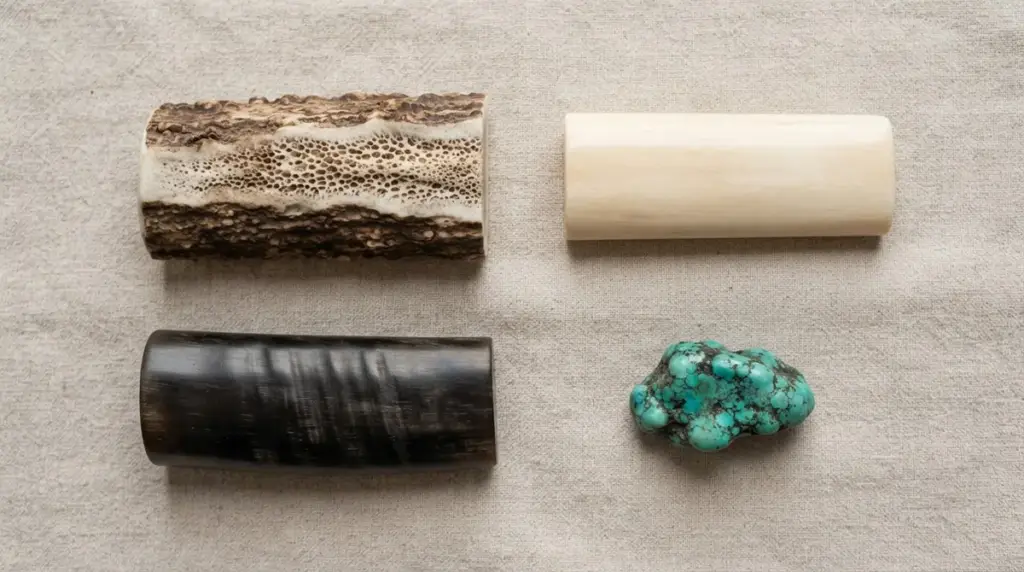
Handle and sheath materials, and what they cost you
Bone, stag, horn and antler are the materials most associated with this look, and they are also the ones that give owners the most trouble. We warranty them, so we get the complaints.
Antler and stag move with humidity. A scale fitted tight in a dry workshop can shrink slightly in a damp house and leave a proud pin you can feel. Bone yellows with skin oil and ultraviolet light, and it will crack if a knife is left in a hot car. Horn is the most stable of the three but takes a dent more easily than you expect. All three are organic and none of them are dishwasher safe under any circumstances.
Beaded and quilled sheaths are a separate question again. Genuine porcupine quillwork is slow, specialised and expensive, and it is one of the clearest markers that you are looking at real Native work rather than a style piece. Machine applied glass seed beading on a stitched leather sheath is not the same thing and should not cost the same.
What our own catalogue actually contains
Rather than describe a vague house style, here are the counted figures from our published catalogue on 30 August 2026. There were 609 published products.
| Material named in the product title | Products | Share of 609 |
|---|---|---|
| Bone, stag or horn | 134 | 22.0 percent |
| Wood or wood composite, including micarta | 176 | 28.9 percent |
| Brass fittings | 121 | 19.9 percent |
| Leather, usually a sheath | 202 | 33.2 percent |
| Antler specifically | 11 | 1.8 percent |
| Turquoise | 14 | 2.3 percent |
| Pearl or abalone | 23 | 3.8 percent |
| The word "Native" anywhere in the title | 1 | 0.2 percent |
The material overlap with the tradition is real. The origin claim is not. It is also worth saying that only 98 of those 609 products carry a stated blade length in their structured attributes, which is a gap in our own listings and one we are working through.
How to buy a genuinely Native made knife
If enrolment matters to you, the route is short and it does not run through a general knife shop.
The Indian Arts and Crafts Board, part of the Department of the Interior, publishes the Source Directory of American Indian and Alaska Native Owned and Operated Arts and Crafts Businesses. It lists over 500 cooperatives, tribal enterprises and privately owned businesses, and a listing requires tribal enrolment documentation or proof of tribal ownership, plus certification that the majority of what the business sells is made by members of federally recognised tribes. Start there.
Beyond the directory, ask three questions of any seller. Who made this piece, by name. What tribe are they enrolled in. Will you put that in writing on the receipt. A seller of genuine work answers all three without hesitation, because the answer is the value. A seller of style pieces will change the subject to steel, layers or heat treatment.
Be sceptical of a few specific signals: a listing that uses a tribal name as a product name, an "authentic" claim with no maker named, a certificate of authenticity issued by the seller rather than by a tribe, and a price that is far below what hand beadwork or quillwork could possibly cost.
What Native American style is honestly good for
There is a legitimate reason to buy a style piece, and it is not authenticity. It is that the material palette works. A stacked antler or bone handle on a mid length hunter gives you a warm, grippy, slightly irregular grip that synthetics do not match, and a full leather sheath is a genuinely good way to carry a fixed blade.
Buy it as a hand forged hunter with organic scales, judge it as one, and hold the seller to the things that actually determine whether it works: full tang or not, steel and hardness, grind, sheath fit and retention. Our guides on full tang and partial tang and on hand forged against factory made cover those in detail.
Prices, and what the gap tells you
Our best selling hunting category held 133 published products on 30 August 2026. Prices ran from 73 dollars at the floor to 938 dollars at the top, with a median of 201 dollars and a middle half sitting between 130 and 266 dollars. Across the whole catalogue of 608 priced products the median was 155 dollars.
| Group | Products | Lowest | Median | Highest |
|---|---|---|---|---|
| Whole catalogue | 608 priced | 55 dollars | 155 dollars | 1,631 dollars |
| Best selling hunting | 133 | 73 dollars | 201 dollars | 938 dollars |
| Damascus skinning knives | 22 | 73 dollars | 106 dollars | 316 dollars |
| Hand forged knives | 544 | 70 dollars | 164 dollars | 1,631 dollars |
Use those figures as a floor when you look at anything marketed as Native made. If a piece with hand quilled sheath work and a named enrolled maker is priced at the same level as a generic antler handled hunter, something in the description is not true. We have not surveyed current pricing from Source Directory businesses, so we are not going to quote a figure for authentic work that we cannot stand behind.
Questions people ask
Is it illegal for a non Native company to sell a knife with an antler handle?
No. Materials are not restricted. What is restricted is the claim. A non Native maker may use antler, bone, turquoise or beadwork freely, and may say the piece is in the style of a tradition, as long as nothing in the listing falsely suggests the item was made by an Indian as the Act defines that term.
Does having Native ancestry let a maker use the word Native American on a listing?
Not by itself. The Act's definition turns on enrolment in a federally or officially State recognised tribe, or certification as an Indian artisan by a tribe. Documented descent without enrolment or certification does not meet it.
Is "Native American style" safe wording?
It is the qualified form the regulations contemplate, and 25 CFR 309.9 allows non Indians to sell items in the style of Indian craft so long as buyers are not falsely led to think an Indian made them. It is not a magic phrase. If the rest of a listing, the imagery or the shop name still implies Native origin, the qualifier will not rescue it.
What did a real pre contact Native knife look like?
In most of the continent, a flaked stone blade of flint, chert or obsidian hafted into wood, antler or bone. In the Arctic and parts of the north, ground slate or cold worked copper. Not pattern welded steel, which arrived from Europe.
Were trade knives Native American knives?
The blades were made in European and American factories. The handles, sheaths and decoration were very often Native work, and the objects were carried and used as Native tools. It is fair to call a rehandled and beaded trade knife a Native artefact. It is not fair to call the factory blade a Native product.
What is an ulu and can anyone make one?
An ulu is a semi lunar Arctic knife used by Inuit, Inupiat, Yupik and Aleut people, with examples dated to around 2500 BCE. Anyone can make that shape. Only a qualifying maker can market one as an Indian or Alaska Native product.
How do I check that a seller is genuinely Native owned?
Look them up in the Indian Arts and Crafts Board Source Directory, which requires enrolment documentation or proof of tribal ownership. If they are not listed, ask for the maker's name and tribal enrolment in writing before you pay.
Does Black Mamba Knives sell authentic Native American knives?
No. We are not Native owned and our smiths are not enrolled or certified, so nothing we make qualifies. We sell hand forged knives that use some of the same materials, and we will not describe them as Native American.
Why is turquoise so common on knives marketed this way?
Turquoise carries a strong visual association with Southwestern jewellery, so it reads as Native at a glance. It is also easy to inlay and inexpensive in stabilised or reconstituted form. Fourteen of our 609 published products use it, and using it says nothing at all about origin.
What should I judge a style piece on instead?
Tang construction, steel and hardness, grind and edge geometry, handle fit and pinning, and how well the sheath retains the knife. Those decide whether it works. If you are choosing a first fixed blade, our guides on knife types and choosing a hunting knife are the place to start.
More guides. Read knife types explained, hand forged against factory made, the skinning knife guide and damascus knife care, or browse our best selling hunting knives. Please check your local law before ordering.
Shop the knives
Plains Hawk Native American Custom Hunting Skinner Knife Twist Damascus Stag Antler Brass Guard Camping Knife Gift USA Made | BMK-230PERSIAN YUMA Knife 9" Long 4.5" Blade" 10.5oz Hunting Fixed Blade Knife Damascus Steel Real Turquoise Stag Handle Knife Black Mamba Hand Made World Class Knives USA Made | BMK-111440c PERSIAN YUMA Knife 9.5" Long 4.5" Blade" 10.5 Oz Hunting Fixed Blade 440C Mirror Polished Turquoise Handle Knife Black Mamba Hand Made World Class Knives | BMK-111-BMore from the workshop
Knife Steel Chart
Four properties that fight each other. Improve one and you give up another.
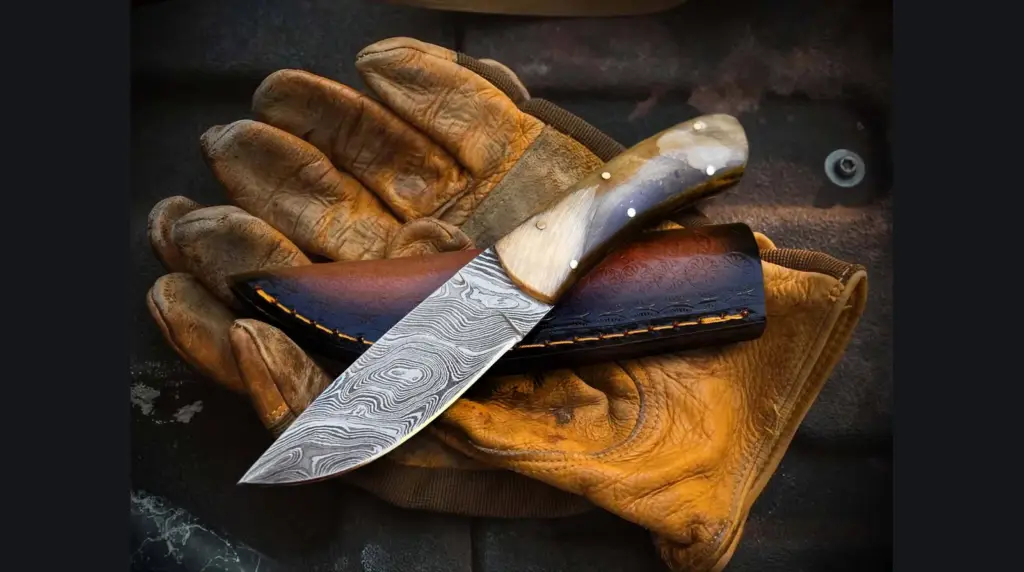
What 352 Layers Actually Means
Where the layer count comes from, and why a bigger number is not a better blade.
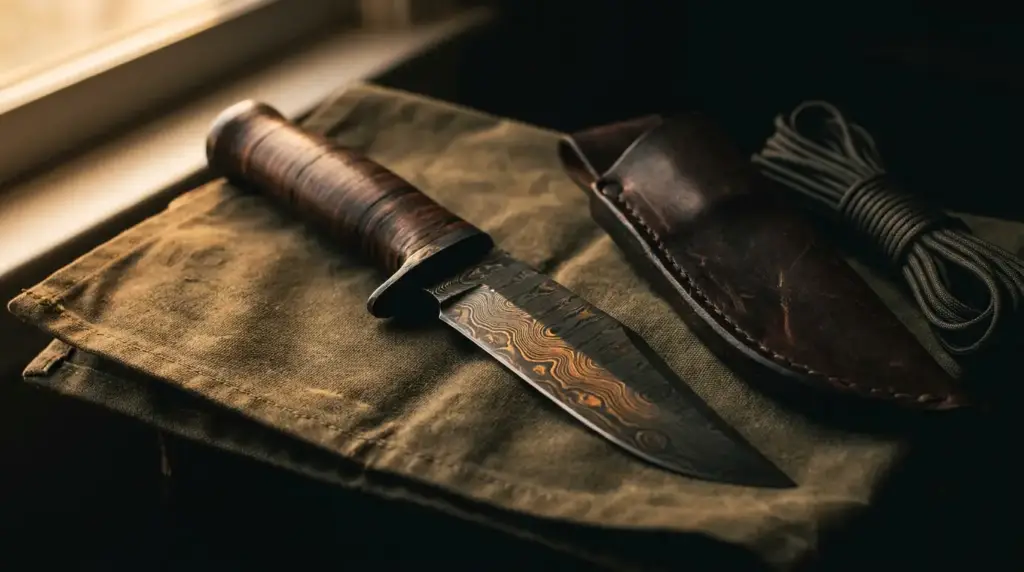
Military Knives: The Complete Buying Guide
The 1942 service pattern explained, choosing by branch and steel, engraving and unit orders, what the rules are on base, and how to claim the 15% military discount in about a minute.
