

Short answer: a balisong is built one of two structural ways. A channel handle is machined from a single solid block with the blade's resting groove milled directly into it. A sandwich handle is assembled from two flat scales fastened around spacers, leaving an open gap for the blade. Everything else — tang pins, pivots, bushings or bearings, the latch, the kicker — is the same set of parts doing the same jobs regardless of which structure holds them.
The two structural families, briefly
Before the parts glossary, the one thing worth knowing up front: almost every balisong on the market is either channel or sandwich construction. We cover the tradeoffs between them — weight, feel, maintenance — in a dedicated comparison: channel vs sandwich vs skeletonized. This guide is about what's actually inside the handle, part by part.
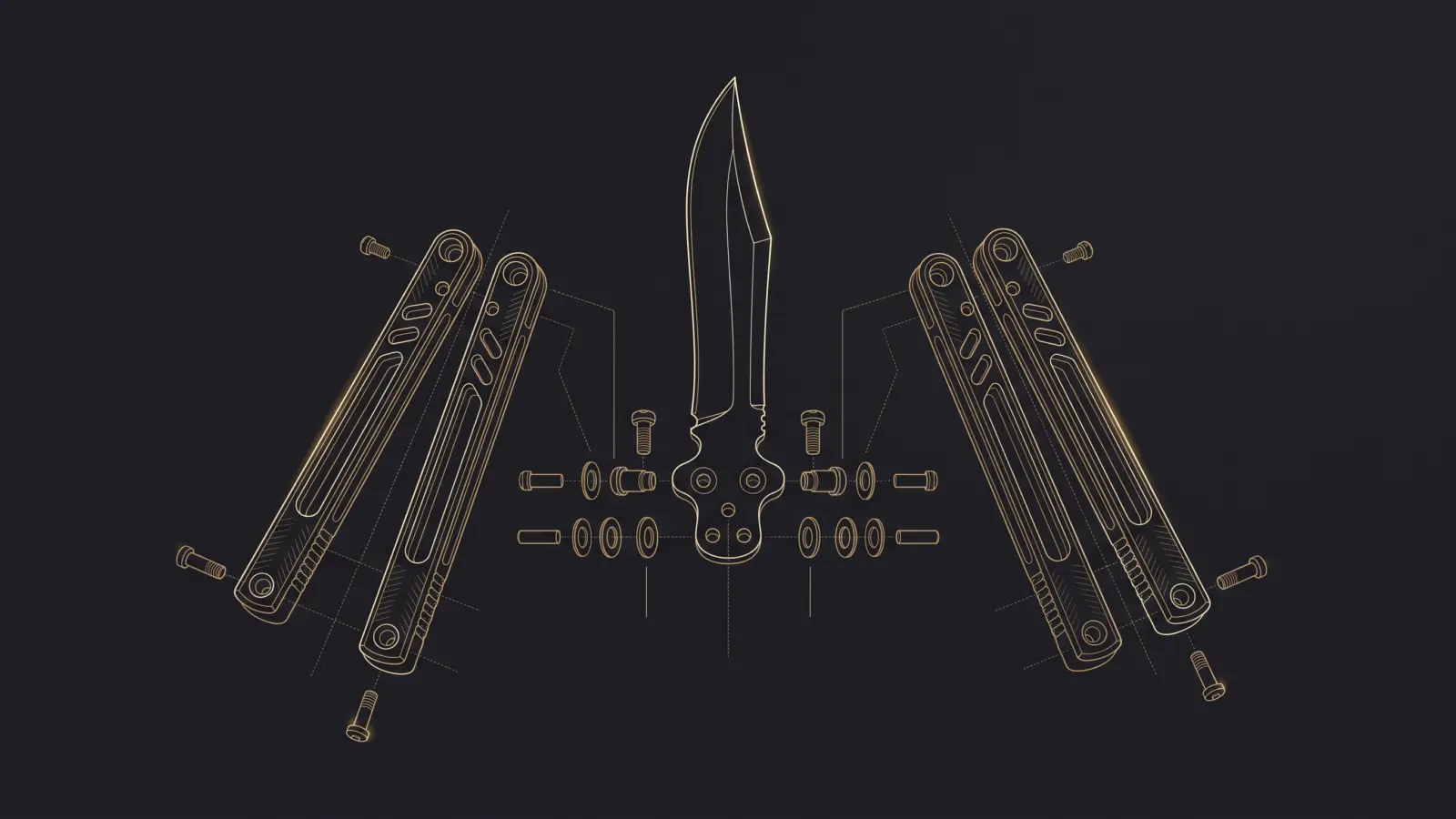
Anatomy — the parts glossary
- Bite handle — the handle that closes over the sharpened edge when the knife is folded shut. It gets its name because it's the one you don't want your fingers between during a bad flip.
- Safe handle — the handle on the spine side, safe to grip through most flipping and manipulation.
- Tang — the flat, unsharpened base of the blade between the edge and the pivot holes. Both handles attach here.
- Tang pin — a small pin fixed into the tang that limits rotation and defines the open and closed stop points.
- Zen pin — does the same stopping job as a tang pin, but mounted in the handle instead of the blade, held by a small screw. More common on sandwich builds since the handle is easier to drill into.
- Pivot pins — the screws at the base of each handle that the handle actually rotates around. On sandwich construction these are usually adjustable, which is how a flipper tunes the tension of a flip.
- Bushings — simple metal sleeves fitted into the pivot holes that the handle spins on. Durable, low maintenance, moderately smooth.
- Bearings — caged ball bearings used in place of bushings for markedly less friction and a faster, freer spin. Preferred by advanced flippers; can feel too loose for a beginner still learning control.
- Latch — the mechanism that locks the knife closed, or open, for safe carry. Spring latches, channel-style latches, and latchless friction-fit designs are the common types.
- Kicker — a small protrusion on the tang that stops the sharpened edge from striking the inside of the handle channel during a flip.
- Choil — a small unsharpened curve near the kicker that gives a sharpening stone somewhere to run out to.
- Blade channel — the internal cavity, whether milled into a solid block or formed by the gap between two scales, that the folded blade actually rests inside.
How a channel handle is machined
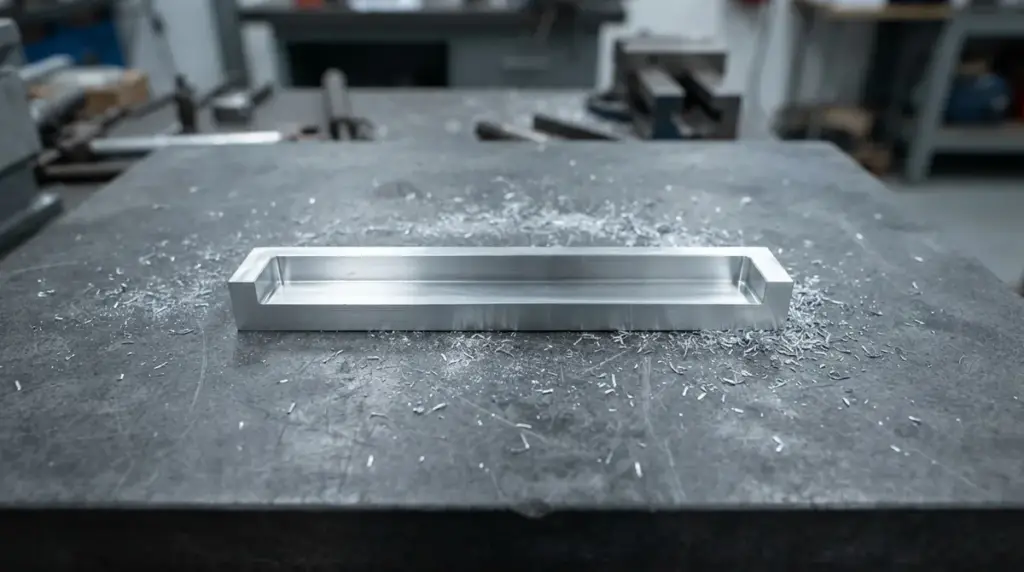
Each handle starts as a solid bar of material — aluminum most often, sometimes steel or titanium — and the blade channel is milled directly into it as a single continuous groove. Nothing is fastened together inside the handle itself; the pivot hardware and any latch components are the only things that attach afterward. That makes a channel handle simple and hard to break, at the cost of being heavier for its size and impossible to disassemble for a deep clean.
How a sandwich handle is assembled
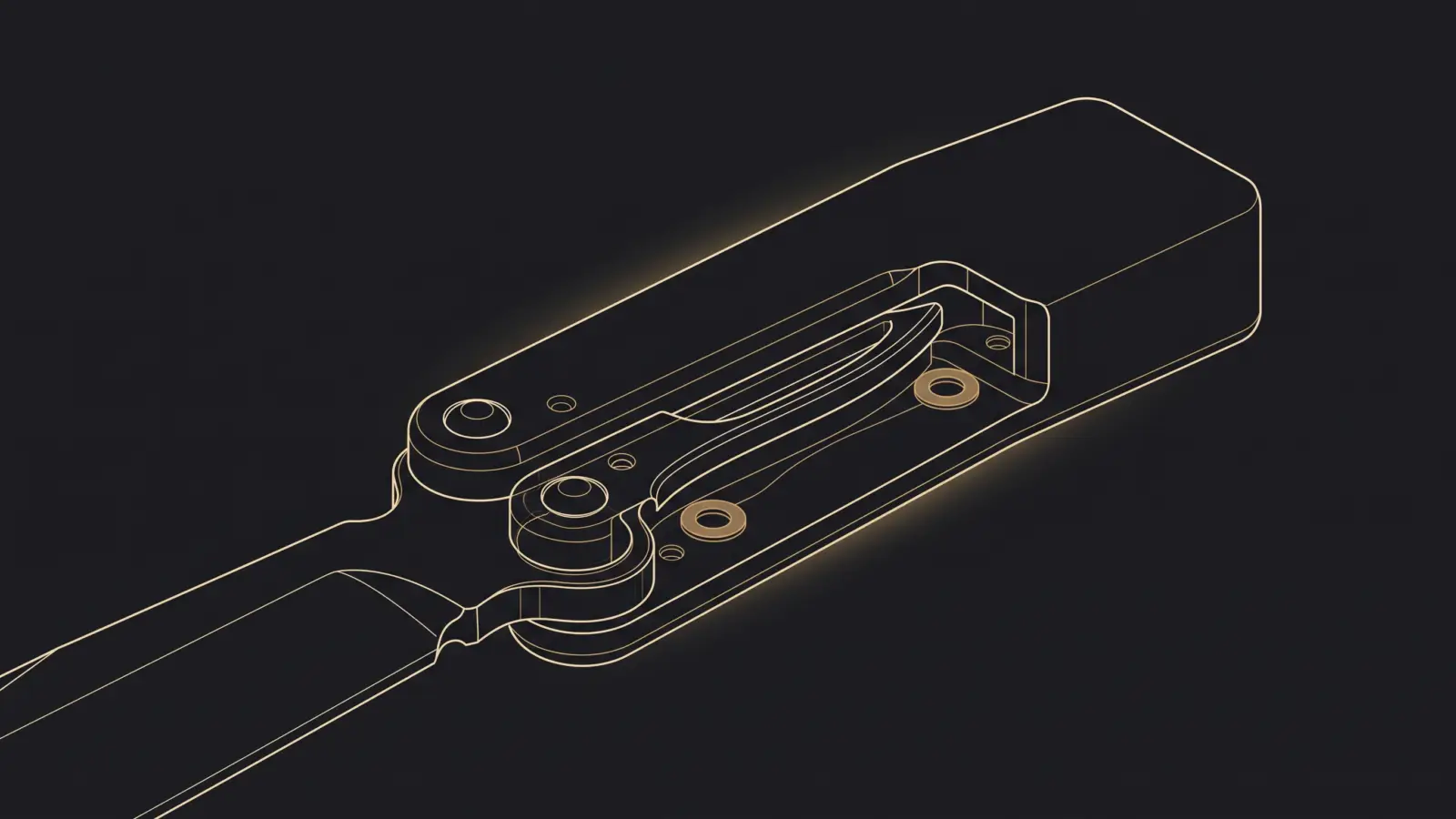
A sandwich handle is built from two flat scales — G10, titanium, aluminum, or carbon fiber — fastened around internal spacers and standoffs, with the pivot hardware running through both layers. The gap between the scales is the blade channel; there's no milling involved, just parts stacked and screwed together. That construction is lighter and fully serviceable — spacers, scales, and pivots can all be swapped or cleaned individually — but it's also more parts that can work loose over time.
What actually changes the flip
Two things affect flip feel more than anything cosmetic: how much the handles weigh (heavier channel handles swing with more momentum and a more contained feel; lighter sandwich handles move faster and looser), and whether the pivots run on bushings or bearings (bushings feel more controlled, bearings spin freer). The construction style sets the starting point; pivot hardware is what most flippers actually tune once they own the knife.
Channel vs sandwich balisong construction, compared properly
Channel vs sandwich balisong comes down to four things you can measure: rigidity, repairability, cost, and weight. A channel balisong is stiffer and heavier. A sandwich balisong is lighter and fixable.
Rigidity favours the channel, because one piece of metal has nothing inside it to shift. A sandwich handle resists twisting only as well as its spacers and screws hold the scales in register, which is why a neglected sandwich build feels vague first. Repairability runs the other way: every sandwich part is replaceable, while a channel handle with a worn pivot bore is finished. Cost follows machine time. Weight you feel directly: more metal, more momentum. The three-family breakdown is in channel vs sandwich vs skeletonized.
| Rigidity | Channel: solid, no internal movement. Sandwich: relies on spacers and screw tension. |
| Repairability | Channel: pivot and latch only. Sandwich: every component replaceable. |
| Cost to make | Channel: more machine time, more waste. Sandwich: flat stock, cheap to vary. |
| Weight | Channel: heavier, more momentum. Sandwich: lighter, faster, easier to over-rotate. |
Washers and bearings: what the pivots ride on
Between handle and tang sits either a washer or a bearing, and that choice changes the feel more than handle material does.
- Phosphor bronze washers — slightly damped, forgiving of grit, and they bed in over the first few hundred flips rather than wearing out.
- PTFE washers — slicker out of the box, softer, and they compress under a tight pivot. Cheap, and intolerant of over-tightening.
- Steel ball bearings — caged races that cut friction hard. Fast and free, but they catch lint, and grit feels worse in a bearing than in a washer.
- Ceramic bearings — harder, corrosion-proof, better with light grit than steel. Dearer, and no cure for a bad pivot bore.
Washers want an occasional strip, wipe and a drop of oil; bearings want it more often. Carry the knife outdoors and washers are the lower-maintenance choice.
Pivot hardware, and what the pins are doing
The pins on a balisong are three parts doing three jobs. Pivot pins or screws are the axis each handle turns on. The tang pin sits in the blade tang and stops the handles open and closed. The zen pin moves that stop into the handle, so the tang stays clean and the stop can be shimmed or replaced.
A pinned balisong, where the pivots are peened rather than screwed, cannot be tuned. There is no thread to turn, so you get the tension the factory set, and re-peening a loose one is a workshop job. Buy screws if tuning matters.
On a screwed balisong, use low-strength thread lock and let it cure before flipping. Over-tightening crushes washers, drags the tang, and can oval the pivot bore permanently.
The pins also decide how the knife treats its own edge. A tang pin is close to indestructible but adds rotating mass and can chip the handle it hammers for years. A zen pin gives a quieter, softer stop, at the cost of a screw that must stay tight. The kicker is the raised shoulder on the tang that keeps the edge from touching the inside of the handle. Grind it away while sharpening and the edge takes those impacts, which is how a balisong ends up with flat spots along the belly.
Latch types and the trade-offs
- Spring latch — sprung so it clears the handle mid-flip. The most forgiving type for learning, with more small parts to lose.
- Magnetic latch — a magnet holds the handles shut. Silent and snag-free, but the hold is weaker under a knock.
- Batangas latch — the traditional Filipino style, mounted on the bite handle and long enough to catch both. Secure, and it rattles unless well fitted.
- Latchless — friction only. Clean lines, no latch bite on the knuckles, but not a carry design.
Balisong handle materials, and why weight distribution matters more
Titanium, G10, brass, aluminium, carbon fibre and stabilised wood all make good balisong handles, and buyers spend too long on that list. What decides the flip is where the mass sits, not what it is made of. Handles heavier than the blade rotate slowly and forgivingly; handles lighter than the blade snap round fast and punish sloppy timing. A brass sandwich handle and an aluminium channel handle of the same weight feel more alike than either does to its own material twin at another weight. Material decides durability and grip: brass and titanium dent rather than crack, G10 stays grippy when wet, wood takes impact worst.
Blade steels used in balisongs
Balisong blades run the same steels as any quality folder, chosen for toughness first because the blade takes repeated shock loads no fixed knife sees. Our butterfly knives use hand-forged 1095 and 15N20 Damascus at 58–60 HRC, and we also work in D2 at 58–62 HRC and 440C at 58–60 HRC. Higher hardness holds an edge longer and chips more readily against a mistimed handle strike, which is why makers rarely push a balisong blade to the top of a steel's range. Comparisons are in the knife steel chart.
Trainer versus live blade construction
A trainer is built exactly like the live knife apart from one thing: the blade has no edge. Same tang, same pins, same pivots, ideally the same weight distribution. That last point separates a useful trainer from a toy, because a trainer lighter than the live knife teaches the wrong timing. A metal butterfly knife trainer of matched weight beats a plastic one. Learn each new move on a trainer first; the list is in butterfly knife tricks. This is general information, not legal advice: check your local law, and see butterfly knife laws.
How to tune a balisong
Three checks, in order, with a hex driver that fits.
- Pivot tension. Tighten until the handle stops moving freely, then back off in small steps until it swings shut under its own weight with no side-to-side play. Play means too loose; drag means too tight.
- Symmetry. Both pivots must be set the same. Hold the knife by the blade and let each handle fall in turn — they should take the same time. Tight on one side and loose on the other feels like the knife is fighting you.
- The tap test. Hold the blade, let both handles hang open, and tap the spine lightly on your palm. Matched handles ring and settle together. If one swings further or rattles alone, the pivots are uneven or a washer has shifted.
Retune after any strip and clean. Thread lock stops screws walking out; it does not stop them loosening a quarter turn.
Questions people ask
Is one construction type inherently safer?
Not meaningfully — safety on a balisong comes from the latch and from practicing with a trainer before a live blade, not from channel versus sandwich. Both hold a blade securely when built and maintained properly.
Can a sandwich handle be taken apart at home?
Yes, that's part of the design — most sandwich builds use standard hex hardware. A channel handle generally cannot be disassembled beyond removing the pivot and latch hardware.
Why do some balisongs feel "looser" than others of the same construction?
Almost always pivot tension and bushing versus bearing choice, not the handle structure itself. A worn or over-loosened pivot will feel loose on either a channel or a sandwich handle.
What are the pins on a balisong for?
Three different pins do three different jobs. The pivot pins are the axis each handle rotates on. The tang pin sits in the blade tang and stops the handles at the open and closed positions. The zen pin does that same stopping job from inside the handle instead of the blade. A kicker is not a pin at all, just a raised shoulder on the tang that keeps the edge off the handle.
Are washers or bearings better in a balisong?
Neither is better outright. Phosphor bronze washers feel damped and controlled, tolerate grit well, and need cleaning least often. PTFE washers are slicker but compress if you over-tighten the pivot. Steel and ceramic bearings spin far more freely and suit experienced flippers, at the cost of more frequent stripping and cleaning, because grit feels worse in a bearing than in a washer.
Can a pinned balisong be tuned?
No. If the pivots are peened or riveted rather than screwed, there is no thread to turn, so the knife keeps whatever tension the factory set. Once a pinned pivot loosens, tightening it again means re-peening, which is a workshop job with the right punch and support. Buy a screwed balisong if you want to adjust pivot tension yourself.
What blade steel is best for a balisong?
Toughness matters more than outright hardness, because a balisong blade takes repeated shock loads from handle strikes that a fixed knife never sees. Hand-forged 1095 and 15N20 Damascus at 58–60 HRC, D2 at 58–62 HRC and 440C at 58–60 HRC all work well. Very hard, very wear-resistant steels hold an edge longer but chip more readily against a mistimed flip.
Is a metal butterfly knife trainer worth buying before a live blade?
Yes, if the weight matches. A trainer is the same knife with an unsharpened blade, so a metal trainer built to the same weight distribution as the live knife teaches correct timing. A light plastic trainer teaches timing you then have to unlearn. Learn each new move on the trainer, get it clean, then repeat it on the sharp knife. Every balisong we sell can be ordered with a Trainer Blade above Add to Cart. It is the same knife with a blunt, unsharpened edge at the same price as the live blade, so the weight question answers itself.
Does the handle material change how a balisong flips?
Less than most buyers expect. Weight and where that weight sits decide the flip, not whether the handle is titanium, brass, G10, aluminium or wood. Handles heavier than the blade swing slowly and forgive mistakes; lighter handles are faster and less forgiving. Material mostly decides durability and grip: brass and titanium dent, G10 grips when wet, wood chips.
Which latch type should a beginner choose?
A spring latch, in most cases. It clears the handle on its own during a flip, so it will not catch mid-rotation and jam a move you are still learning. Batangas latches are secure and traditional but sit in the way more. Magnetic latches are quiet with a weaker hold. Latchless designs are for flipping, not for carry.
More guides
- Channel vs Sandwich vs Skeletonized
- Butterfly Knife Tricks for Beginners
- Butterfly Knife Laws in the US
More from the workshop
How to Clean a Pocket Knife
Ten minutes twice a year keeps a folder working for a lifetime.
How Damascus Steel Knives Are Made
Billet to blade: forge welding, folding, pattern work, heat treat and the acid etch.
Sharpening a Serrated Edge Without Ruining It
The one procedure a general sharpening guide cannot cover, scallop by scallop with a tapered rod.
