

A katana is defined by its curve, its single edge and its length: a blade over about 60 centimetres, worn edge up. The shape came out of mounted combat in feudal Japan, where a curved edge drawn across a target cuts rather than chops.
What ours are
Hand-forged Damascus blades with traditional furniture, wrapped handles and fitted scabbards, made in our own shop. They are display and collector pieces built to real proportions, not stage props.
Full tang matters
The tang runs the length of the handle and is pinned, which is what stops a blade separating from its handle. Swords with a short welded tang are the ones that fail.
The pattern
Folded 1095 and 15n20 etch to different depths, so the figure runs through the steel. On a katana the long flat gives the pattern room to show, which is why these are among the most striking pieces we make.
-
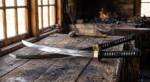
Handmade 32″ Japanese Damascus Katana Samurai Ninja Sword – A Premium USA-Made Gift with Wooden Sheath | BMK-561
Original price was: $708.00.$566.00Current price is: $566.00. -
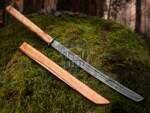
Handmade 32″ Damascus Katana Japanese Sword Damascus Samurai Ninja Sword – The Ultimate Gift – With a Wooden Sheath USA Made | BMK-560
Original price was: $708.00.$566.00Current price is: $566.00.
Questions people ask
Do these arrive sharp? They ship with a working edge unless stated otherwise. Treat them as edged tools, not ornaments, and store them out of reach of children.
Katana or samurai sword? The same thing. Katana is the Japanese term for the pattern; samurai sword is the English shorthand.
How do I care for one? Wipe the blade with a light oil every few months, keep it out of a closed scabbard in humid conditions, and handle it by the handle rather than the flat.
How long is a katana? Ours run about 30 to 32 inches overall. Traditionally the blade alone is over 60 cm; shorter than that is a wakizashi, and shorter again is a tanto.
Can I hang it on a wall? Yes, on a horizontal stand with the edge facing up, which is how they were stored and what keeps the scabbard fit correct. In a humid room, leave the blade out of a closed scabbard.
Katana, wakizashi or tanto
| Blade | Length | Worn | Bought for |
|---|---|---|---|
| Katana | Blade over 60 cm; about 30 to 32 in overall | Edge up, through the belt | The full-size display piece, the one people picture |
| Wakizashi | Roughly 30 to 60 cm blade | Paired with the katana | Completing a set, or a shorter shelf |
| Tanto | Under 30 cm | Carried like a knife | Desk and cabinet display; the affordable way in |
More: the full handmade swords collection covers Viking, gladius, falchion, kilij and longsword patterns, and the 352 layers guide explains what the fold count on these blades actually means.
Freshly finished and added here: 32 Japanese Damascus Katana Samurai Ninja Sword, and 32 Damascus Katana Japanese Sword Damascus Samurai.
Buying for a wedding party? The groomsmen knife sets come as six matched swords, 15% less than buying them singly, and each one can carry its own engraved name.
