
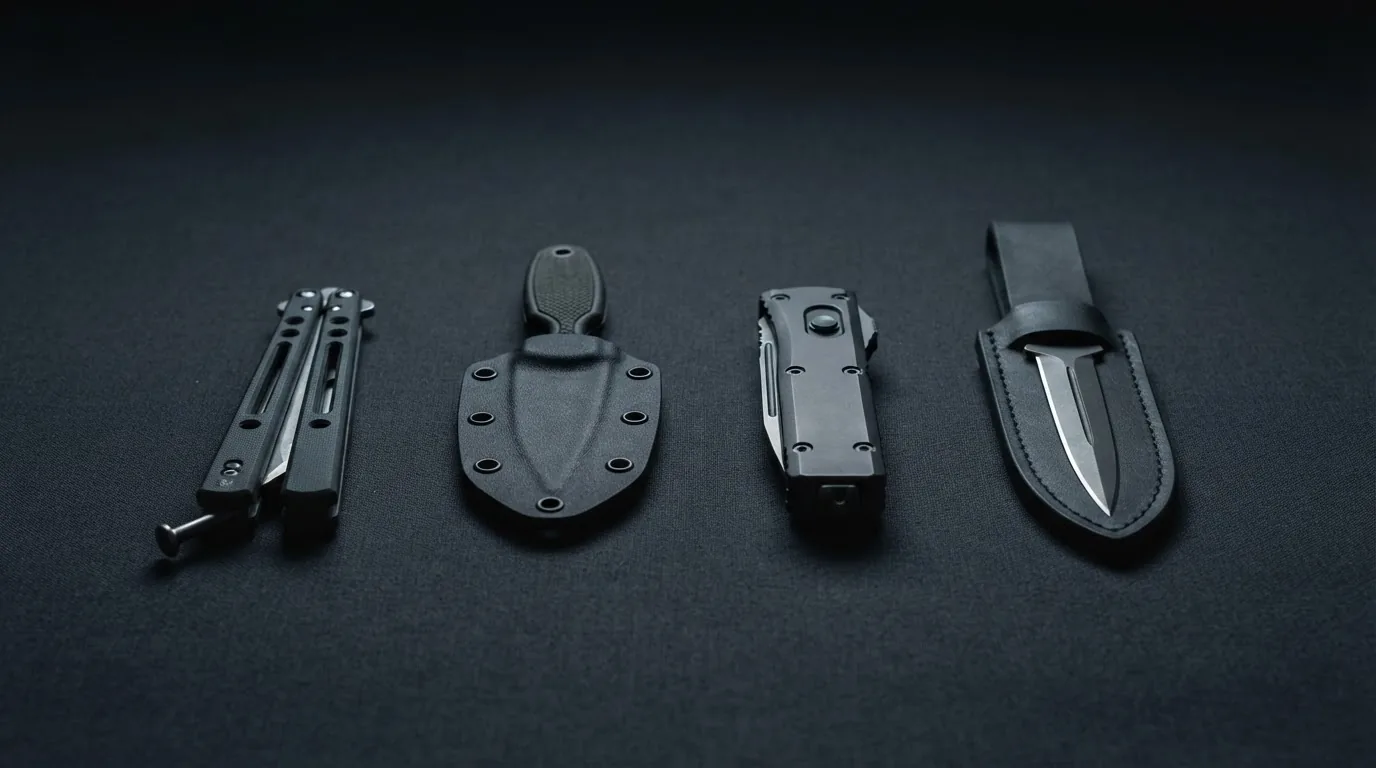
Short answer: the ballistic knife. Not the switchblade, not the butterfly knife, not the one that looks frightening in a film. The ballistic knife is the only knife in the United States Code that Congress made a federal offence to simply possess, and the maximum sentence is ten years. Every other knife in America, including the switchblade, is regulated federally only at the level of selling, shipping and importing.
This page explains why that is, what the runners up are, and how the picture has changed since 2023, which is a great deal.
This is general information rather than legal advice, and knife law changes faster than most pages that cover it. Check your own state and city before you buy or carry anything.
Why the ballistic knife wins
A ballistic knife has a detachable blade launched out of the handle by a spring. Federal law defines it in exactly those words at 15 U.S.C. 1245(d): a knife with a detachable blade propelled by a spring-operated mechanism.
Section 1245(a) then makes it an offence to knowingly possess, manufacture, sell or import one, punishable by up to ten years. Section 1245(b) adds a mandatory minimum of five years for possessing or using one during a federal crime of violence.
Compare that with the Federal Switchblade Act at 15 U.S.C. 1242, which covers introducing a switchblade into interstate commerce, manufacturing for that purpose, transporting or distributing it. There is no possession verb anywhere in it, and the maximum is five years rather than ten. Congress went twice as hard on ballistic knives as it did on switchblades.
One honest caveat, because plenty of pages skip it. The ballistic knife offence carries a jurisdictional hook: the conduct has to be in or affecting interstate commerce, or in a territory, Indian country, or federal maritime jurisdiction. It is not a bare nationwide possession ban in the way a state statute would be. But in or affecting interstate commerce is the broad Commerce Clause formula, and a knife that has ever crossed a state line sits comfortably inside it. Describing this as "no federal possession ban" is a stretch that some knife rights groups make and the statutory text does not support.
Roughly a dozen states ban ballistic knives on top of that, including California, Indiana, New York and Virginia. In California and Indiana the state ban reaches possession too. In Virginia it is technically an intent to sell offence, though possession is treated as prima facie evidence of that intent, which amounts to much the same thing in practice.
The strangest part: no documented case of a ballistic knife being used in a violent crime has ever been produced. The 1986 federal ban rode into law attached to the Anti-Drug Abuse Act on the back of testimony about body armour that was never corroborated. It remains the most heavily criminalised knife in the country.
The ranking, by how much trouble you are actually in
Most pages rank knives by how many states restrict them. That produces a table nobody can verify, because nobody has read fifty criminal codes this month. Ranking by the worst legal exposure available is both more honest and more useful.
| # | Knife | Worst case |
|---|---|---|
| 1 | Ballistic knife | The only federal possession offence, ten years, plus around twelve state bans. Nothing else is close. |
| 2 | Switchblade / automatic | Federal restrictions on import, interstate commerce and the mail. State bans exist but are collapsing fast. |
| 3 | Dirk, dagger and stiletto, concealed | The widest state coverage of any category. Almost always a carry offence rather than a possession one, and usually a misdemeanour. |
| 4 | Gravity knife and balisong | No federal possession exposure at all. Caught in a handful of states by switchblade and gravity definitions rather than by name. |
| 5 | Sword cane and throwing star | Narrow, but in California all three of these plus the ballistic knife are outright possession bans. |
| 6 | Undetectable knife | No federal law exists. Where states regulate it, it is usually a commercial manufacturing offence rather than a possession one. |
Three things almost every knife law page gets wrong
1. There is no federal undetectable knife law. The Undetectable Firearms Act at 18 U.S.C. 922(p) is about firearms, and there is no knife equivalent anywhere in federal law. California regulates undetectable knives at Penal Code 20810, and even there the offence is commercial: manufacturing, importing for commercial sale, keeping for sale. Simple possession of one is not what that statute prohibits.
2. In California a cane sword is more illegal than a switchblade. Penal Code 21510 makes it a misdemeanour to carry a switchblade, keep one in the passenger area of a car in public, or sell or give one away, and the definition only bites at a blade of two inches or longer. Owning one at home is lawful. Meanwhile Penal Code 20510, 21110 and 22410 make simple possession of a cane sword, a ballistic knife or a shuriken an offence outright. The scary looking one is the legal one.
3. Indiana repealed its throwing star ban in 2023. Indiana Code 35-47-5-12 was repealed by Public Law 22-2023. Most published guides still list Indiana as a throwing star state. Its ballistic knife statute at 35-47-5-2 does survive.
Statewide blade length limits we could actually verify
Blade length is the rule most people expect to be simple and it is the one most misreported. These are the only statewide limits we could trace to a statute.
| Where | Limit | Applies to |
|---|---|---|
| Rhode Island | More than 3 inches | Concealed carry. Measured from where the blade joins the handle to the end of the blade. |
| Colorado | Over 3.5 inches | Concealed carry only, and a hunting or fishing knife carried for sport is excluded. |
| Connecticut | 4 inches edged blade, 1.5 inches automatic | Carrying on the person, open or concealed. The broadest of these. |
| Delaware | 3.75 inches | The ordinary pocketknife threshold, raised from 3 inches in 2025. |
| Texas | Over 5.5 inches | Not a carry ban. It makes the knife location-restricted, which triggers prohibited-place rules only. |
| Federal buildings | 2.5 inches | A pocket knife under 2.5 inches is excluded from dangerous weapon in a federal facility. Everything at or above it is not. |
Everywhere else, we could not verify a statewide number and we are not going to invent one. Check your own code.
The direction of travel
If your idea of American knife law was formed before about 2020, it is out of date, and in the permissive direction.
- New York, 2019. Gravity knives removed from the penal law.
- Pennsylvania, 2023. Automatic knives legalised.
- Virginia, 2023. Switchblade concealed carry ban repealed.
- Indiana, 2023. Throwing star ban repealed.
- Hawaii, 2024. Possession, sale and transport of butterfly knives, switchblades and gravity knives all legalised. Concealed carry still an offence.
- Massachusetts, 2024. The switchblade carry ban struck down on Second Amendment grounds.
- Vermont and Delaware, 2025. Switchblade bans repealed outright, Vermont with expungement of prior convictions.
- California, 2026. The exception. The Ninth Circuit upheld the switchblade ban in January and denied rehearing in July.
Seven states have also passed knife preemption laws since 2023, which stop cities writing their own stricter rules: Nebraska, Idaho, Louisiana, West Virginia, Iowa, Arkansas and Ohio.
What has not moved in that period: ballistic knives, undetectable knives, sword canes and throwing stars. Not one state has touched them since 2023, and 15 U.S.C. 1245 has been untouched since 1986. All the reform energy has gone into switchblades and preemption.
Questions people ask
What is the most illegal knife in the US?
The ballistic knife. It is the only knife category Congress made a federal offence to possess, at 15 U.S.C. 1245, with a maximum of ten years and a five year mandatory minimum if it is possessed or used during a federal crime of violence. Around a dozen states ban it separately as well.
Are switchblades illegal in the US?
Not federally in the sense most people mean. Federal law restricts importing them, introducing them into interstate commerce and sending them through the mail, but there is no federal possession offence. State bans still exist but have shrunk sharply, with Hawaii, Massachusetts, Vermont and Delaware all falling between 2024 and 2025.
What knife is banned in the most states?
Almost certainly the dirk, dagger and stiletto category, because nearly every state concealed weapon statute names them. We could not verify an exact count and we are not going to print one. The important detail is that these are carry offences rather than possession offences, and usually misdemeanours.
Is there a federal law against undetectable knives?
No. The Undetectable Firearms Act covers firearms only and has no knife equivalent. California regulates undetectable knives at Penal Code 20810, but that offence is about commercial manufacture and sale rather than simple possession.
Are butterfly knives illegal in the US?
Not federally, and no state now bans them by name. New Mexico is the only state we could verify with a genuine possession ban, reached through its switchblade statute plus a 1991 case. Our butterfly knife laws guide goes state by state. If you live somewhere they are legal and want to see what is out there, Balisong Butterfly is a shop that focuses on butterfly knives.
What is the legal blade length in the US?
There is no national number. Rhode Island sets 3 inches for concealed carry, Colorado 3.5 inches concealed, Connecticut 4 inches for carrying at all, Delaware 3.75 inches as the ordinary pocketknife threshold, and Texas 5.5 inches as a location trigger rather than a ban. In federal buildings the line is 2.5 inches.
Can I mail a knife?
Ordinary knives yes. Knives that open by inertia or gravity are non-mailable through the United States Postal Service under 18 U.S.C. 1716(g), with narrow exceptions for government procurement. Private carriers are the usual route for those.
Is it legal to own a sword cane?
It depends entirely on the state, and in California it is not: Penal Code 20510 makes possessing a cane sword an offence outright, which is stricter than the state treats switchblades. New York names cane swords directly in Penal Law 265.01 as well.
More reading. Butterfly knife laws by state.
More from the workshop
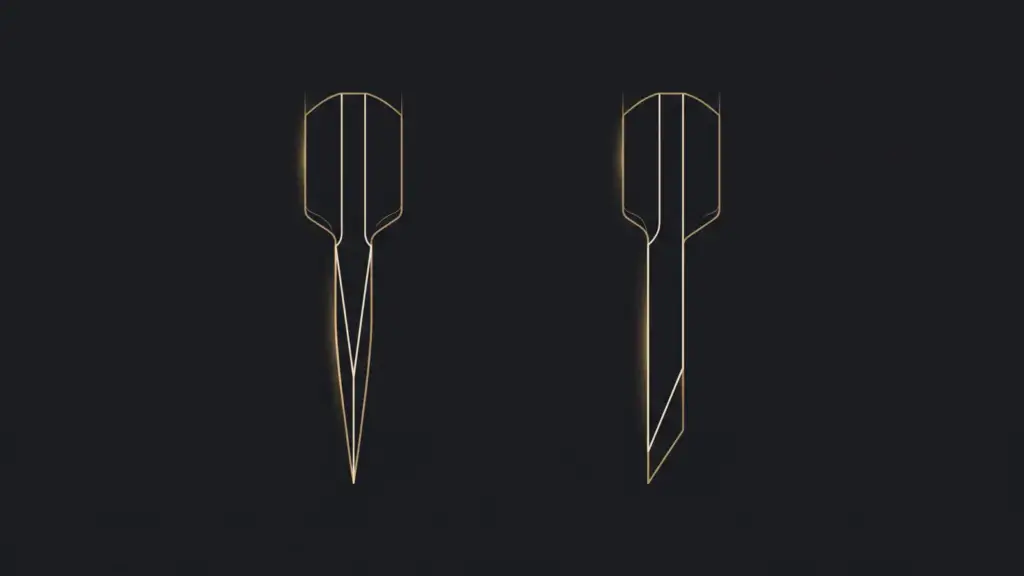
Chef Knife Bevels Explained
What a full flat grind and chisel grind actually do in the kitchen, and which one to buy.
Butterfly Knife Tricks for Beginners
Start on a trainer, get smooth before fast, and learn the close before the open.
1095 or D2: Two Steels We Actually Sell
The pairwise comparison the steel charts skip, from a catalogue holding 111 D2 knives and 320 Damascus.
