
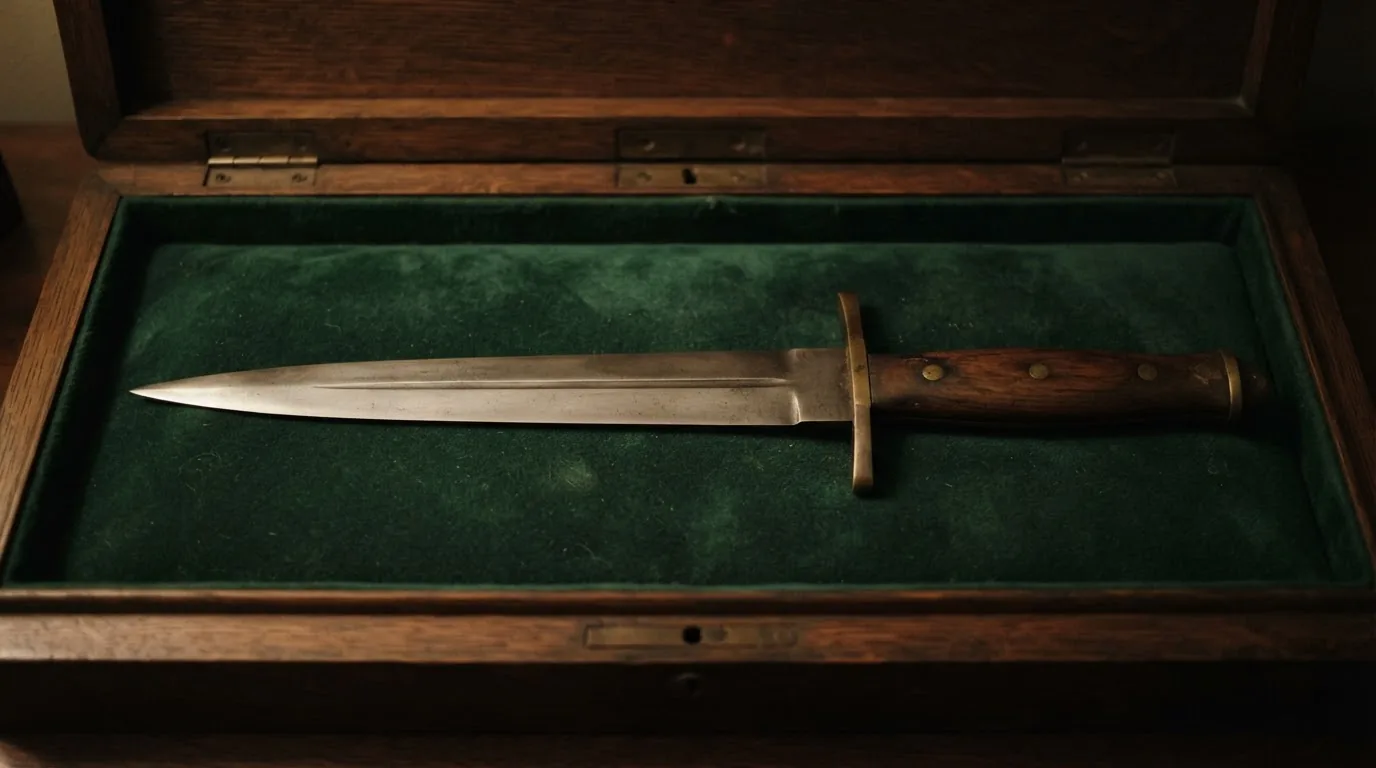
Short answer: a hunting dagger is a double edged fixed blade, historically used by European hunters to finish game the shot did not kill. It is almost never the right knife for the work modern hunters actually do, because a second edge facing your knuckles is a liability the moment you start skinning. We sell nine of them at $112 to $401 and we still think most people should buy a drop point.
What a hunting dagger is
Two edges, a symmetrical point, and usually a guard. That is the whole definition. Everything else, the length, the fuller, the guard style and the handle, varies by century and by country.
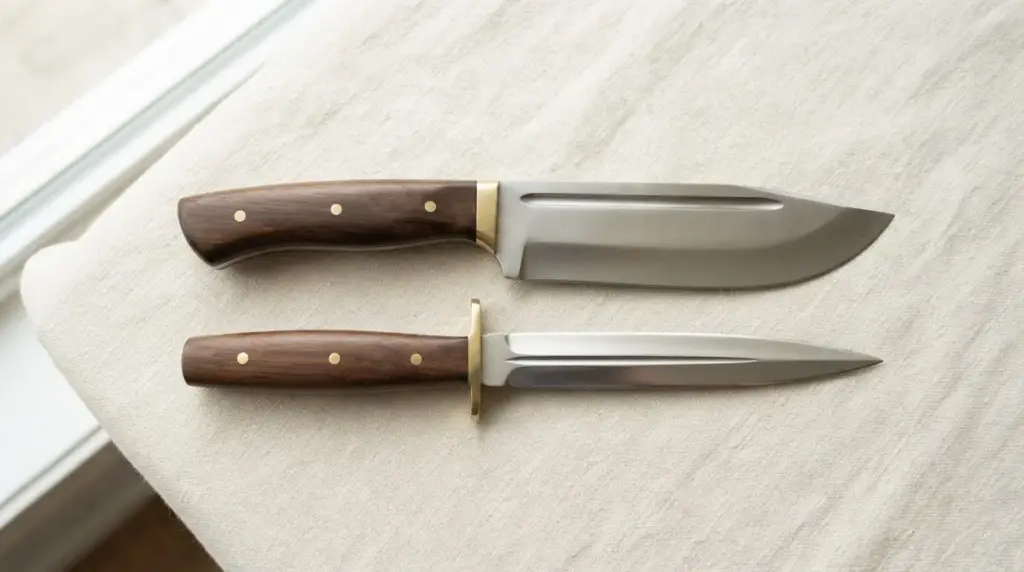
The distinction that matters is not decorative. A single edged knife has a spine, and a spine is a place to put your thumb, the heel of your other hand, or a baton. A double edged knife has no spine. Every part of the blade is sharp, which means every part of the blade is a place you cannot safely apply force.
If you want the full comparison between a knife and a dagger as categories, we have a page dedicated to it. This page is about what happens when you take a dagger hunting.
Where the pattern comes from
The European hunting dagger descends from the medieval hunting sword, which was longer and mainly carried by mounted hunters. The hunting sword itself dates back to the twelfth century and was used at hunting parties across Europe from the seventeenth to the nineteenth century, with blades typically no more than 36 inches. Its job was finishing game rather than killing it outright, described plainly in the period as a way of not wasting further shot.
The German version is the Hirschfaenger, which translates as deer catcher, and it runs roughly 18 to 30 inches. It was a weapon of the fancy hunts of the German nobility, and it survives today mostly as part of traditional German hunting dress rather than as a working tool.
The related boar weapons show the same thinking from the other direction. A boar spear carried two lugs or wings behind the head, which existed both to stop the spear going in too far and getting stuck or breaking, and to stop an injured boar working its way up the shaft towards the hunter. A bear spear used a short crosspiece for the same reason. Surviving German and Austrian hunting spears date from around 1425 to 1450.
That is the honest lineage of the crossguard on a hunting dagger. It was not there to protect the hand from an opponent's blade. It was there because an animal that is not dead yet keeps moving up the weapon.
Why the second edge is a liability
Skinning is not cutting so much as separating. You slide the edge into the thin plane between hide and muscle, keep tension on the hide with your other hand, and pull. The technique depends on being able to lay a thumb or a knuckle on the spine and steer.
You cannot do that with two edges. You lose the thumb ramp, you lose the ability to press down on the back of the blade, and the upper edge sits directly under whatever hand is holding the hide. Ask anyone who has field dressed a deer at dusk in gloves whether they want a blade that cuts in both directions.
The point makes it worse. A symmetrical spear point has a fine tip and very little belly, and belly is the working part of a skinning stroke. A dagger tip punctures. It punctures the hide, it punctures the paunch, and puncturing the paunch is how you ruin the meat. Our skinning knife page explains why the good skinners have wide bellies and deliberately blunt points, which is the exact opposite of a dagger.
The narrow point is also structurally weak. Bone contact near the tip of a symmetrical dagger blade is a good way to snap it, and a broken dagger point is not repairable in the field.
So the pattern went ornamental. Not because anyone banned it, but because the rifle got better and the last job the dagger did well disappeared.
The law on double edges, briefly
This is a guide page so we can say more than one line, but keep it in proportion. None of this is legal advice, laws change and cities have their own ordinances. Please check your local law before ordering.
Two statutes we read while writing this page. Michigan. MCL 750.227(1) provides that "a person shall not carry a dagger, dirk, stiletto, a double-edged nonfolding stabbing instrument of any length, or any other dangerous weapon, except a hunting knife adapted and carried as such, concealed on or about his or her person". A violation is a felony punishable by up to five years or a fine of up to $2,500.
Massachusetts. General Laws chapter 269 section 10(b) applies to whoever "carries on his person, or carries on his person or under his control in a vehicle, any stiletto, dagger" and, in the same list, "any knife having a double-edged blade". The stated penalty runs from six months in a house of correction to five years in state prison.
The Michigan wording is worth reading twice, because it carves out "a hunting knife adapted and carried as such". Whether a decorative double edged dagger in a display sheath counts as a hunting knife adapted and carried as such is exactly the sort of question you do not want to be arguing at a roadside. We are not going to tell you it does.
Other states use different language again, and we did not verify them this session, so we are not going to write them from memory. Read your own code.
What our nine daggers actually are
We read the specification table on every published listing in our dagger category on 30 August 2026. There are nine, and all nine state a blade steel.
| Listing | Blade | Overall | Price | Steel as listed |
|---|---|---|---|---|
| Damascus dagger, rosewood and turquoise, steel bolsters | 7 inches | 12 inches | $401 | 1095 and 15N20 Damascus |
| Four edge cross dagger, stainless | not stated | not stated | $351 | Stainless steel |
| Damascus dagger, leather handle, limited edition | 7 inches | 12 inches | $294 | 1095 and 15N20 Damascus, 352 layers |
| Medium Damascus dagger, limited edition | 4 inches | 9 inches | $254 | 1095 and 15N20 Damascus, 352 layers |
| Carbon steel dagger, lamb horn and wood, brass clip | 4 inches | 10 inches | $245 | Hand forged high carbon steel |
| D2 push dagger with an engraved handle | 4 inches | not stated | $240 | D2 tool steel |
| Damascus spear point dagger, rosewood, brass clip | 8 inches | 13 inches | $205 | 1095 and 15N20 Damascus |
| D2 dagger, rosewood, steel clip | 7.5 inches | 12.5 inches | $165 | D2 tool steel |
| Damascus fixed blade, rosewood, steel bolster | 7 inches | 12 inches | $112 | 1095 and 15N20 Damascus |
Two admissions from that table. The $240 entry is a push dagger and it is filed in the dagger category as well as its own, which inflates the count by one if you are shopping for a classic double edged blade. And one of the nine does not state a blade length or an overall length at all, which is a gap in our listing rather than a mystery about the knife.
Size, and what it tells you about intent
| Measure | Our nine daggers | Our push daggers | Historic hunting dagger |
|---|---|---|---|
| Blade length | 4 to 8 inches, median 7 | 4 inches on 13 of 15 | Part of an 18 to 30 inch Hirschfaenger |
| Overall length | 9 to 13 inches, median 12 | 7 inches on 13 of 15 | 18 to 30 inches |
| Price range | $112 to $401, median $245 | $97 to $240, median $135 | Not applicable |
Note the price. The dagger category has a median of $245 against $155 for the whole 609 product catalogue and $135 for our push daggers. Daggers are among the more expensive things we sell, and they are the ones with the narrowest practical use. That is not a coincidence. Ornament costs money.
Note the length too. A 7 inch double edged blade on a 12 inch handle assembly is a display piece and a belt knife, not something you tuck into a daypack. If it were meant for field work it would be four inches long.
Steel and hardness
| Steel as listed | Listings | Hardness we hold it to | Corrosion |
|---|---|---|---|
| 1095 and 15N20 Damascus | 5 | 58 to 60 HRC | Rusts readily. No meaningful chromium in either alloy |
| D2 tool steel | 2 | 58 to 62 HRC | Semi stainless at best. Chromium in solution tops out near 9.3 percent |
| Hand forged high carbon | 1 | 58 to 60 HRC | Rusts readily |
| Stainless steel | 1 | Not stated on the listing | The only genuinely corrosion resistant blade in the category |
Eight of the nine are carbon steel in one form or another. A display dagger that lives on a wall in a humid room and never gets touched will spot, and the spotting will start at the fingerprints. If it is going on a wall, wipe it with an oiled cloth every few months. Our Damascus care page covers the routine and the oil page covers what to use.
Guard, grip and the crossguard question
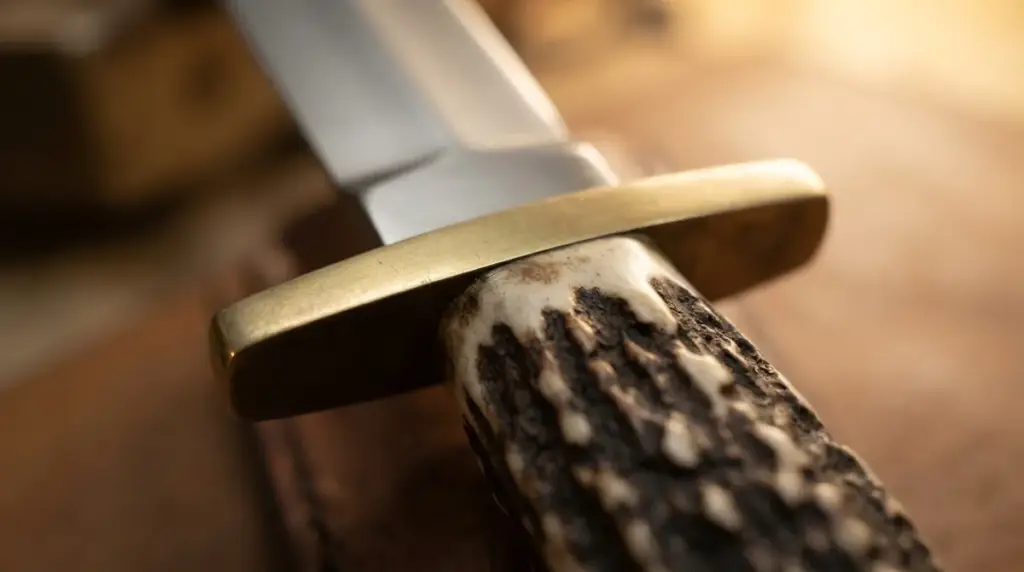
Most historic hunting daggers carry a guard, and the reason is the boar spear reason: an animal that is not dead does not stop. A modern decorative dagger frequently carries a guard because the pattern has one, which is a different reason with the same result.
A guard is genuinely useful on a double edged blade regardless of the history, because there is no safe way to choke up on a blade that is sharp on both sides. Without a guard, a wet hand slides forward onto two edges instead of one. If you are choosing between two daggers and only one has a guard, take the one with the guard.
Handle material follows the same logic as everywhere else in the catalogue. Our dagger listings that state a handle name rosewood four times, once with turquoise inlay, once with a D2 bolster, once with a steel bolster, and one names lamb horn with natural wood. Rosewood is dense, stable and grippy enough dry. None of the nine uses Micarta or G10, which is what you would specify if the knife were meant to be used hard in bad weather.
Sharpening and care of a double edge
Two edges means four bevels and roughly double the sharpening time. It also means you cannot rest the blade flat on anything, which rules out several convenient stropping positions and makes a guided system awkward unless it clamps the spine, and there is no spine.
The tip is the difficult part. A symmetrical spear point comes to a very fine apex, and the last half inch of both edges converges there. It is very easy to round the point off by dragging it round the stone at the end of a stroke, and once the symmetry is gone it is difficult to get back without removing a lot of steel.
Work slowly, keep the angle from the factory bevel, and count strokes on both sides so the edges stay even. Our sharpening guide covers the fundamentals and the fixed blade bevel page explains what grind you are actually working with.
One more thing worth saying: many decorative daggers arrive with an edge that is sharp enough to cut and not sharp enough to work. That is normal for the pattern and not a defect. If you want a working edge on a display blade, expect to put it there yourself.
Buy it as an object, not as a field knife
We sell nine of these and we would like to sell more of them. We are still going to tell you that if you are buying one knife for hunting, it should not be this one. A 4 inch drop point or a dedicated skinner will out perform a dagger at every job you will actually do between the shot and the truck, and will cost you less.
Buy a hunting dagger because the shape has four hundred years of history behind it, because a 352 layer blade looks extraordinary in the light, or because it is going on a wall next to something else worth looking at. Those are good reasons. Buy it as a general purpose hunting knife and you will be irritated the first time you use it.
If the pattern interests you but you want something that works, our Damascus hunting knife guide and best hunting knife page cover the single edged options in the same steels and the same price band.
Questions people ask
Is a hunting dagger good for field dressing
No. The second edge removes the spine you need to steer with, sits under your off hand, and the fine symmetrical point punctures hide and paunch. A drop point or a dedicated skinner does the job faster and more safely.
What is a Hirschfaenger
The German hunting dagger, literally deer catcher. Roughly 18 to 30 inches overall, developed from the longer medieval hunting sword, and used mainly in the hunts of the German nobility. It survives today largely as part of traditional hunting dress.
Why do hunting daggers have a crossguard
For the same reason a boar spear had lugs behind the head. The crosspiece limited how far the weapon penetrated and stopped a wounded animal working its way up towards the hunter. On a modern dagger it also stops a wet hand sliding forward onto two edges.
Are double edged knives illegal
In some states, in some circumstances. Michigan MCL 750.227(1) prohibits carrying concealed a double edged nonfolding stabbing instrument of any length, with an exception for a hunting knife adapted and carried as such. Massachusetts chapter 269 section 10(b) covers any knife having a double edged blade carried on the person or in a vehicle. Check your own state and city code.
What do your daggers cost
From $112 to $401 as of 30 August 2026, with a median of $245. That is well above our whole catalogue median of $155.
What blade length are your daggers
Between 4 and 8 inches on the eight listings that state one, with a median of 7 inches and an overall length median of 12 inches. One listing states neither.
What steel are they
Five are 1095 and 15N20 Damascus, two are D2 tool steel, one is hand forged high carbon and one is described simply as stainless steel. Eight of the nine will rust if neglected.
Can a dagger be used for camp chores
Badly. You cannot baton it, you cannot press on the spine because there is not one, and you cannot choke up on the blade. A cheap single edged fixed blade will do more camp work than an expensive dagger.
Is a dagger the same as a push dagger
No. A push dagger has the blade set at ninety degrees to a T shaped handle held in a closed fist. A hunting dagger has the blade in line with the handle like any ordinary knife. One of our nine dagger listings is actually a push dagger, filed in both categories.
How do I display a hunting dagger safely
Out of the sheath, on a stand or in a case, away from a bathroom or a kitchen and away from direct sun. Leather sheaths hold moisture against a carbon blade, which is the most common cause of the spotting we see on returned display pieces. There is more on this on our knife storage page.
More guides
Keep reading: knife against dagger, the skinning knife guide, the Damascus hunting knife guide, choosing the best hunting knife and Damascus knife care. The dagger category is here.
More from the workshop
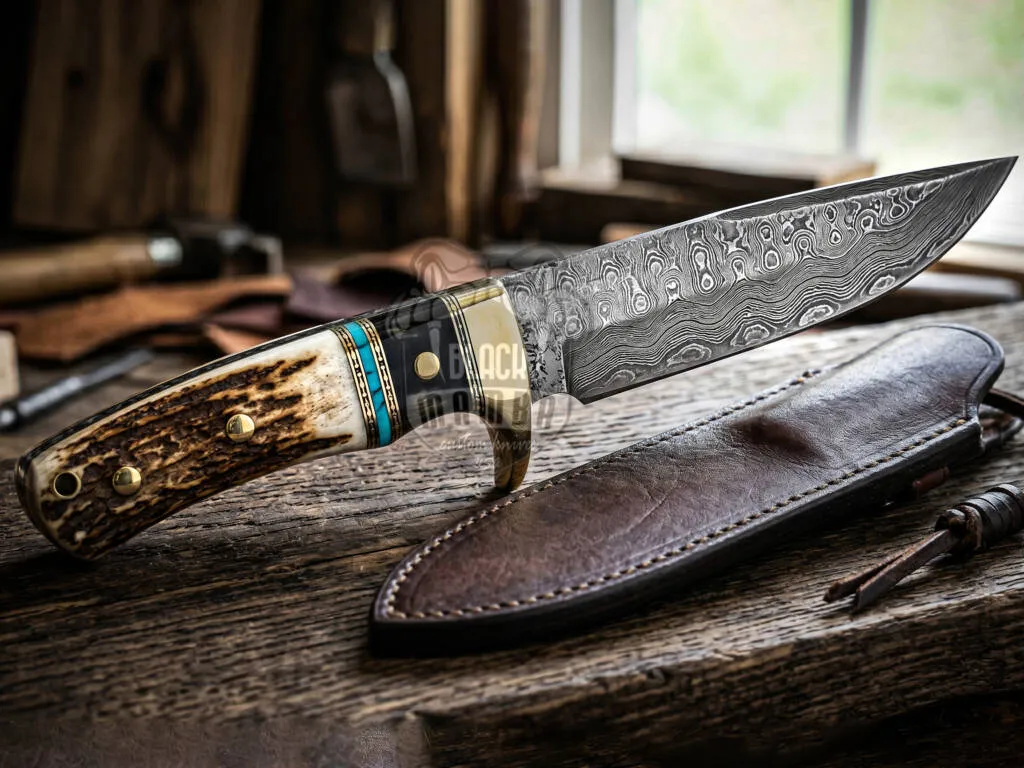
Knife Blade Shapes Explained
What each blade profile is actually built to do, and which one you want.
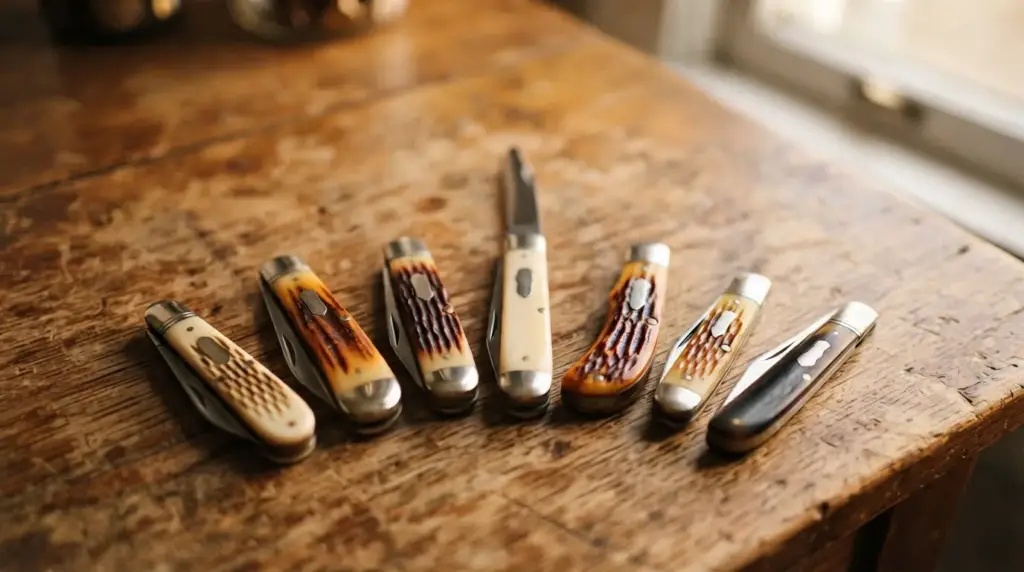
Trapper, Stockman and Barlow: Traditional Pocket Knife Patterns
Frame shapes, blade shapes and bolsters decoded, with the pattern numbering system and an honest note on what we do not make.
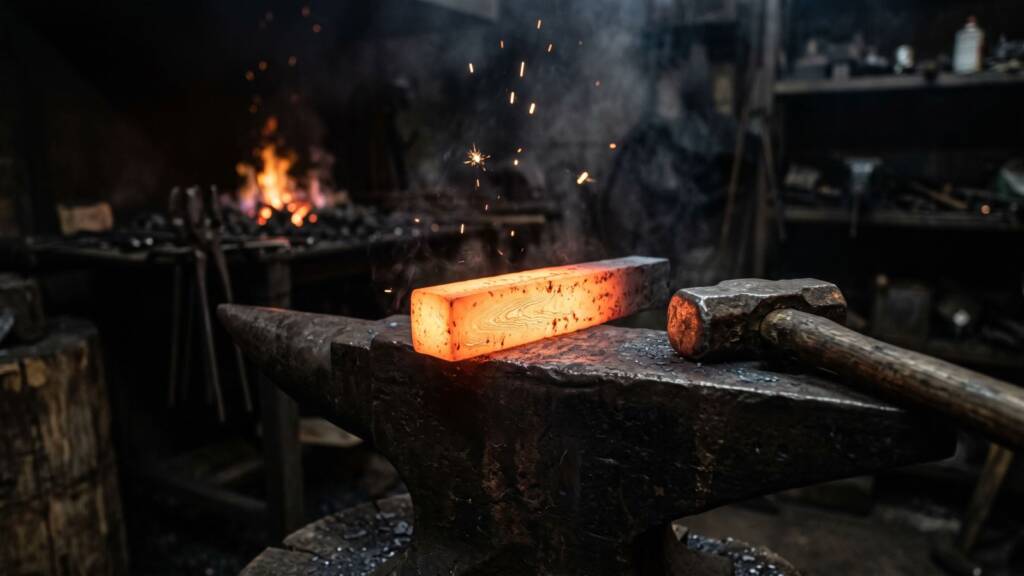
How Damascus Steel Knives Are Made
Billet to blade: forge welding, folding, pattern work, heat treat and the acid etch.
