
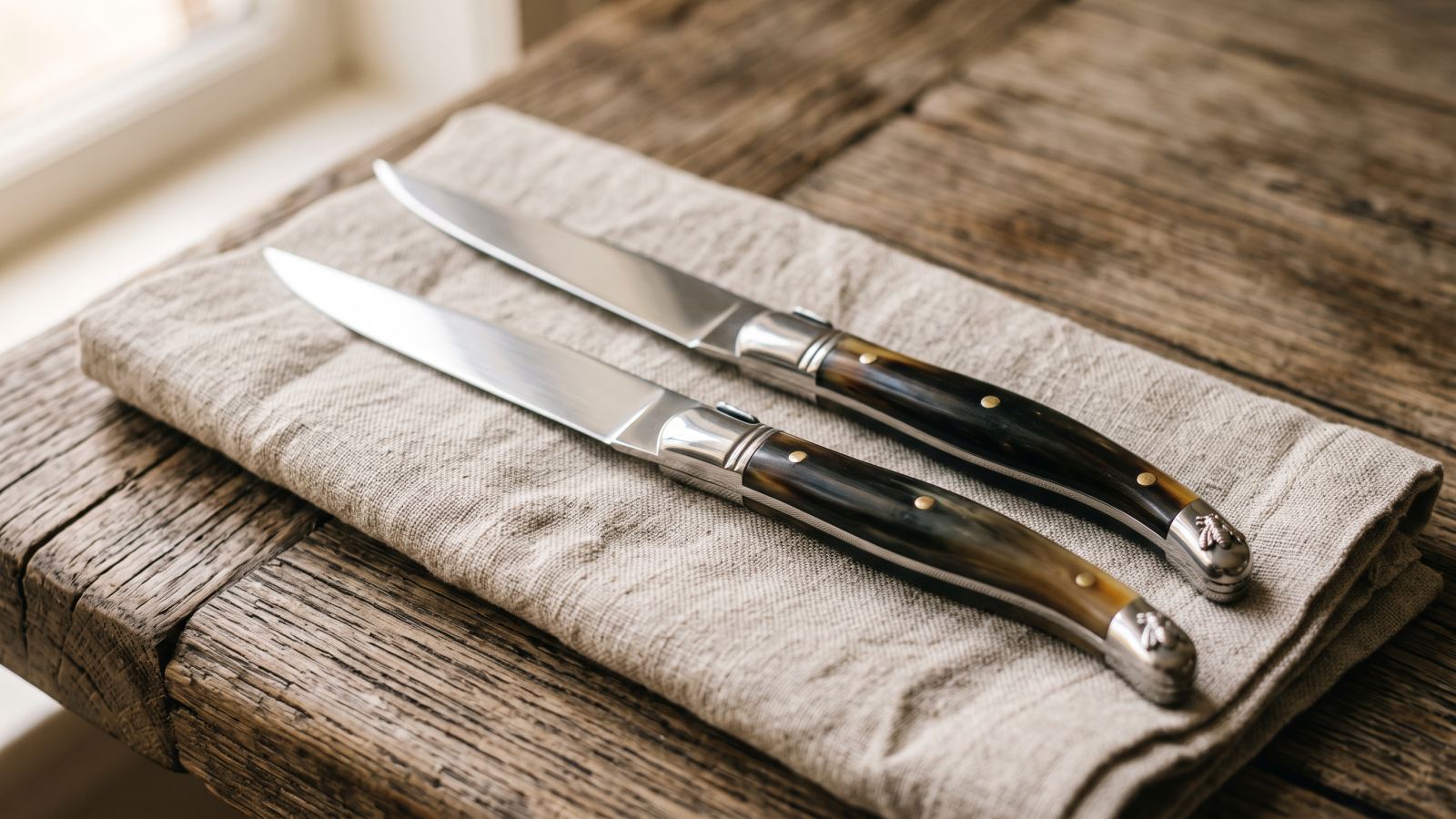
Short answer: Laguiole is a knife pattern from a village in Aveyron, France — not a brand and, for most of its modern history, not a protected origin either. French courts ruled the name generic in 2014, and until October 2024 anybody anywhere could stamp it on anything. That is why you can buy six "Laguiole" steak knives for ten dollars and also pay six hundred for six. Both are legally entitled to the word. The bee on the spine, the cross in the handle, and the price are what tell you which one you have.
Where the pattern comes from
The village of Laguiole sits in the Aubrac highlands of Aveyron, in the Massif Central. The knife pattern is traditionally dated to about 1829 and settled into the shape we recognise around 1860. It was a working tool for shepherds and cattle herders, and it picked up influence from the Spanish navaja by way of Aveyron labourers who took seasonal work in Catalonia and came home with ideas.
It grew features as its owners needed them. An awl was added around 1840, for the unglamorous job of relieving bloat in livestock. The corkscrew arrived by about 1880, when Aveyronnais who had moved to Paris were running a great many of the city's cafés and bars and needed one more than they needed an awl.
The part nobody tells you at the market stall
"Laguiole" is not a protected name in the sense that Champagne is. The cheese from the same region holds a protected designation. The knife, for a long time, did not.
The story is genuinely remarkable. In 1993 a man with no connection to the village registered "Laguiole" as a trademark, and by 2005 held European protection across dozens of unrelated product classes — clothing, furniture, toys. The commune of Laguiole sued and lost twice: a Paris court dismissed the case in 2012, and in 2014 the Court of Appeal held that "the Laguiole knife is a name for a knife that has entered common parlance". Generic. The village lost the right to its own name because too many people had used it for too long.
The pendulum came back. France's highest civil court reversed in 2016 on grounds of bad faith filing. In 2017 the European court confirmed that the village's leading maker could protect the name for knives and cutlery specifically. And in March 2019, on remand, the Paris Court of Appeal cancelled around twenty of the opportunistic trademarks outright, finding a deliberate strategy to deprive the municipality of the use of its own name.
Then came a geographical indication, and it went wrong before it went right. In September 2022 a "Couteau Laguiole" IG was granted to an association based in Thiers, roughly two hundred kilometres from Laguiole; a court annulled it in July 2024 on the reasonable grounds that Thiers is not Laguiole. In October 2024 a narrower "Couteau de Laguiole" indication was granted covering twenty-four communes of northern Aveyron only, and the first certifications were issued in April 2025.
So the state of play today: that certification is the only origin guarantee attached to the word. The word by itself still is not one.
How much is imported? Nobody will give you a number
You will see "90% are fake" repeated across the internet. We could not find an original source for it and we are not going to repeat it. What is on the record is more useful anyway.
The mayor of Laguiole has described counterfeits arriving in "quantities we are not even able to measure". And the genuine industry is small enough to put numbers on: the village's largest maker produces just over 100,000 knives a year, all the members of the French makers' association combined turn over about €15 million, and roughly 250 of Laguiole's 1,300 residents work in knifemaking.
A few hundred people making knives in one French valley, against imports arriving in uncountable volume. That is the shape of it without inventing a percentage.
The bee, the cross, and what they actually mean
| Feature | The story you are told | What is true |
|---|---|---|
| The bee (la mouche) | Napoleon granted the village the right to bear the imperial bee | Mouche means "fly", and technically it is the terminal end of the backspring, above the blade pivot. The decorative bee shape only appeared after the Second World War, over a century after Napoleon. Charming story, wrong century. |
| The shepherd's cross | A shepherd stuck the knife in the ground to make an altar for evening prayer | Six to eight pins inlaid in the handle. It does not appear on knives before about the 1950s and is decoration. Some premium models deliberately leave it out to avoid drilling into a fine handle material. |
| Guilloche on the spring | — | This one is real and useful. Hand chiselled filework on the spring is fine goldsmith-grade work, and the precision of the chasing is one of the more reliable indicators of a well made knife. |
The single most useful tell is forged bee versus applied bee. On a good knife the bee and the spring are forged from one piece of steel — no seam, no join. On a cheap one the bee is a separate part soldered to the end of the spring, and if you look closely at the underside you can see where they meet. That one detail separates two price brackets more reliably than anything else on the knife.
Handles, and why horn costs what it does
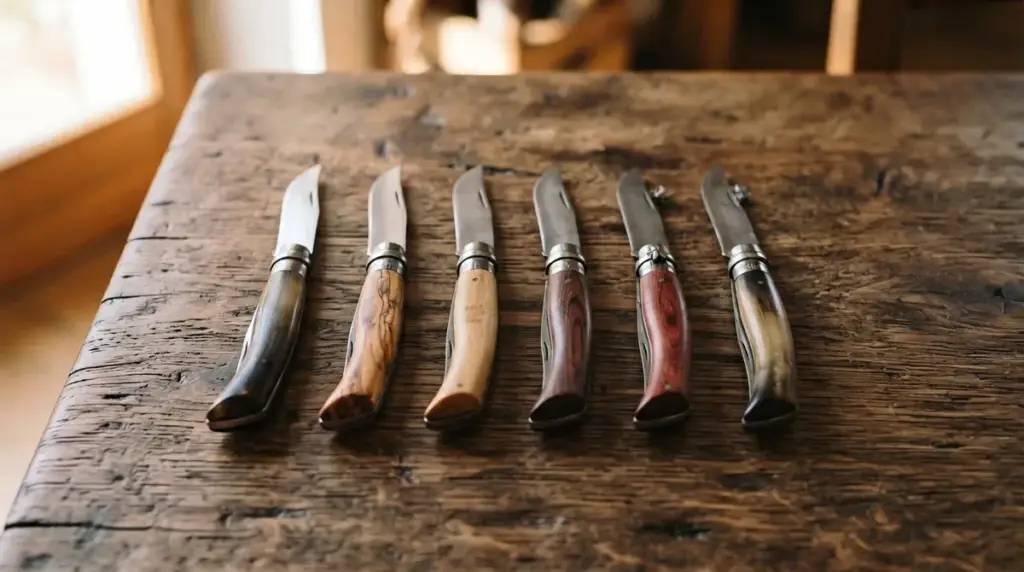
Traditional handles are cattle or buffalo horn, juniper, olive, boxwood, walnut, oak from wine barrels, and bone. Budget genuine models often use "stamina wood", real wood laminated with resin, which is a legitimate material honestly used. Plastic is not a traditional Laguiole handle material and its presence tells you something.
Horn has an economics problem worth understanding. Only the final four or five inches of a horn is solid; the rest is hollow and has to be heat pressed flat to be usable. Pressed horn slowly remembers what shape it used to be and warps over years. Solid horn tip is the dense part, it does not warp, and a single horn yields about two knives' worth. That is why "solid horn tip" costs several times "horn".
Telling a French one from an import
| Check | French made | Import |
|---|---|---|
| The bee | Forged in one piece with the spring | Soldered on, visible seam |
| Blade | Forged; steel named, commonly Sandvik 12C27 or 14C28 stainless, or T12 carbon | Stamped from sheet; steel unnamed or "stainless steel" |
| Edge | Plain | Often serrated, which is not a traditional Laguiole feature |
| Marking | Maker's mark on the blade and country of origin on the knife | No maker's mark at all |
| Fit | Blade perpendicular when open, closes smoothly without knocking, no gaps at the bolsters | Side play, gaps, blade rubs the spring |
| Price, set of six | Over €100, up to €1,000 for artisan work | Under €10 for six is a real and common price |
The French makers worth knowing by name are Forge de Laguiole, Coutellerie Honoré Durand, Laguiole Tradition, Laguiole Créations and Benoît l'Artisan, all of which hold the 2025 geographical indication certification. Laguiole en Aubrac and Fontenille Pataud are respected French makers too, though their workshops are not in the village itself — say "French made" rather than "made in Laguiole" and you will be right. Château Laguiole is the sommelier corkscrew brand.
One nuance that catches people out: a knife can be French assembled from parts made elsewhere. If it matters to you, ask specifically about the blade.
The one care rule
Never put them in the dishwasher. Not the wooden handled ones, not the horn handled ones, not the ones you were told were fine. The makers' own product pages say hand wash only and that dishwashing voids the warranty, and the reason is the handle rather than the blade. Heat and prolonged wet make horn revert toward its original curl and make wood swell against steel bolsters it is pinned to. The blade will survive the dishwasher. The handle is what you are protecting.
Wash by hand, do not leave them soaking, dry them straight away. Blades in Sandvik stainless want nothing else. Carbon steel blades stamped T12 will develop a patina, which is normal and protective — our carbon steel care notes apply directly. Only ABS plastic handled versions are genuinely dishwasher safe, and if you own those you probably were not worried.
What we make, since you will ask
Our Laguiole pattern knives are hand forged in Memphis, Tennessee. They are American made knives in a French pattern, and we would rather say that plainly than let the name imply something it should not. If you want a knife from the village in Aveyron, buy one from a maker holding the geographical indication — that is a real thing and it is worth paying for. If you want the pattern, forged by hand, with a named steel and a maker who will answer questions about it, that is what we do. The same knives appear in our steak knife collection, which is where most of them end up.
Questions people ask
What is a Laguiole knife?
A traditional French knife pattern from the village of Laguiole in Aveyron, dating to around 1829: a slim, gently curved handle, a pointed blade, a decorated backspring ending in a bee, and often a cross of pins set into the handle. It exists as a folding pocket knife, a sommelier corkscrew and, most commonly today, a steak knife.
Are Laguiole knives made in France?
Some are. Many are not. The name was ruled generic by a French court in 2014, so it can legally be used by anyone anywhere. Since October 2024 a "Couteau de Laguiole" geographical indication covers twenty-four communes in northern Aveyron, and the first certifications were issued in April 2025. That certification, not the word alone, is the origin guarantee.
What does the bee on a Laguiole knife mean?
Structurally it is the end of the backspring, and its name in French means "fly", not "bee". The bee shape is decorative and only appeared after the Second World War. The Napoleon story is legend. What matters is whether it is forged as one piece with the spring or soldered on afterwards.
How can you tell if a Laguiole knife is real?
There is no "real" in the trademark sense, only well made and badly made. Look for a forged rather than soldered bee, a named steel, a maker's mark, a plain rather than serrated edge, and a blade that sits perpendicular when open and closes without knocking. And look at the price: six knives for ten dollars cannot contain the labour.
Why are some Laguiole knives so expensive?
Hand forging, hand fitting, hand chiselled guilloche on the spring, and a single cutler assembling each knife from start to finish. Add solid horn tip or a fine wood handle and the material itself becomes expensive. A French set of six routinely runs past €100 and artisan pieces reach €1,000.
Can Laguiole knives go in the dishwasher?
No, unless they have ABS plastic handles. The makers state hand wash only and that dishwashing voids the warranty. Heat and moisture warp horn and swell wood against the pinned bolsters. Wash by hand and dry immediately.
What steel are Laguiole knives made from?
French makers commonly use Sandvik 12C27 or 14C28 stainless, and the village's largest maker uses a T12 carbon steel stamped on the blade heel. Imports frequently do not name a steel at all, which is itself the answer.
Are Laguiole knives good for steak?
Very. The pattern is slim, sharp and light, and a plain edge cuts meat cleanly instead of tearing it the way a serrated blade does. Steak is the main use they have today. Just do not put them in the dishwasher afterwards.
More reading. What is actually made in the USA, hand forged versus factory, and carbon versus stainless in the kitchen.
More from the workshop
Butchering at Home: The Four Knives That Do the Work
Four knives, the order of work after the animal is home, and the two we do not sell.
1095 or D2: Two Steels We Actually Sell
The pairwise comparison the steel charts skip, from a catalogue holding 111 D2 knives and 320 Damascus.
KA-BAR Knife Guide: History, Markings and Value
The 1219C2 pattern explained: wartime makers, dating by markings, real values and what the Corps issues now.
