
Short answer: two steels that react differently to acid are stacked into a billet, heated to welding temperature, forge welded into one solid bar, then cut, restacked and welded again — each cycle doubling the layer count. The bar is drawn out, shaped into a blade, hardened and tempered, and finally etched in acid so the two steels darken at different rates and the pattern appears. Everything else — ladder, raindrop, twist, feather — is a deliberate distortion of those layers before the blade is ground.
Step one: the billet
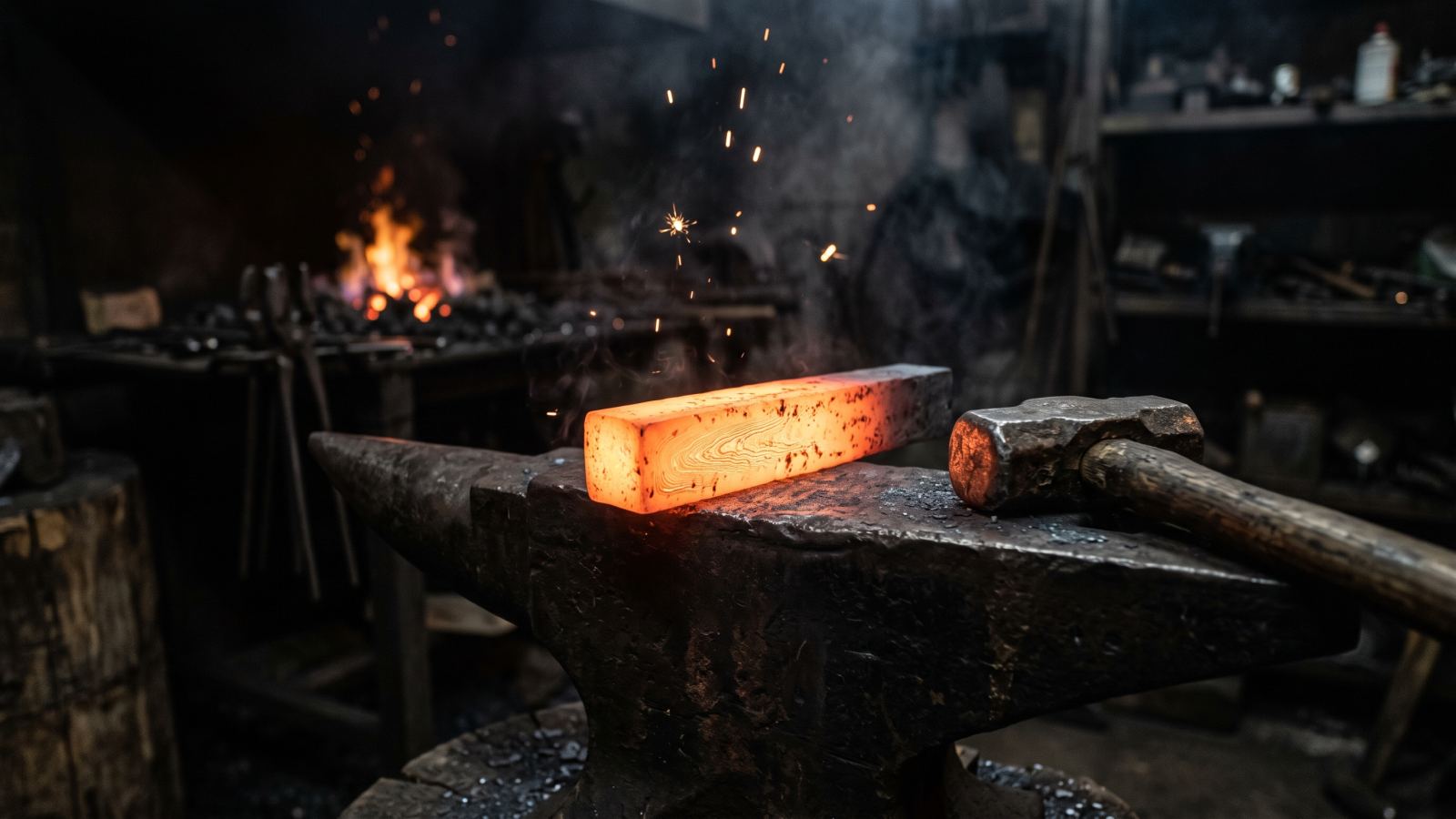
You need two steels that behave the same in the forge and differently in the acid. The standard American pairing is 1095 and 15N20. Both are simple high carbon steels that weld and harden at similar temperatures, so they can be worked as one piece. The difference is that 15N20 carries roughly two per cent nickel, and nickel resists ferric chloride. When the finished blade goes in the acid, the 1095 layers darken and the 15N20 layers stay bright. That contrast is the pattern.
| Pairing | Why it is used |
|---|---|
| 1095 + 15N20 | The default. Maximum carbon in the dark layers, strong nickel contrast in the bright ones. |
| 1084 + 15N20 | 1084 is near eutectoid and very forgiving to heat treat. Common with makers who quench by eye. |
| 5160 + 15N20 | Tougher, springier billet. Favoured for big choppers and swords. |
| O1 + L6 | Older tool steel combination, fine grain, subtler contrast. |
| Stainless pairings — AEB-L, 440C, 154-CM with 302 or 316 | Stainless Damascus. Much harder to weld because chromium oxide forms instantly in open air, so the billet is sealed in a canister or welded under vacuum. Expensive, and the reason genuine stainless Damascus costs what it does. |
| 416 and other stainless in billet form | Turns up in mosaic and canister work as a filler or contrast layer rather than as a cutting steel. |
The bars are cut to length, cleaned back to bright metal, stacked alternately and tack welded at one end so the stack cannot shift. That stack is the billet. A typical starting billet might be fifteen to twenty layers.
Step two: the forge weld
This is where Damascus is won or lost. The billet is brought up to roughly 2,300°F — a yellow-white heat, well above the temperature you would ever forge at normally — and borax flux is sprinkled on so it melts and flows into the seams. The flux does one job: it keeps oxygen away from the mating faces. Steel that oxidises will not weld to itself.
At welding heat the billet comes out and takes a series of light, fast blows, starting at one end and working along. Light, because a heavy first blow squirts the flux out and shears the layers apart instead of setting them. Once the layers have taken, the billet goes back in and is drawn out under heavier work.
The two ways this fails are worth knowing because you can see them in a finished blade:
- Cold shut — a seam that never welded, showing as a dark line running with the layers. It may only reveal itself when the blade is ground or, worse, when it is used.
- Delamination — layers separating under stress. The same fault, discovered later.
A clean etch that shows continuous, unbroken layers around the whole blade is the visual evidence that the welds took. It is the main reason people who know Damascus stare at the plunge line and the spine rather than at the pretty part.
Step three: doubling
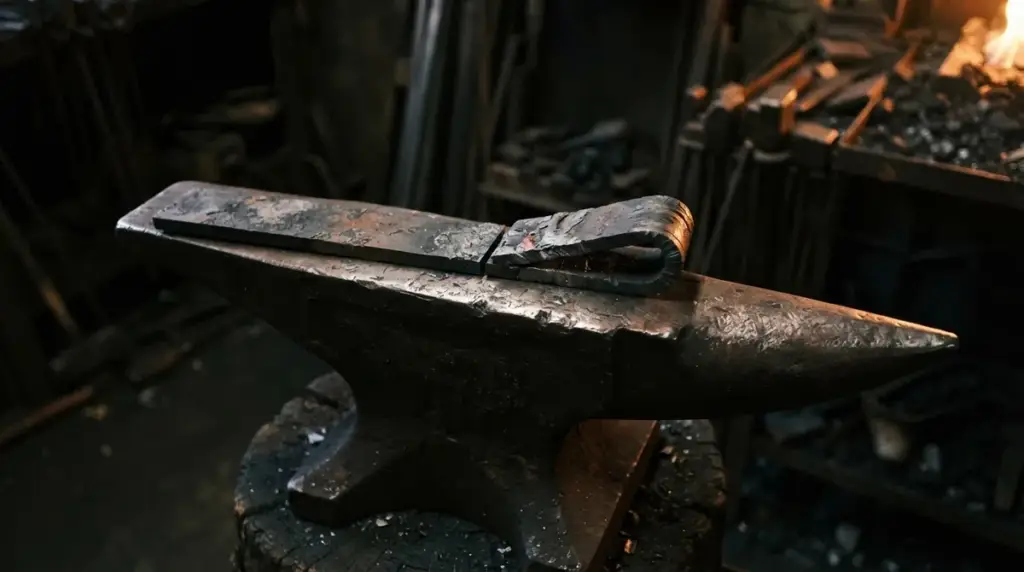
The welded bar is drawn out to twice its length, cut in half or folded back on itself, cleaned, fluxed and welded again. Every cycle doubles the layers.
| Start | After 1 fold | 2 | 3 | 4 | 5 |
|---|---|---|---|---|---|
| 15 layers | 30 | 60 | 120 | 240 | 480 |
This is arithmetic, not craftsmanship, which is why layer count is a poor quality measure. A clean 120 layer billet beats a badly welded 500 layer one every time, and past a certain point the layers become thinner than the eye can resolve and the pattern loses contrast rather than gaining it. We went through the numbers properly in what 352 layers actually means.
Worth clearing up while we are here: this folding is not the same thing as the folding in a traditional Japanese blade. There, one steel is folded to drive out slag and even out carbon — cleanup. Here, two dissimilar steels are folded to create contrast — decoration. Same verb, opposite intent.
Step four: making the pattern
Straight layers give a plain, wood-grain look. Everything more interesting comes from deliberately distorting them before the blade is ground, then grinding through the distortion so the layers surface at an angle.
| Pattern | How it is made |
|---|---|
| Ladder | Grooves pressed or ground across the bar at intervals, then the bar is forged flat again. The layers bow around each groove. |
| Raindrop | Same idea with round dimples drilled or punched instead of grooves. Flattening turns each dimple into a set of concentric rings. |
| Twist | The bar is heated and twisted along its length, then flattened. The layers spiral. |
| Feather | A twisted bar is split lengthwise, opened out like a book and welded flat. The mirrored halves make the quill and vanes. It is the most difficult of the common patterns and the highest failure rate. |
| Mosaic / canister | Shapes, rods or powdered steel are arranged inside a sealed steel canister and welded into a solid block, then sliced. This is how you get letters, stars and repeating figures. |
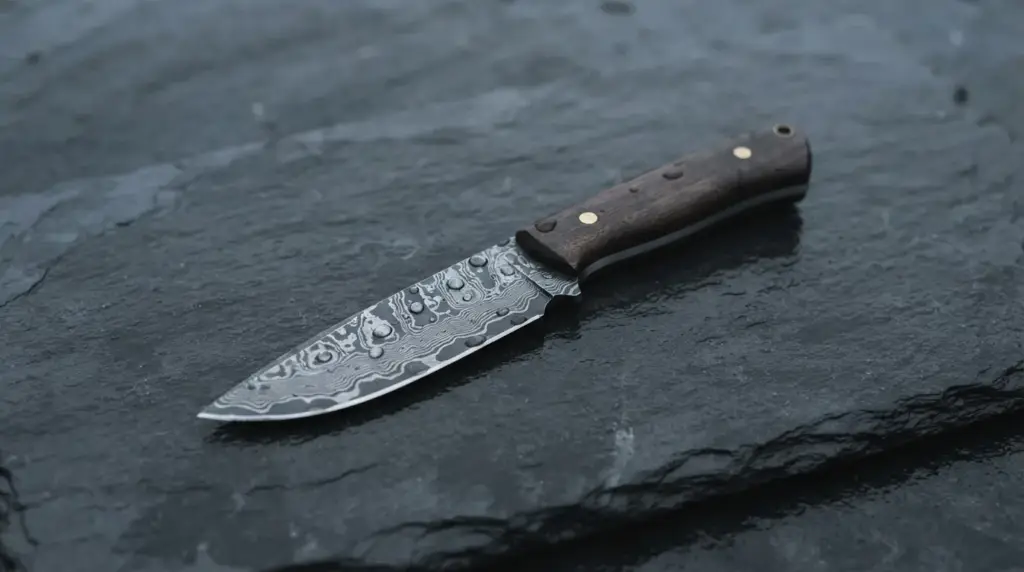
All of it is done before the knife exists. By the time a blade is being ground, the pattern is already inside the steel, and the grinding is what exposes it. That is also why a real pattern reappears when you sharpen the blade and a printed one does not — see real versus fake Damascus. Our patterns guide shows what each one looks like finished.
Step five: the blade
The patterned bar is forged or ground to shape, then goes through the same heat treatment any carbon steel knife needs, and this is the part that decides whether it is a knife or an ornament.
- Normalising. Two or three cycles of heating to critical temperature and air cooling, to refine the grain that all that forging coarsened.
- Hardening. Heat to critical — around 1,475°F for a 1095 billet — hold briefly, then quench in oil. The steel converts to martensite: very hard, very brittle.
- Tempering. Two cycles at around 400°F to trade a little hardness for toughness. This is what lands a blade at 58 to 60 HRC instead of leaving it at glass-hard 65 where it would chip on a chicken bone.
Heat treatment is the single largest determinant of how a knife performs, and it is invisible. You cannot see it in a photograph and you cannot feel it in your hand in a shop. It is why "who did the heat treat" is the question that separates makers, and why a maker who will not answer it has told you something.
Step six: the etch
The blade is finished to its final grit, degreased completely — a fingerprint will show in the etch — and lowered into diluted ferric chloride. Ten to thirty minutes depending on concentration and how deep a relief is wanted. The 1095 corrodes faster and goes dark; the nickel-bearing 15N20 barely reacts and stays bright.
Then it is neutralised, usually in a baking soda solution, because acid left in the surface will keep working. It is rinsed, dried, and oiled. Some makers hand rub the high layers back afterwards to raise contrast further.
Two consequences for the owner. First, the surface you are looking at is a controlled corrosion, which is why a Damascus blade wants oil and a dry place — our Damascus care guide covers the routine. Second, an etch is a finish and it will change over years of use, developing a patina over the dark layers. That is normal and, on a working knife, rather good looking.
How long all this takes
A plain layered billet, welded and folded four or five times, is a morning's work for someone who does it every day. A feather pattern billet is a day, with a real chance of ending in a scrap bin. A mosaic canister billet is several days and a significant material cost before anyone knows whether it worked.
Then the blade itself: shaping, grinding, three heat treatment stages, finishing to a high grit, etching, handle fitting, sharpening. That is the honest explanation of Damascus pricing. Not the steel, which is cheap. The hours, and the failures that get paid for by the successes.
We forge our own billets in Memphis rather than buying pattern-welded sheet, which is why our hand forged knives carry patterns you will not find on somebody else's catalogue, and why we can tell you the two steels and the hardness on any of them.
Questions people ask
How are Damascus knives made?
Two steels with different chemistry are stacked into a billet, forge welded at around 2,300°F, then repeatedly drawn out, folded and re-welded to multiply the layers. The bar is patterned, ground to a blade, hardened and tempered, and finally etched in acid so the two steels darken at different rates and the pattern appears.
What two steels are used to make Damascus?
The most common pairing is 1095 and 15N20. The 15N20 contains about two per cent nickel, which resists the acid etch and stays bright while the 1095 goes dark. Other pairings include 1084 with 15N20, 5160 with 15N20, and stainless combinations such as AEB-L or 440C with a nickel bearing stainless.
How do you make Damascus steel?
Clean and stack alternating bars of two compatible steels, tack them into a billet, bring the billet to welding heat with borax flux to keep oxygen out, and set the welds with light hammer blows before drawing it out. Cut, restack and repeat to double the layers each time. Then pattern, shape, heat treat and etch.
What temperature does forge welding need?
Around 2,300°F, which is a yellow-white heat and considerably hotter than normal forging temperature. Below that the layers will not fuse; much above it the steel begins to burn and is ruined.
What is borax used for in Damascus?
It is flux. Melted borax flows into the seams between layers and keeps oxygen away from the mating faces. Oxidised steel will not weld to itself, so without flux the billet simply comes apart.
What is a Damascus billet?
The stack of alternating steel bars before and during welding, and the solid patterned bar it becomes. Blades are cut or forged from the finished billet. A mosaic billet is one built inside a sealed canister so that shapes or figures repeat through the block.
How many times is Damascus folded?
Usually four to seven times, which takes a fifteen layer starting billet to somewhere between 240 and 1,920 layers. Beyond that the layers become too fine to see and the pattern loses contrast. Layer count describes the process, not the quality.
Is Damascus steel stronger than regular steel?
No. A Damascus blade is only as good as the steels in it and the heat treatment given to it, and a well made monosteel knife of the same hardness performs the same or better. What pattern welding proves is that the blade was made by hand, because you cannot stamp a forge weld out of a sheet.
Can you make Damascus with stainless steel?
Yes, but it is much harder. Chromium oxidises instantly in open air and blocks the weld, so stainless billets have to be sealed in a canister or welded under vacuum. That equipment cost is why genuine stainless Damascus is expensive and why most of what is sold as stainless Damascus is not.
Why does Damascus steel need to be etched?
Because before the acid the blade is a uniform grey. The etch corrodes one steel faster than the other, and that difference is the visible pattern. It is a controlled corrosion, which is part of why a Damascus blade wants oil and dry storage.
More reading. Damascus layers explained, hand forged versus factory, and are Damascus knives worth it, and what is actually made in the USA.
More from the workshop
How to Sharpen a Knife on a Whetstone
Angle, burr and strop: the three things that decide whether a knife gets sharp.
Do Damascus Knives Rust?
Damascus is carbon steel and it rusts. Why the nickel does not help, what causes it, and how to stop it.
Valuing an Old Pocket Knife: Marks, Condition and Reality
Tang stamps, dot dating, the collector grading scale, and why cleaning it costs you money.
