Short answer. Value an old pocket knife in this order: read the tang stamp to identify the maker and narrow the date, identify the pattern and frame size, then grade the condition honestly against a collector scale. Condition does most of the work, and the single most important thing to understand is that originality outranks appearance. A dull, dirty, unsharpened knife with a crisp stamp is worth more than the same knife cleaned up and put on a stone. Most old pocket knives are worth modest money. A few are worth a great deal, and the difference is almost always the stamp plus the condition, not how nice it looks in your hand.
Start with the tang stamp
The tang is the part of the blade that disappears into the handle when the knife is closed. Open the main blade and look at the flat area just in front of the pivot. Almost every commercial pocket knife made in the last hundred and fifty years carries a maker mark there, and often a place of manufacture and a pattern number.
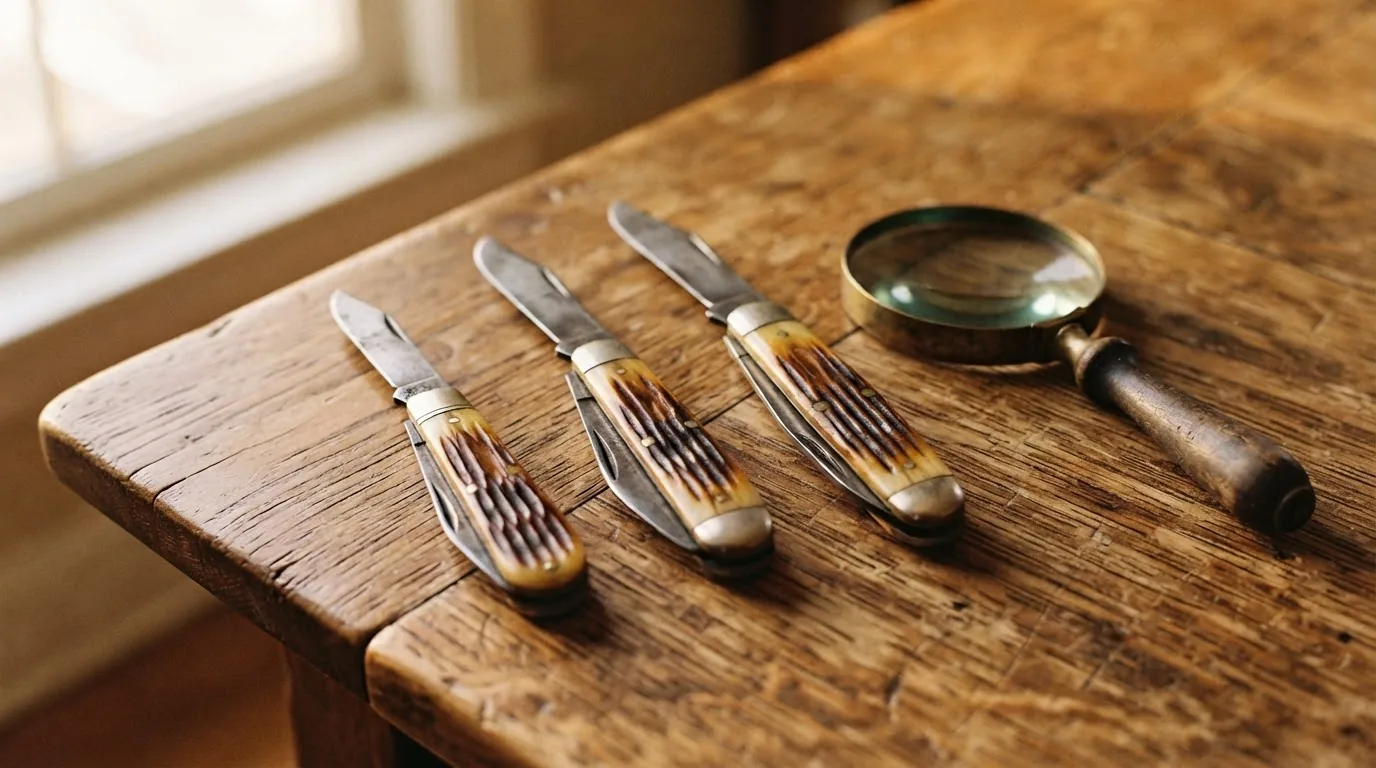
Read it under magnification and good raking light. Stamps wear, and a mark that is illegible to the naked eye is often perfectly readable at ten times with the light coming across it rather than straight down.
What you are trying to establish, in order: who made it, roughly when, and whether the stamp matches the knife. A wrong stamp for the frame, or a stamp that looks pressed into a re handled knife, is the commonest sign of a married piece assembled from parts.
Do not clean the tang. Do not wire brush it, do not run it on a buffing wheel, and do not touch it with abrasive paper. The stamp is the single most valuable feature on the knife and it is a few thousandths of an inch deep. Polishing it is the fastest way to turn a hundred dollar knife into a twenty dollar one.
Dating a Case by the dots
W. R. Case and Sons run the best documented dating system in American cutlery, and because Case knives are so common in old collections it is worth knowing in full. Case publish this themselves in their knowledge base, and the outline runs as follows.
 Magnum 4.75 Inches Damascus Laguiole Knife Handmade Damascus Pocket Knives French Knife Steak Knife USA Made | BMK-501
 Tri Fold Pocket Knife | Super Steel 3 Blades Knife Black Mamba Knife Hunting Knife Steak Knife Multi Purpose | BMK-003
 Penta Fold Pocket Knife | Super Steel 5 Blades Color Camel Bone Knife Black Mamba Knife Hunting Knife Steak Knife Multi Purpose USA Made Gift | BMK-007
| Period | Stamp | How the year is read |
|---|---|---|
| 1970 to 1979 | Round C | Ten dots in 1970, one dot removed each year, one dot left in 1979 |
| 1980 to 1989 | Square C with a lightning bolt S | Dots flanking the lightning bolt S, often in a triangular arrangement |
| 1990 to 1993 | Year stamped directly | No dots, the actual year appears on the tang |
| 1993 to 1999 | Long tail C | Dot dating resumes |
| 2000 to 2009 | Long tail C with a hooked tail | Xs and dots, dots removed 2001 to 2005, then Xs removed 2006 to 2009 |
| 2010 to 2019 | Xs and dots | One dot removed each year 2011 to 2015, then one X each year 2016 to 2019 |
| 2020 to 2029 | Ten dot system | Back to ten dots, one removed per year |
Two cautions. First, the dots tell you the year the blade was stamped, which is not always the year the knife was assembled or sold. Second, this system only applies to Case. Applying dot logic to a Schrade or a Camillus will get you nowhere.
Other makers worth recognising
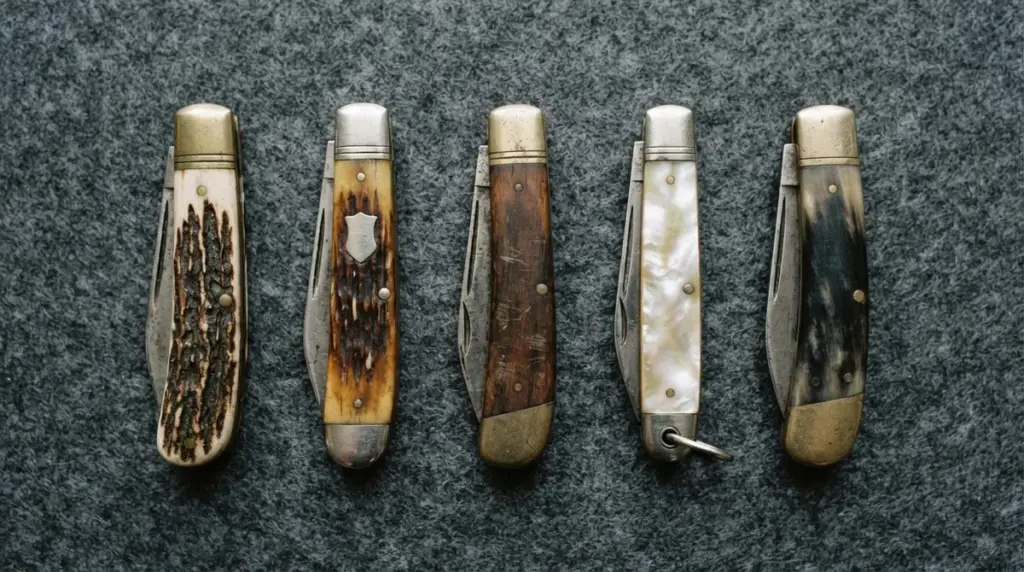
You do not need to memorise every cutlery firm, but a handful come up constantly in American and European drawers.
W. R. Case and Sons, marked Case XX, with the dating above. Buck Knives, with the anvil logo, best known for the 110 folding hunter. Schrade and Imperial Schrade, American, high volume, and a very large share of what turns up in general collections. Camillus, marked Camillus New York, which also made large numbers of military contract knives. Victorinox, the shield and cross, Swiss. Opinel, French, with the rotating locking collar. Puma, marked Puma Solingen, German.
Two things drive value up sharply within these names: contract and commemorative runs with documented low production, and knives that can be tied to a specific date range by a stamp variation that only existed for a year or two. Two things drive value down: a name that was used by more than one company at different times, and a mark that was licensed to an importer.
Identify the pattern and the frame
Pattern names are the vocabulary of the trade and they are how sold listings are indexed. A trapper is two blades, clip and spey, on a long frame. A stockman is three blades, clip, sheepsfoot and spey, on a serpentine frame. A barlow has a long bolster and usually two blades. A jack is a general term for a knife with blades at one end only. A sowbelly, a canoe, a peanut and a congress are all distinct frames with distinct followings.
Get the pattern right before you search for prices, because a trapper and a stockman of the same age and maker can differ in value by a large multiple. If you are unsure what the parts are called, our knife anatomy guide names them, and our page on multi blade pocket knives covers how the blade combinations were meant to be used.
Measure the closed length in inches and note the handle material: jigged bone, stag, mother of pearl, celluloid, delrin, wood or micarta. Handle material moves price more than almost anything except condition. Pearl and stag command real premiums. Celluloid is a warning sign, because it degasses as it ages and can corrode the blades and springs from the inside out.
Condition grading, and the scale collectors use
Collectors grade against a published scale rather than by adjectives. The National Knife Collectors Association scale is the one most widely quoted in the American market, and it is worth reproducing because it is far more specific than the language used in most listings.
| Grade | Definition as published |
|---|---|
| Mint | Factory fresh, absolutely original as it came from the manufacturer, not carried and not sharpened |
| Near mint | Slight carry or shop wear, blades snap perfectly, handles show no cracks |
| Excellent | No more than 10 percent blade wear, handles sound with no cracks, blades snap well |
| Very good | About 25 percent blade wear, slight handle cracks, possibly one lazy blade, stamping clearly visible to the naked eye, nothing changed or repaired |
| Fair | 50 percent blade wear, lazy blades, cracks and chips in the handle, handles replaced with the same type, blades repaired, stamping faint but readable with a glass |
| Poor | Blades very worn, handles bad or missing, blades replaced, stamp almost impossible to read even with a glass |
Note what the scale actually measures. Blade wear, handle integrity, blade snap, stamp legibility and originality. It does not measure shine, and it does not reward a knife that has been cleaned up. A repaired or replaced blade drops a knife to fair or below no matter how good it looks.
Why sharpening and cleaning make it worth less
This is the finding that surprises almost every owner, and it is the reason most valuation pages are useless: they tell you to clean the knife before photographing it.
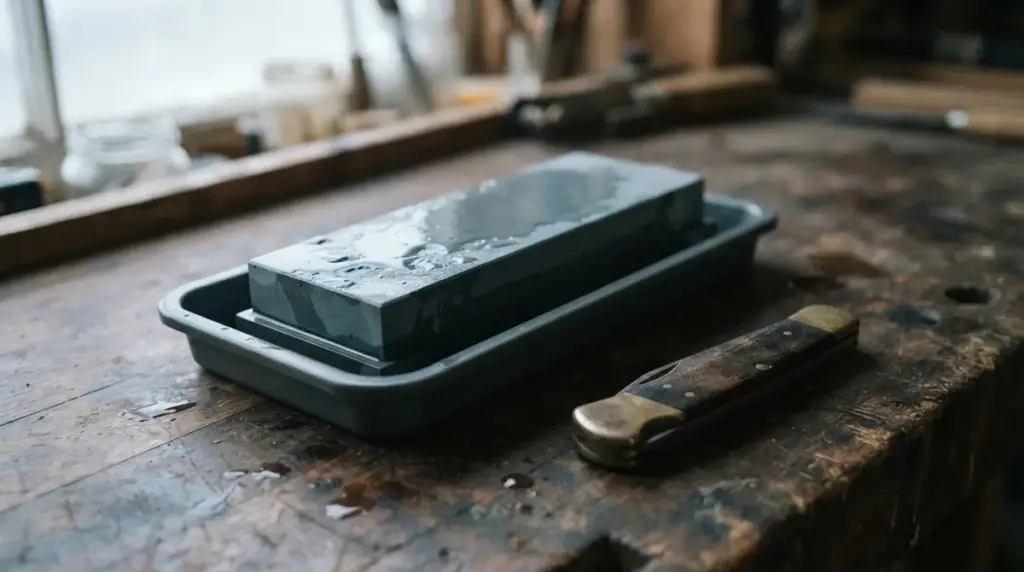
Value in a collectable pocket knife is a function of how much of the original factory object survives. Every pass on a stone removes steel that the factory put there and can never be put back. A knife described as unsharpened is a knife whose blades still carry the factory grind, the factory edge bevel and the factory blade height. That is measurable, and it is the difference between the top two grades and the rest.
Cleaning does the same damage faster. Buffing removes the patina, which is a protective oxide layer that took decades to form, and it rounds off the crisp edges of the tang stamp. Wire brushing scratches the blade and the bolsters. Aggressive solvent cleaning attacks old celluloid and dries out bone. A knife that has been polished to look new reads to an experienced buyer as a knife that has had value deliberately removed from it.
What you may do safely: wipe it with a dry cloth, work a drop of light oil into the joints, and photograph it exactly as it is. Nothing more. Our pocket knife cleaning guide is written for users rather than collectors, and if you are holding something old, the collector rule overrides everything in it.
How to measure blade wear
Blade wear is the single number the grading scale leans on hardest, and most people estimate it badly.
Close the knife and look at the blade from the side. Compare the height of the blade, meaning the distance from edge to spine, against an example of the same pattern that has not been sharpened. On a well used knife the edge has migrated up towards the spine and the blade has become narrower and often more pointed in profile. Ten percent of that height is a small but visible amount. Twenty five percent changes the silhouette of the blade obviously.
Also check for a lazy blade, meaning one that does not snap open or shut under spring pressure. Check for blade wobble side to side when open. Check the half stop if the pattern has one. Check whether all blades sit centred in the well when closed, and whether any blade rubs another. Each of these moves a knife down a grade.
What actually drives the price
Ranked roughly by how much they move the number.
Condition and originality. The gap between mint and very good on the same knife is routinely a multiple, not a percentage.
Maker and stamp variation. Short lived stamp variations, pre war marks and documented contract runs are where the money is.
Rarity of pattern and handle material. Pearl, genuine stag and unusual frames carry premiums. Delrin does not.
Completeness. Original box, papers, and the original sheath if it had one. On commemoratives this can be a large share of the value.
Provenance. Only when it is documented. An unsupported family story adds nothing.
Appearance. Last, and only within a grade.
Where to check real sold prices
Asking prices are fiction. Use completed and sold listings only.
Search eBay with the sold items filter and match on maker, pattern number, stamp era and grade, not on the photograph. Cross check against dedicated collector marketplaces and club forums, where descriptions are usually far more disciplined about grading. Auction house archives are useful for the upper end. For anything you believe is genuinely rare, a paid appraisal from a cutlery specialist costs less than the mistake of selling it wrong.
We are not going to publish a table of typical values by maker, because we do not hold verified sold data and inventing one would be worse than saying nothing. Any figure you see on a page like this that is not sourced to actual completed sales should be treated as unverified.
A reality check, and what a new knife costs for contrast
Most old pocket knives that come out of a drawer are common patterns from high volume makers in used condition with sharpened blades. In collector terms that is very good at best and usually fair. They are worth keeping and carrying. They are usually not worth a great deal of money, and the honest advice is to enjoy the knife rather than to plan around the number.
For contrast, here is what new hand work costs, using our own live catalogue on 30 August 2026. This is a comparison, not a claim that a new knife is a better investment. It is not. A new knife loses value the moment it is carried, exactly like the old one did.
| Measure | All 609 BMK products | 111 folding pocket knives |
|---|---|---|
| Lowest price | $55 | $70 |
| Lower quartile | $114 | $101 |
| Median | $155 | $128 |
| Upper quartile | $254 | $263 |
| Highest price | $1,631 | $845 |
The inconvenient part for us: if what you actually want is the object your grandfather carried, nothing we make replaces it, and a competent restoration of the joints and a light oiling will serve you better than a purchase. We sell new knives. We are not going to pretend a new one carries the same meaning.
When to leave it alone entirely
Leave it alone if the stamp is crisp and the blades are unsharpened, because you are holding the top of the grading scale and any intervention moves you down it. Leave it alone if the handles are celluloid and showing crazing or a vinegary smell, because that knife needs to be isolated from your other knives rather than worked on. Leave it alone if you are about to sell it and you are tempted to make it look better first.
Intervene only for stabilisation: dry it, oil the pivots lightly, store it out of a sealed plastic bag so it can breathe, and keep it away from leather sheaths, which hold moisture and tanning acids. Our knife storage guide covers the environment side of that.
Questions people ask
How do I find out what my old pocket knife is worth?
Identify the maker from the tang stamp, date it as narrowly as the stamp allows, identify the pattern and frame, grade the condition against a published scale, then search sold listings for that exact combination. All four steps matter. A price found without a grade is meaningless.
Does sharpening an old pocket knife reduce its value?
Yes, substantially. Collector grades are built on originality, and an unsharpened blade still carries the factory grind and full blade height. Once you sharpen it you can never get back into the top grades. If there is any chance the knife is collectable, do not put it on a stone.
Should I clean an old knife before selling it?
No, beyond a dry wipe and a drop of oil in the joints. Buffing rounds the tang stamp, removes decades of patina and reads to experienced buyers as deliberate value removal. Photograph it as it is.
How do I date a Case knife?
By the dots and the shape of the C in the stamp. Ten dots in 1970 with one removed each year through the decade, a square C with a lightning bolt S in the 1980s, the year stamped directly from 1990 to 1993, a long tail C from 1993, then Xs and dots through the 2000s and 2010s, and back to ten dots from 2020. Case publish the full sequence themselves.
What is a tang stamp?
The maker mark stamped on the flat of the blade near the pivot, visible when the blade is open. It usually carries the maker, often the place of manufacture and sometimes a pattern number. It is the primary identification and dating evidence on the knife.
What does mint condition mean for a pocket knife?
Under the National Knife Collectors Association scale, factory fresh and absolutely original as it left the manufacturer, never carried and never sharpened. Near mint allows slight carry or shop wear with perfect blade snap and uncracked handles. Almost nothing found in a drawer is either.
Are old carbon steel blades a sign of age?
They are a weak indicator rather than proof. Early pocket knives were generally carbon steel and stainless became common later, but carbon steel folders have been made continuously and are still made today. Use the stamp for dating and treat the steel as supporting evidence only.
What handle material adds the most value?
Genuine mother of pearl and good stag, followed by well jigged bone. Delrin and moulded synthetics add nothing. Celluloid is a liability rather than an asset, because it breaks down chemically over decades and can corrode the springs and blades of the knife it is attached to and of anything stored beside it.
Is a knife with a replaced blade worth anything?
It drops to fair or below on the collector scale even if the replacement is the correct type from the same maker. It remains a usable knife with sentimental value. It is no longer a collectable one, and it should be described as repaired in any listing.
Can you value or appraise my knife?
No. We forge and sell new knives and we hold no verified sold price data for the vintage market, so any number we gave you would be invented. Use completed sold listings, collector forums and a paid cutlery appraisal for anything you believe is rare.
More guides. For the parts and what they are called, read knife anatomy explained. For the blade combinations on traditional frames, see multi blade pocket knives. For a maker whose old models come up constantly in collections, see the Ka-Bar knife guide. For spotting a pattern that is not what it claims to be, read real versus fake Damascus. For safe long term storage, see how to store knives.
Shop the knives
Magnum 4.75 Inches Damascus Laguiole Knife Handmade Damascus Pocket Knives French Knife Steak Knife USA Made | BMK-501Tri Fold Pocket Knife | Super Steel 3 Blades Knife Black Mamba Knife Hunting Knife Steak Knife Multi Purpose | BMK-003Penta Fold Pocket Knife | Super Steel 5 Blades Color Camel Bone Knife Black Mamba Knife Hunting Knife Steak Knife Multi Purpose USA Made Gift | BMK-007 Queen Snake 8.5" Long Damascus Pocket Knife Damascus Hunting Knife Stag Antler Handle Pocket Clip Knife with Leather Sheath USA Made | BMK-445
More from the workshop
Fishing Knives: Bait, Fillet, Folding and Saltwater
Sizing a fillet blade, why carbon Damascus loses to salt water, and what our seven fishing listings really are.
Butterfly Knife Tricks for Beginners
Start on a trainer, get smooth before fast, and learn the close before the open.