
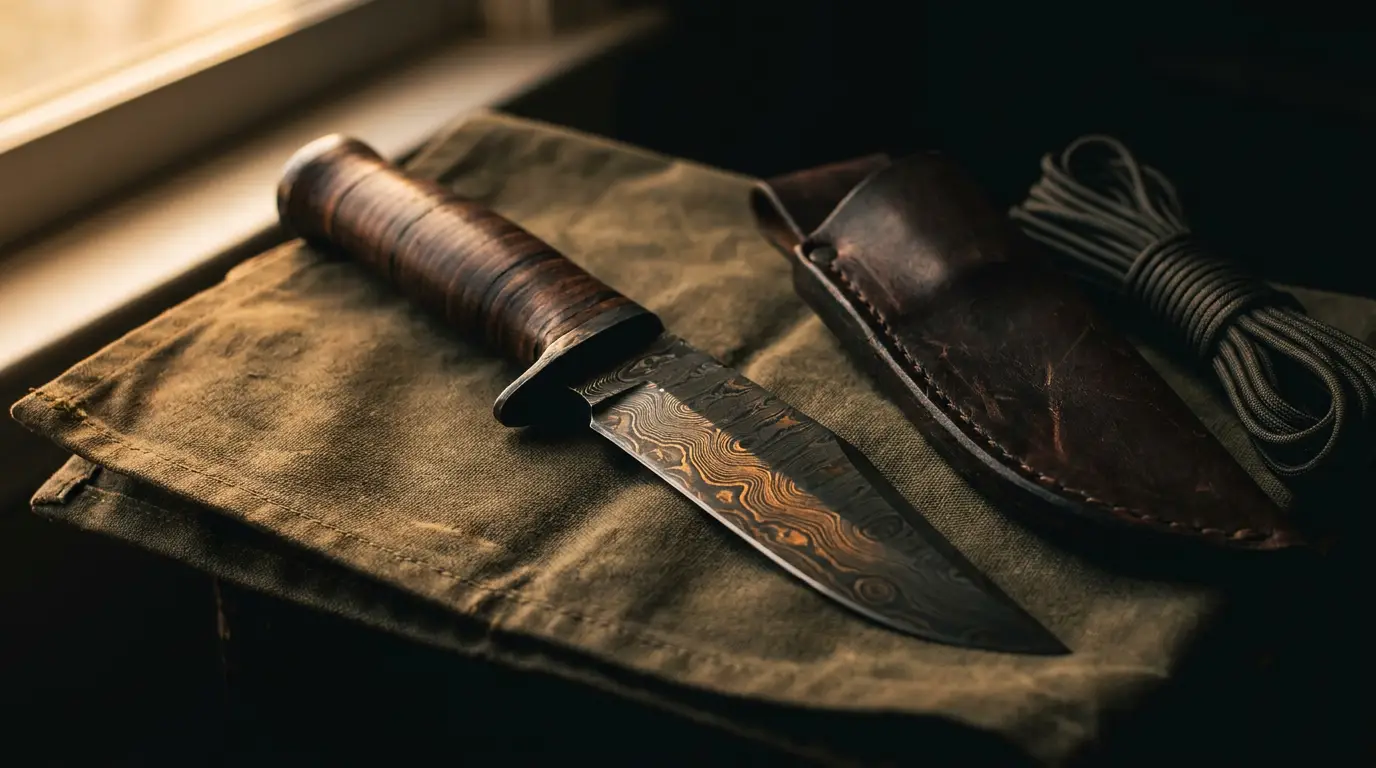
Short answer: for most people in uniform the right knife is a seven inch clip point on a full tang, in carbon Damascus if you will look after it and 440C if you will not, with a leather sheath you can wear point down. Everything below is why. And if you have served, our discount is 10% off. Email us, call us or message us on live chat and we will send you a personal code.
The pattern that set the standard
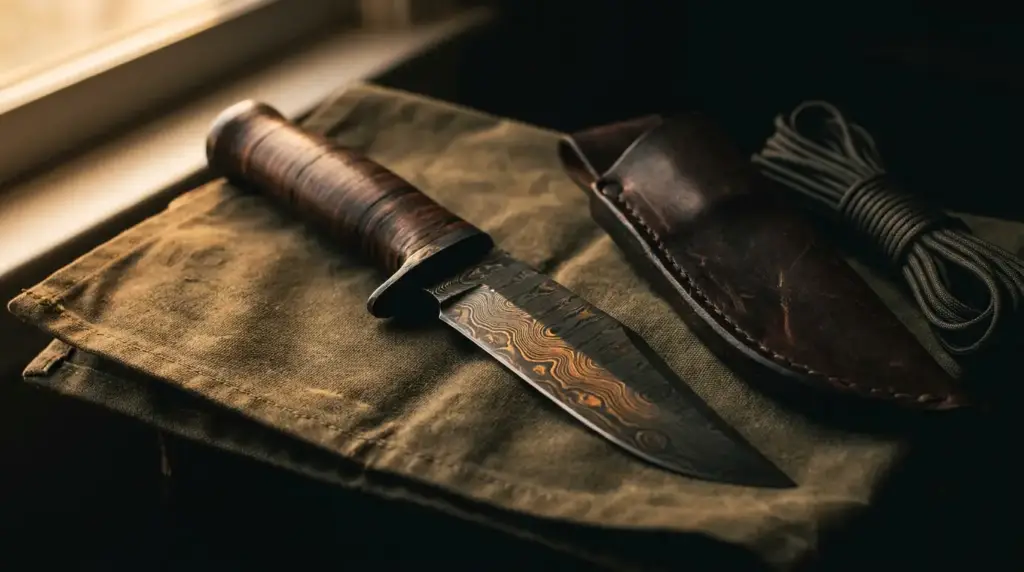
The Marine Corps adopted the knife on 23 November 1942 under the prototype designation 1219C2, and called it the Knife, Fighting Utility, Mark 2. The first shipment left Camillus Cutlery on 27 January 1943. Union Cutlery, Pal, Robeson and later Ontario built them too, which is why originals vary in small details.
The specification is worth reading as a list of decisions rather than a list of parts. Seven inch clip point blade. Stacked leather washer handle. Straight steel crossguard. A pommel that was peened at first and pinned later. A leather sheath for the Marines, plastic for the Navy. Nothing there is decorative.
The name has nothing to do with the Marine Corps. Union Cutlery trademarked Ka-Bar in 1923 after a fur trapper wrote in to say he had killed a wounded bear with one of their knives. The letter was barely legible and only “ka bar” could be made out of what was presumably “kill a bear”. They put it on the tang and it outlived the company name.
Why the shape works
Seven inches, and not more
Long enough to break down a crate or split kindling, short enough to control for food prep and cordage. Past about eight inches a fixed blade stops being a tool you keep on you and becomes a thing you leave in a pack. That is the whole argument.
The clip point
The clipped section drops the tip below the spine, which puts the point where your hand thinks it is. That matters for the fiddly work — opening packaging, drilling a hole in leather, digging a splinter out. The belly behind it does the slicing.
Stacked leather
Leather washers compressed onto the tang swell slightly at both ends, so the handle stays put in a wet hand without needing aggressive texture. It is warm in cold weather, it does not get slick with sweat, and it improves with use. Polymer is more weatherproof and nobody has ever handed one down.
Full tang
The steel runs the whole length of the handle. There is no join to fail, and a failure at the join is the only failure mode that turns a knife into a hazard. Every fixed blade we forge is full tang.
Choosing by branch
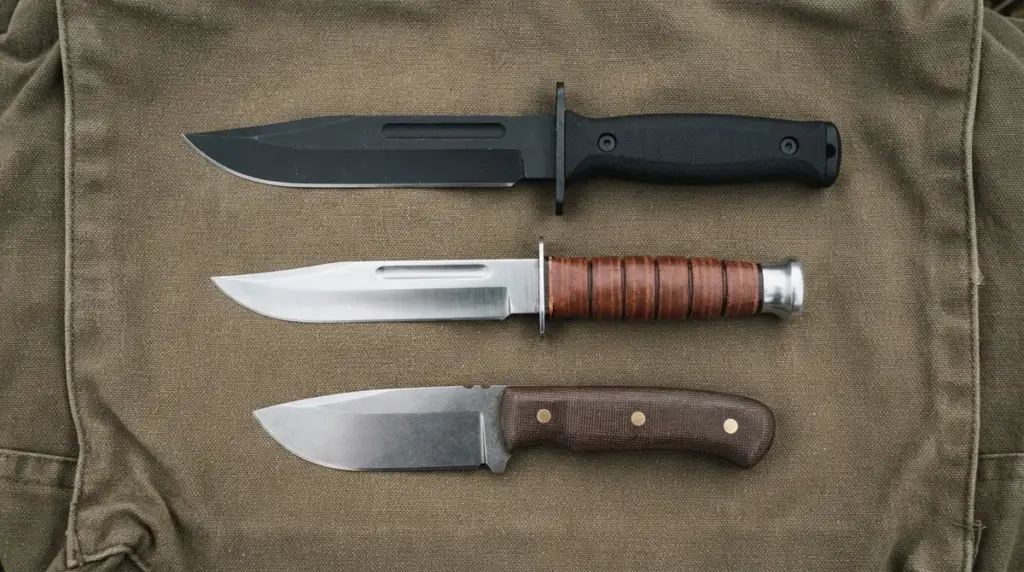
The honest version: the branch mostly changes the environment, and the environment mostly changes the steel.
Salt air and long storage → stainless. Ship board, coastal, humid. Dry, cold or field use where you can maintain it → carbon Damascus. Better edge, easier to bring back on a stone anywhere.
- Marine Corps. The 1942 pattern itself. Carbon Damascus if it will be used and oiled, 440C if it will live in a locker.
- Army. Field and utility blades, and the trench knife lineage if you want the older shape.
- Navy and Coast Guard. 440C stainless, every time. Salt does not negotiate.
- Air Force and Space Force. Usually the least demanding environment of the four, so pick on feel rather than corrosion resistance.
- Retirement and remembrance pieces. Different brief entirely — see engraving below.
Carbon Damascus or 440C
This is the only decision that genuinely changes how the knife behaves.
Damascus, 1095 and 15N20
Takes the finest edge of anything we make and comes back on a pocket stone in the field. It will patina, and it will spot if it goes away wet. That is a maintenance habit, not a fault. 352 layers is our standard billet, 58–60 HRC.
440C stainless
The forgiving choice for humidity, salt air, and a knife that sits in a drawer between deployments. Slightly more work to bring back to a screaming edge, and it will never develop the character carbon does.
Longer comparison in the steel guide, and the maintenance routine in the care guide. If you are buying carbon and you are honest with yourself that you will not oil it, buy the stainless.
Side by side
| Carbon Damascus (1095 + 15N20) | 440C Stainless | |
|---|---|---|
| Edge retention | Excellent — hardened 58–60 HRC | Very good |
| Rust resistance | Needs a wipe of oil and a dry sheath | High — shrugs off humidity and salt air |
| Looks | 352-layer pattern, one of a kind | Clean mirror or satin finish |
| Best for | Field use, gifts, display — anywhere the blade will be looked at as much as used | Shipboard, coastal, humid postings, low-maintenance carry |
| Maintenance | Five minutes a month | Nearly none |
Engraving, unit orders and retirement gifts
We engrave in house, and on our knives it is free. The things people ask for most:
- Name, rank and dates of service on the blade or the guard
- A unit crest or squadron patch design
- Deployment dates, or a hull number
- A short line on the reverse — usually a motto, sometimes a date nobody else would recognise
For a unit order the practical numbers: we have run two hundred engraved knives inside sixty days. Send quantities, the timeline and artwork to bulk and unit orders and you will get a real answer rather than a quote generator.
One piece of advice that has saved people money. If the knife is a gift for somebody still serving, ask where they are stationed before you engrave a date on it. Engraved knives are much harder to return.
Carrying it on an installation
This is the part guides skip, and it is the part that gets knives confiscated at a gate.
Installation commanders set the policy, not the state. Federal property runs on its own rules, and those rules differ from base to base. As one published example, the Army regulation covering Fort Gordon (32 CFR § 552.129) treats knives with blades longer than three inches as controlled: they may be carried to field duty only when a commander authorises it, and when carried they must be in a sheath or scabbard worn in a clearly visible manner. Concealment is prohibited.
Three inches is the figure in that particular regulation. Do not assume it is the number at your installation — check your local policy, and check the state law for wherever you live off post. Our knife law guide covers the state side.
Practical version: a seven inch fixed blade is a range, field and home knife. It is not something to put in a car and forget about before you drive through a gate.
How the 10% military discount works
Active duty, veterans, reserves and National Guard, any branch and any era.
- Email us at sales@blackmambaknives.com, call 901 669 8608, or message us on live chat and ask for the military discount.
- Our team replies with your personal 10% code by email.
- Use the code at checkout.
One thing worth knowing. The code is tied to your email address and works once, so there is no point passing it around; anyone you send it to can ask us for their own.
The code works on anything in the store. If you want to start with the service patterns, they are collected under military discount knives.
Questions people ask
Do I have to have been in combat, or in a particular branch?
No. Active duty, veterans, reserves and National Guard, any branch, any era.
I am medically retired. Do I still qualify?
Yes. Medically retired counts as a veteran. Just mention it when you get in touch.
Can I use the discount on a sale?
Yes. The 10% comes off the sale price, so you get both. Only one discount code can be used per order.
How long does the code last?
Ninety days from the day it is issued.
Is a Damascus blade actually usable, or is it a display piece?
It is a working knife. The pattern is what 352 layers of 1095 and 15N20 look like after forge welding and etching — it is the steel, not a coating. How to tell the difference from a printed pattern.
Can you match a knife somebody carried in service?
Often, yes. Send photographs to the workshop through contact us. Older patterns are the part of this job we enjoy most.
Do you ship to APO and FPO addresses?
Ask before ordering — carrier rules on blades change, and we would rather tell you up front than refund you later.
More guides
- Damascus vs D2 vs 440C vs VG10: Which Steel
- Damascus Knife Care and Sharpening
- Full Tang vs Partial Tang
- Knife Blade Shapes Explained
- Hand-Forged vs Factory Made Knives
Back to all guides · Military & veteran knives · Claim your 10% discount
More from the workshop
Butterfly Knife Trainer Guide
What a balisong trainer is, how it compares to a live blade, and how to order any of our balisongs as one.
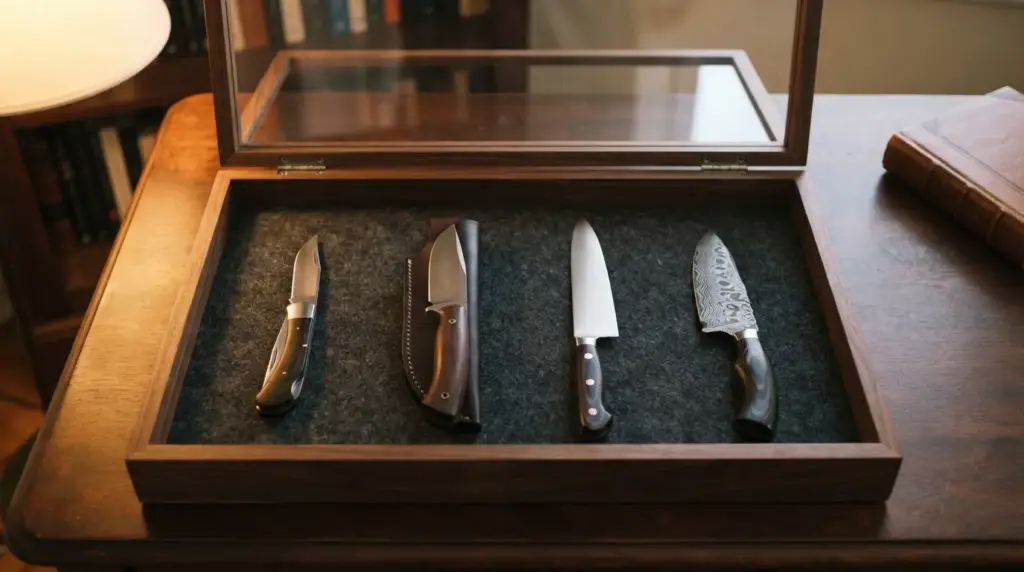
Starting a Knife Collection Without Wasting Money
Four knives, one rule, a budget that holds, and the truth about resale value.
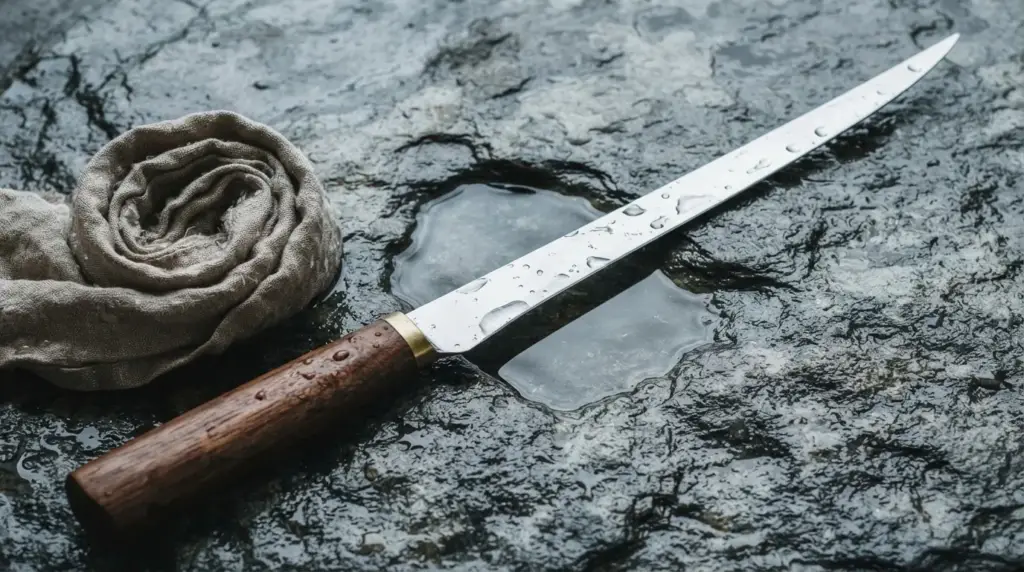
Fishing Knives: Bait, Fillet, Folding and Saltwater
Sizing a fillet blade, why carbon Damascus loses to salt water, and what our seven fishing listings really are.
