
The pattern that went ashore in 1942
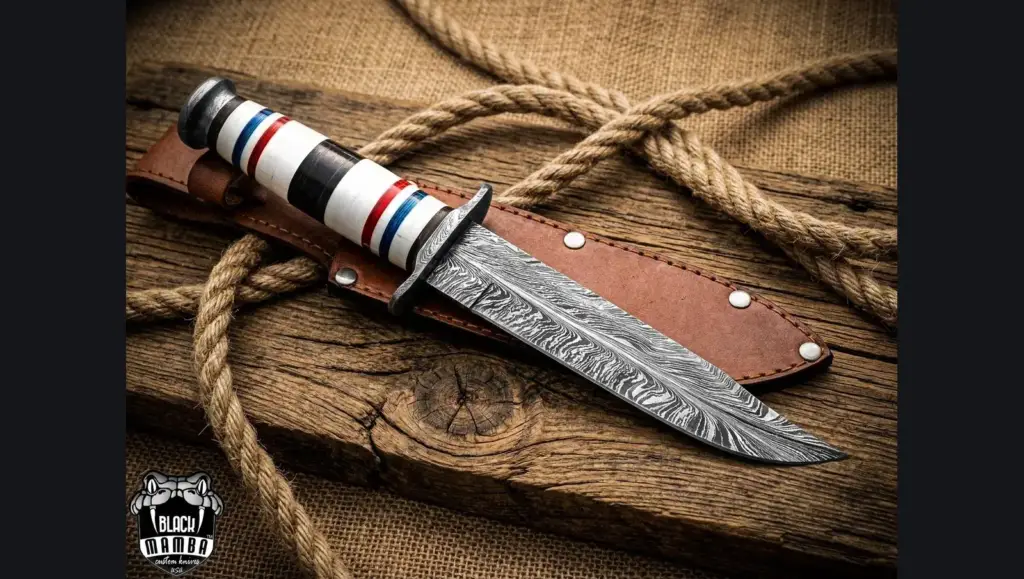
A seven inch blade, a stacked leather washer handle, a leather sheath. The service knife design barely changed in eighty years because it did not need to. We forge that shape the old way, in Memphis, Tennessee.
Your service earns 15% off
To claim your 15% military discount, fill out our contact form or message us on live chat. Our team will send your personal discount code by email.
Claim your 15% code
Fill out the contact form and mention the military discount, or start a live chat with us. Either way works.
Read the buying guide first
The 1942 pattern explained, how to choose by branch and by steel, engraving and unit orders, and what the rules actually are for carrying a fixed blade on an installation.
Designed once, and got it right
The 1942 fighting utility knife had to do everything: open crates, cut rope, dig, pry, prepare food, and be reliable when wet and cold and filthy.
What came out of that brief is a set of proportions that still make sense. Around seven inches of blade with a clipped point, enough belly to be useful and enough spine to take abuse. A stacked leather washer handle that swells slightly at both ends so it does not slip out of a wet hand, and that grips better the more it is used. A full tang running the length of the handle so there is no join to fail. A leather sheath that holds it point-down without a snap.
Modern polymer handles are more weatherproof. They are not warmer in the hand, they do not age, and nobody hands one down. That is the trade, and it is why we still stack leather.
Heavy blades, and the ones beside them
The kukri profile puts the weight forward of your hand, which is why it chops far above what its size suggests. It is a clearing and camp tool first. Pair it with something small — a four inch utility blade does ninety percent of the actual cutting, and the heavy blade only comes out when it is earned.
The gift that gets kept
Retirements, promotions, change of command, end of tour. A plaque goes on a wall. A knife goes in a drawer that gets opened.
We engrave names, dates, unit designations and service numbers in house before the knife ships. Keep it short — a name and a date reads better twenty years on than a paragraph does. For a whole unit, send us the list and we cut each one individually rather than running a template.
Collections by branch
Marine Corps
The classic 1942 fighting utility pattern, forged in Damascus and 440C.
Army
Field and utility blades, including the trench knife lineage.
Navy
Corrosion matters at sea — these lean on 440C stainless rather than carbon.
Heritage patterns
Older shapes we still forge because people still ask for them.
Veteran gifts
Retirement and remembrance pieces, engraved in house.
Daggers
Double-edged patterns with a long service history.
Carbon or stainless for a field knife
Damascus, 1095 and 15N20
Takes the finest edge and comes back on a stone anywhere, with nothing but a pocket hone. It will patina, and it will spot if it goes away wet. That is a maintenance habit, not a fault.
440C stainless
The forgiving choice for humidity, salt air and long storage. Slightly more work to bring back to a screaming edge, and it will not develop the character carbon does.
Longer comparison in the steel guide, and the maintenance routine in the care guide.
Marking a milestone for someone who served? The 250th Anniversary knives are a small commemorative run with engraved gold fittings.
Ordering for a unit?
We have run orders of two hundred engraved knives inside sixty days. Send the numbers, the timeline and what you want on them.
Please check your local law before ordering.
