

Short answer: there is no single best knife steel, only the right trade-off. Every steel balances four things that fight each other: edge retention, toughness, corrosion resistance and ease of sharpening. Improve one and you usually give up another.
The four properties
Edge retention. How long it stays sharp. Driven by hardness and by hard carbides in the steel.
Toughness. Resistance to chipping and breaking. The direct opposite of hardness. Harder steel holds longer and chips sooner.
Corrosion resistance. Mostly a function of chromium. Above roughly 11 per cent the steel is called stainless.
Ease of sharpening. How quickly you get the edge back with normal stones. Usually the inverse of edge retention.
Anyone claiming a steel is best at all four is selling something.
The steels we work with
| Edge | Tough | Rust | Sharpen | |
| 1095 carbon | Good | Very good | Poor | Excellent |
| 15N20 | Good | Excellent | Poor | Excellent |
| Damascus (1095+15N20) | Good | Very good | Poor | Excellent |
| D2 tool steel | Very good | Fair | Good | Fair |
| 440C stainless | Good | Good | Very good | Good |
| VG10 | Very good | Fair | Very good | Good |
What the numbers mean
1095 is a plain high carbon steel: roughly 0.95 per cent carbon, almost no chromium. Simple, fine grained, takes a superb edge, rusts if you look at it wrong.
15N20 is 1075 carbon steel with about two per cent nickel. The nickel resists acid etching, which is precisely why it is the bright layer in Damascus. It is also unusually tough.
D2 carries around 12 per cent chromium, which puts it just at the edge of stainless. Excellent wear resistance from large chromium carbides, and those same carbides make it slower to sharpen.
440C has about 17 per cent chromium and high carbon. The classic properly hardenable stainless, and the sensible choice for wet work.
VG10 is a Japanese stainless with cobalt and vanadium. Fine grain, takes a very keen edge, holds it well, and is more brittle than the carbon steels.
Hardness, and why we stop at 58 to 60
HRC is the Rockwell hardness scale. Kitchen knives commonly run 56 to 62; ours run 58 to 60 on Damascus, 1095, 440C and VG10, and 58 to 62 on D2.
That is a deliberate choice, not a default. Push past 61 and the edge lasts longer but chips when it meets bone or a hidden staple. Drop below 57 and it rolls under ordinary use. Fifty-eight to sixty is where a working knife belongs, and we would rather a knife came back for sharpening than came back broken.
Choosing by what you do
Wet, salty or neglected: 440C. Heavy cutting volume, dry conditions: D2. Best edge and easiest field maintenance: Damascus or 1095. Kitchen, very keen edge, stainless: VG10.
What knife steel actually is
Every knife steel is iron with a small amount of carbon and a short list of other elements added on purpose. The proportions are the whole story, because each element buys you one property and charges you another.
| Element | What it adds | What it costs you |
|---|---|---|
| Carbon | Hardness and edge retention. Nothing hardens without it. | Too much and the blade gets brittle. |
| Chromium | Corrosion resistance. Around 13 percent is where a steel becomes stainless. | Large chromium carbides coarsen the edge and slow sharpening. |
| Vanadium | Very fine, very hard carbides. Excellent wear resistance. | Needs diamond abrasives to sharpen properly. |
| Molybdenum | Strength at temperature, and helps the steel harden all the way through. | Cost. |
| Nickel | Toughness, and it stays bright under acid, which is what makes a Damascus pattern visible. | Does not harden on its own. |
| Manganese | Helps the steel harden predictably in a quench. | Little, in the amounts used. |
That table explains almost every argument you will read about knife steel. Stainless steels resist rust because of chromium and give up a little edge refinement to get it. Carbon steels take a keener edge and rust. Powder steels use vanadium to have both, and charge you in money and sharpening time.
The wider knife steel chart
Our own range is four steels, but you will be comparing them against everything else on the shelf, so here is the wider picture. Ratings are relative to each other rather than absolute, and every one of them assumes a competent heat treat.
| Steel | Type | Edge retention | Toughness | Corrosion resistance | Ease of sharpening |
|---|---|---|---|---|---|
| 1095 | Simple carbon | Medium | High | Low | Very easy |
| 15N20 | Carbon with nickel | Medium | Very high | Low | Very easy |
| 1095 and 15N20 Damascus | Pattern welded carbon | Medium | High | Low | Very easy |
| D2 | Semi stainless tool steel | High | Medium | Medium | Hard, wants diamond |
| 440A | Budget stainless | Low | High | High | Very easy |
| 440C | High carbon stainless | Medium to high | Medium to high | High | Easy |
| VG10 | Japanese stainless | High | Medium | High | Moderate |
| 8Cr13MoV | Budget stainless | Low to medium | Medium | Medium to high | Very easy |
| 154CM | Stainless tool steel | High | Medium | High | Moderate |
| S35VN | Powder stainless | Very high | Medium | High | Hard, needs diamond |
| MagnaCut | Powder stainless | Very high | High | Very high | Hard, needs diamond |
Two things worth noticing. First, nothing is best at everything, and the steels that come closest are the ones you will spend the longest sharpening. Second, the gap between a good steel and a great one is smaller than the gap between a good heat treat and a bad one.
How to read a knife steel chart without being misled
Charts like the one above get quoted as if they settle arguments. They do not, for three reasons.
- Heat treat outranks alloy. The same 440C can come out at 58 HRC with fine, evenly spread carbides, or at 54 HRC with coarse ones and retained austenite. Same certificate, completely different knife. No chart can show you this, and it is the single largest variable.
- Geometry outranks both. How thin the blade is behind the edge decides how it cuts far more than the alloy does. A thin 1095 blade will out-cut a thick S35VN one and it is not close.
- Edge retention is measured on cardboard. Most published rankings come from rope or card cutting tests, which reward wear resistance. If your knife meets bone, wet hide or a cutting board instead, toughness matters more and the ranking inverts.
Use a chart to shortlist, then ask the maker for the hardness figure and where the heat treat was done. Those two answers tell you more than the whole table.
Knife blade hardness chart: what each HRC band means in practice
Almost everything a blade steel hardness chart tells you sits inside about eight points on the Rockwell C scale. That is the usable knife steel hardness scale, and each band behaves differently in the hand.
| Under 54 HRC | Soft. The edge rolls rather than chips. Easy to sharpen, and you will be doing it often. Common on stamped kitchen knives and machetes, where a bent edge beats a broken one. |
| 54 to 57 HRC | Forgiving and very quick on a stone. Fine for a camp chopper or a knife that gets abused, weak on edge holding. |
| 58 to 60 HRC | The working band. Holds an edge through a day of real cutting and still comes back on ordinary stones. Where our Damascus, 1095 and 440C blades sit. |
| 60 to 62 HRC | Hard. Longer edge life, less forgiveness. Sensible in wear resistant steels used for slicing rather than prying. Our D2 runs 58 to 62. |
| Above 62 HRC | Very hard. Excellent edge retention on clean material, and likely to chip on bone, staples or a glass board. Mostly Japanese kitchen and powder steels. |
Hardness is not a quality score. A knife hardness chart tells you what the maker chose to prioritise, nothing more. Two blades at the same number can behave very differently.
Why no steel wins on the edge retention and toughness chart at once
Nothing tops a knife steel edge retention chart and a knife steel toughness chart at the same time, and the reason is physical rather than commercial. Edge retention comes from hardness and from hard carbide particles suspended in the steel. Those same carbides are brittle, and every one of them is a place a crack can start. Add enough of them to win on wear resistance and you have given up impact resistance to get there.
The same trade runs through the other two properties. Chromium buys corrosion resistance, but in a simple steel it forms large chromium carbides that coarsen the edge and slow sharpening. Vanadium makes finer, harder carbides that hold an edge far longer, and then refuses to give the edge back to anything softer than a diamond plate. This is why a steel comparison chart is a map of compromises rather than a league table.
A practical way to use any steel rating chart: decide which property you cannot live without, accept that you are paying for it in one of the other three, and choose from what is left. Our knife steel comparison guide does that for our four steels by use case.
Knife steel types chart: budget, mid and premium tiers
Grouping by price tier is more honest than ranking, because it describes what you are buying rather than pretending one steel beats another outright. These are the alloys you meet most often on a knife material chart.
Budget and workhorse. 1095 and 1075 are plain carbon steels: fine grained, easy to forge, easy to sharpen, quick to rust. 5160 is spring steel, very tough, used for big choppers and swords, and modest on edge retention. 80CrV2 is 1080 with a little chromium and vanadium, tougher than 1095 for a small premium. 8Cr13MoV and AUS-8 are budget stainless steels: rust resistant, pleasant to sharpen, dull sooner than anything above them. None of these is bad steel.
Mid tier. D2 is the semi-stainless tool steel that holds an edge well and sharpens slowly. 440C is a properly hardenable high carbon stainless and still the sensible answer for wet work, covered in detail in our 440C steel guide. 14C28N is a fine grained Sandvik stainless that takes a keen edge and is easy to bring back, which makes it a strong choice on a pocket knife steel chart. VG-10 sits at the top of this tier: very keen, stainless, a little brittle at the apex.
Premium and powder. S30V and S35VN are powder stainless steels with vanadium carbides, holding an edge far longer than anything above and asking for diamond abrasives when they finally go. M390 pushes wear and corrosion resistance further again. MagnaCut stands out because it gets high toughness and high corrosion resistance without giving up much edge holding. All are expensive, all are slow to sharpen, and none can be forge welded into pattern welded Damascus.
Heat treatment matters more than the name on the blade
The alloy sets the ceiling. Heat treatment decides how close the finished knife gets to it. The same bar can be normalised properly, held at the right temperature for the right time, quenched in the right medium and tempered twice, or heated until it looks about right and dunked in used engine oil. Both knives get sold as the same steel.
What goes wrong is invisible: grain grown coarse because the steel sat too hot too long, retained austenite because a high alloy steel was never cryo treated, or a temper that overshot and cost hardness. None of it shows on a blade steel comparison chart, and you feel all of it the first time the edge folds.
So ask two questions of any maker: what hardness does this blade run at, and who did the heat treat. A maker who can answer both plainly is telling you more than any knife metal chart can. It is also why we quote a band rather than a single number, and why an easily sharpened steel is worth more than it looks once you have read how to sharpen a knife properly.
The steels we forge, and why we stopped there
We work in 1095 and 15N20 Damascus, D2, 440C and VG10. That list is short on purpose. We are a forge, so the steel has to behave under a hammer and, for Damascus, forge weld cleanly to a partner steel with a different response to acid etching. That rules out every powder steel immediately, whatever it does on a chart.
The rest is about the owner rather than the shop. Our knives are hunting, camp and kitchen tools, and the person carrying one is usually a long way from a set of diamond plates. A steel you can bring back on a stone by the truck is worth more in the field than one that holds twice as long and needs a workshop to restore. Where that does not apply, we use the harder options: D2 tool steel for heavy repeat cutting, and 440C stainless for anything wet, salty or likely to be put away damp.
Questions people ask
Is Damascus stronger than a single steel?
No, and anyone who says so is repeating a myth. Modern Damascus is chosen for the pattern and for a good balance of properties. Historically forge welding was a way to even out inconsistent steel; with modern steel that problem is solved.
Does more layers mean better steel?
No. Layer count controls the pattern only. Full explanation in what 352 layers actually means.
What about the super steels?
Powder steels like MagnaCut and S35VN hold an edge remarkably well. They are also expensive, harder to sharpen without diamond stones, and not forge weldable into Damascus, which is what we make.
Which should I buy?
Side by side by use case in our steel comparison guide.
What is the best knife steel?
There is no best. There is a best for a job. For hunting and camp use where the knife gets wiped and oiled, layered 1095 and 15N20 Damascus or plain 1095. For salt water, food and neglect, 440C or VG10. For long edge holding between sharpenings, D2 or a powder steel, at the cost of sharpening time.
What is the easiest knife steel to sharpen?
Simple carbon steels: 1095, 15N20 and Damascus built from them. A few passes on an ordinary stone brings them back. 440C is close behind. D2 and the powder steels want diamond abrasives and patience.
Which knife steel does not rust?
None of them, strictly. Stainless steels resist rust rather than being immune to it. 440C, VG10 and the powder stainless steels will tolerate wet hands, food acids and a damp drawer. Carbon steels and carbon Damascus will patina and can rust if stored wet.
Is a higher HRC always better?
No. Hardness buys edge retention and spends toughness. Above about 61 HRC most knife steels start chipping instead of rolling, and a rolled edge can be steeled back while a chipped one has to be ground out. For working knives, 58 to 60 is the sensible band.
What knife steel do most American makers use?
For forged work, 1095 and 15N20, because they weld cleanly to each other and etch with good contrast. For stock removal, 440C, 154CM and increasingly the powder stainless steels. Our own range is Damascus, D2, 440C and VG10.
1095 vs 440C: which is the better knife steel?
Neither, and the comparison is really carbon against stainless. 1095 takes a slightly finer edge, is the easier of the two on a stone, and will rust if you leave it wet. 440C resists corrosion properly, holds an edge at least as long in normal use, and needs less looking after. Wet or neglected work goes to 440C. Dry work with a wipe down goes to 1095.
VG10 vs 1095: what is the real difference?
VG10 is a Japanese stainless with cobalt and vanadium; 1095 is a plain carbon steel with almost no chromium. VG10 holds an edge longer, will not rust in a kitchen, and is more brittle at the apex, so it dislikes bone and frozen food. 1095 is tougher and far quicker to sharpen anywhere. Kitchen and wet work favour VG10. Field use and easy maintenance favour 1095.
Why do the Benchmade, Spyderco and Blade HQ steel charts disagree?
Because they are rating different things. Most published charts score edge retention from rope or cardboard cutting, which rewards wear resistance and ignores impact. Others rank by lab toughness, or by what the brand happens to stock. Hardness also differs between makers using the same alloy. Treat any brand steel chart as a shortlist tool, then compare the hardness figures rather than the rankings.
What is the toughest knife steel?
Among common knife steels, the simple low alloy ones: 5160, 15N20, 80CrV2 and 1075 all take impact well because they carry few hard carbides to crack. 1095 is close behind. Of the stainless steels, MagnaCut is unusually tough for its class. Any steel toughness chart will also shift with hardness, since the same alloy run softer is tougher and holds an edge for less time.
What steel should a pocket knife blade be?
For a folder carried daily, corrosion resistance and easy sharpening usually beat outright edge holding, because the blade lives against your leg and gets used in short bursts. 14C28N, 440C and VG10 all suit that. 8Cr13MoV works at the budget end. D2 and the powder steels hold longer if you are willing to sharpen them properly. Our own folders are listed under folding pocket knives.
Is there a knife steel chart PDF to download?
We do not publish one. The tables on this page are built to print straight from your browser, which is the same result without a file that goes stale. Steel charts date quickly as new alloys arrive and hardness figures change, so a page we can correct is more use to you than a PDF sitting in a downloads folder from two years ago.
More from the workshop
San Mai and Damascus: Two Different Laminates
A three layer core and jacket against a stack of hundreds, and what each one really does.
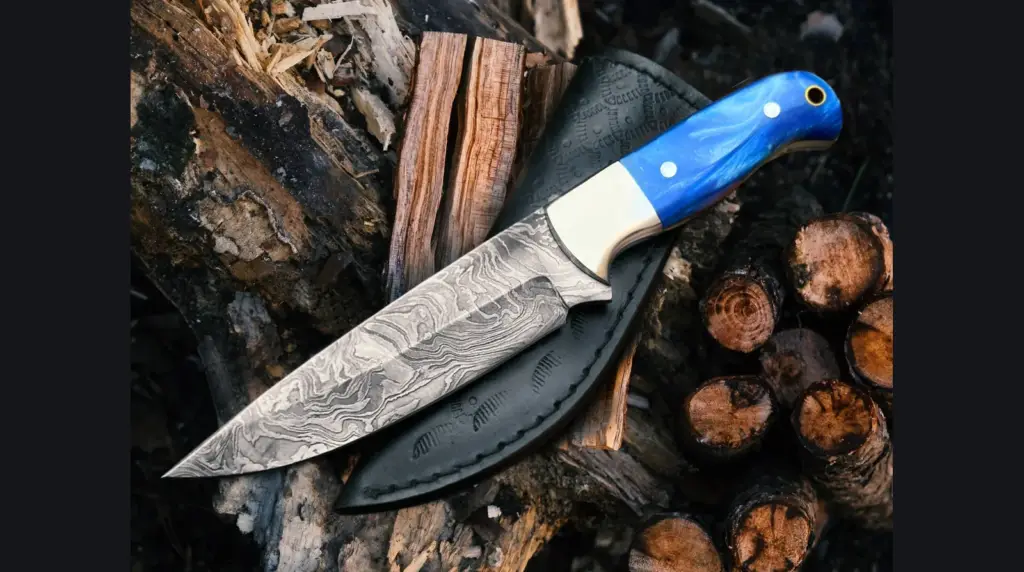
How to Tell Real Damascus from a Printed Pattern
Four checks that separate forge-welded steel from a surface-etched imitation.
Engraving a Knife: What Works and What Ruins the Blade
What engraving costs, what fits in 20 characters, and why the handle beats the blade.
