
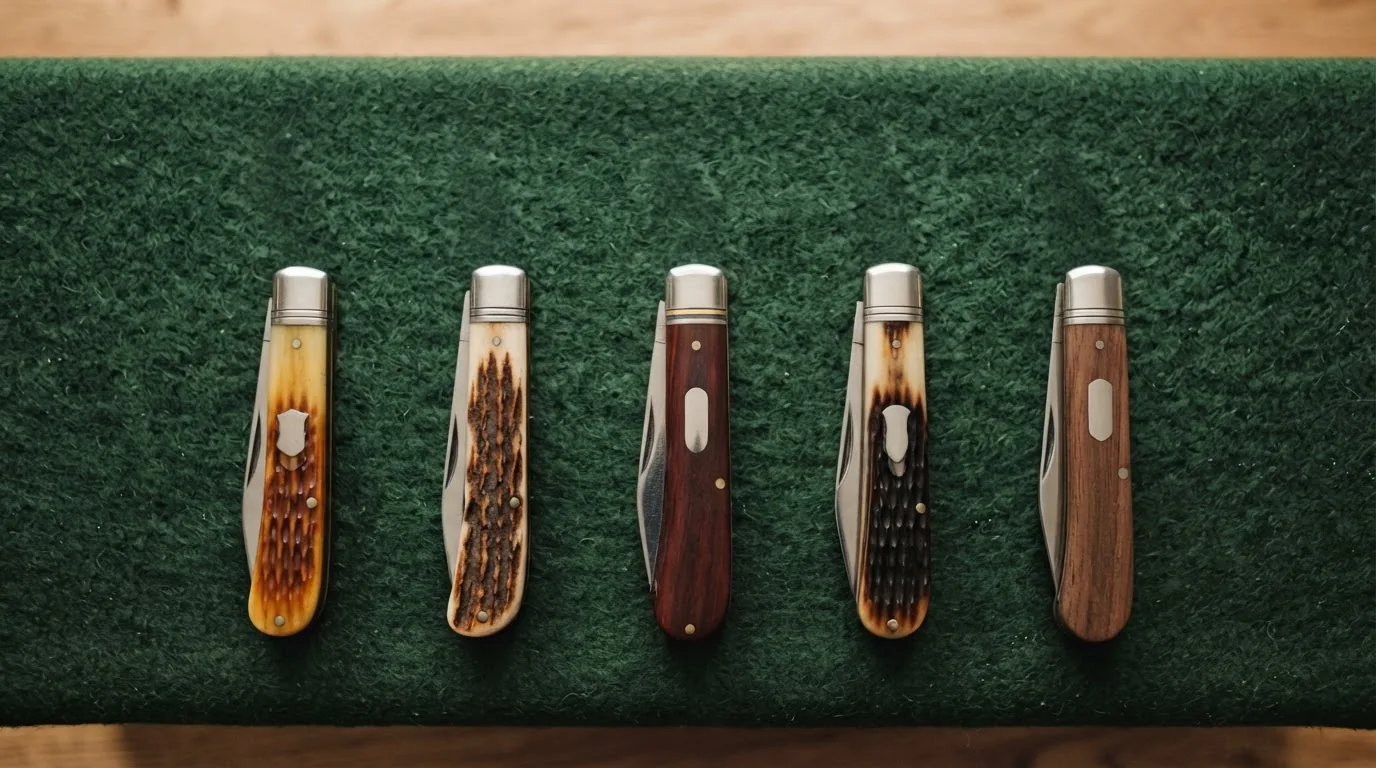
Short answer: A traditional multi-blade pocket knife carries two, three or four blades so each one can hold a different edge for a different job — a fine clip point you never pry with, a blunt spey for scraping and skinning, a straight sheepsfoot for cutting down onto a board. Stockman, trapper and barlow are the patterns most people mean, and nearly all of them are slipjoints rather than locking knives.
Why a traditional folder carries more than one blade
A single-blade folder does everything you ask of it, which is the problem. The same edge opens boxes onto a concrete floor, scrapes a gasket, cuts twine against a fence post, and is then asked to peel an apple cleanly. It cannot do all of that and stay sharp, and the tip pays first.
The multi-blade answer is division of labour. One blade is the fine one, and it stays sharp because it only ever cuts things that deserve a sharp edge. The others absorb the abuse: the blunt-nosed blade takes the scraping and the work near a hide or a finger, the straight-edged blade takes the rope and the cardboard on a hard surface. Traditional blades are also ground thin so they cut well, and a fine grind tolerates no prying at all — so a spare blade in the same handle turns a rolled edge mid-job into an inconvenience rather than the end of the job.
Jack, penknife and whittler: how the blades are arranged
Some of these words describe the frame rather than the shape of the knife.
- Jack. Every blade pivots from the same end of the handle. A trapper is a jack, and so is a barlow. It is a construction term, not a shape.
- Two-end frames. Blades pivot from both ends. A canoe and a congress are built this way, which lets a small frame carry more blades without stacking them on one pivot.
- Penknife. Originally a knife for trimming quill pens. It now means a light frame carrying small pen-type blades.
- Whittler. A mechanical layout rather than a profile: three blades on two backsprings. The large blade rides on both springs and has a heavy pull; the two small blades each ride on one spring and open lightly.
Worth saying plainly: pattern names were never standardised. Different cutlers have used the same name for different knives, and most of the tidy origin stories attached to these patterns are collector tradition rather than documented history. Treat the names as shorthand for blade count and blade shape.
The classic patterns, one by one
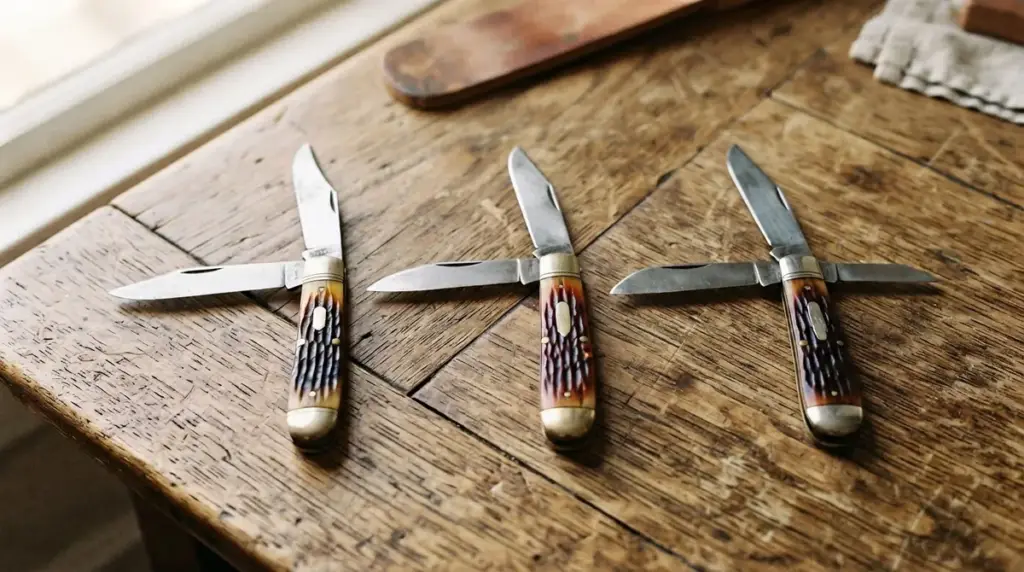
| Stockman | Three blades — clip, sheepsfoot, spey — on a serpentine frame. Built for farm and ranch work. |
| Sowbelly | The stockman blade set on a deeply curved frame. Same three jobs, rounder in the hand. |
| Trapper | Two full-length blades, a clip and a spey, both pivoting from one end. Skinning plus general cutting. |
| Muskrat | Two identical long clip blades on a trapper-style frame. A second fresh edge without stopping to sharpen. |
| Barlow | Usually two blades, a main and a pen, on a jack frame with an unusually long front bolster. |
| Canoe | Usually two blades, one at each end, on a frame that swells in the middle and tapers to both ends. |
| Congress | Commonly four blades on a crescent frame, blades at both ends, with a sheepsfoot as the main. |
| Peanut | A very small two-blade jack, typically clip and pen. Almost nothing in the pocket. |
| Whittler | Three blades, two springs. Heavy main blade at one end, two light small blades at the other. |
| Penknife | Small light frame with small pen-type blades. Letters, string, fine work. |
| Copperhead | A jack whose swelled bolsters sink the pivot end, shrouding the closed blade tips inside the frame. |
The stockman explains the whole idea, because its three blades are deliberately unlike each other. The clip is the fine one — a long, thin point for piercing, splinters and anything delicate. The sheepsfoot has no point at all and a dead-straight edge, so it cuts down onto a surface along its full length without the tip digging in. The spey is short, blunt-nosed and shallow, a blade you can drag along something without puncturing it.
The trapper takes the same logic and makes both blades long: a big clip for detail, a big spey for working close to hide or hand. The barlow is defined by its bolster rather than its blades — it runs a long way back down the handle, reinforcing the weakest part of a folder and letting the rest of the knife stay plain and cheap. The whittler and congress are the woodworking patterns: a straight-edged main blade for stock removal, small squared-off blades for detail and notching.
What each blade shape is actually for
Shapes mean something slightly different here, because they are chosen to complement each other rather than to be a compromise on their own. The fuller breakdown is in knife blade shapes; this is what they do inside a traditional folder.
- Clip point. The back is clipped away toward the tip, leaving a thin, controllable point. The precision blade. Keep it off staples and concrete.
- Spey. Shallow, with a blunt upswept nose and a nearly straight edge. Named for livestock work, and the shape follows from it — you can run it along a hide or a gasket without the tip catching.
- Sheepsfoot. Straight edge, spine curving down to meet it, no usable point. It cuts on a flat surface along its whole length and will not stab what is under the cut.
- Pen. A small spear- or clip-shaped blade with edge and spine curving to meet near the centreline. Fine, controlled work in a small package.
- Coping. Straight edge with the spine dropping sharply to a squared-off tip. Notching, cutting into a corner, getting into a stopped cut in wood.
- Wharncliffe. A dead-straight edge with the spine sweeping down in one long curve to a fine, low point. Scoring and cutting to a line.
How a slipjoint works, and why it is not a lock
Almost every pattern above is a slipjoint. A flat steel backspring runs the length of the handle, and the base of each blade — the tang — is cut with flats and curves that press against it. Open the blade and the spring is forced up; the tang then rests on a flat the spring holds down. That pressure is all that keeps the blade open.
Walk and talk describes the feel of that mechanism. The walk is how smoothly the blade travels against the spring; the talk is the snap it makes closing into the handle. A well-made slipjoint snaps shut crisply, with the spring flush with the handle spine open, closed and at the half stop. A half stop is an extra flat cut on the tang at ninety degrees, so the blade pauses square to the handle both ways — it cannot slam shut in one motion, and you get a defined point to move your fingers. The pull is the effort needed to open a blade, usually rated one to ten; a stiff pull on a big trapper blade is correct, and so is a pen blade that opens with a fingernail.
None of this is a lock. There is no lock bar, no detent, no stop pin. Load a slipjoint's spine while it is cutting, twist it in a deep cut, or let it bind and lever, and the spring gives and the blade folds on your fingers. Slipjoints are for slicing and pull-through cuts, not for prying, stabbing or hard-point work. If you want a lock, that is a different tool — see how to choose an EDC knife.
Opening two blades safely, and sharpening around them
The nail nick is the small crescent milled into the blade's flat; you catch it with a thumbnail and pull against the spring. On a stiff main blade that takes a real grip, and the usual injury happens when the nail slips off the nick.
- Open one blade at a time. The classic multi-blade cut is a hand closing on an edge the owner forgot was standing open at the other end.
- Hold the frame, not the blades, fingers clear of the other blades' paths.
- Use the half stop. Bring the blade square, reset your grip, then finish the movement.
- Close by the spine with the edge's landing path empty.
- Sharpen with only that blade open, everything else closed inside the handle and out of reach.
- Use narrow abrasives — a slim pocket stone, ceramic rod or small diamond plate — so the frame and the neighbouring blade do not foul the stroke.
- Keep each blade's shape. A sheepsfoot sharpened with a rocking motion grows a belly and stops doing the one thing it is for.
The method is in how to sharpen a knife, and the angles behind it in pocket knife bevels explained.
Carrying one, and what wear looks like
These knives were designed to live loose in a trouser pocket, and they carry well because they have no clip and no corners. That also means they collect what is in the pocket: lint and denim fibres pack into the blade wells and around the pivots, and damp lint holds moisture against the springs.
Carbon steel blades take a grey patina from use, which is normal and not the same as rust. Brass bolsters darken, and bone handles polish where your fingers sit. The wear that matters is blade play, a spring no longer sitting flush, and a blade rubbing its neighbour — and that usually starts with grit in the joint. Flushing the joints and drying them properly is most of the maintenance: see how to clean a pocket knife.
Choosing a pattern by what you actually cut
- Boxes, tape, string, everyday cutting. A two-blade jack or a peanut — one blade for parcels, one kept fine.
- Outdoor and livestock work. A stockman or sowbelly. The three-blade set was designed for that mix.
- Field dressing and hide work. A trapper, where the spey does the close work.
- Whittling and small woodwork. A whittler or congress.
- Dress trousers and light carry. A penknife or peanut.
- Prying, hard use, one-hand opening. None of the above. Use a locking folder or a fixed blade.
You can see the folders we build at folding pocket knives.
Questions people ask
What are the three blades on a pocket knife for?
On a stockman the standard three are a clip point, a sheepsfoot and a spey. The clip is the fine, pointed blade for piercing and detail work. The sheepsfoot has a straight edge and no point, for cutting down onto a flat surface. The spey is blunt-nosed, for scraping and working close to a hide without puncturing it.
What is the difference between a stockman and a trapper?
A stockman carries three blades — clip, sheepsfoot and spey — usually on a serpentine frame. A trapper carries two, a long clip and a long spey, both pivoting from the same end of a wider frame. The trapper gives you two full-size blades; the stockman gives a third shape, with each blade smaller.
Are multi-blade pocket knives locking knives?
Almost never. Traditional multi-blades are slipjoints: a backspring holds each blade open under pressure, but nothing latches it. Load the spine hard, twist the blade in a cut, or pry with it and the blade can fold. They are excellent slicing knives and poor prying tools. If you need a lock, buy a locking folder.
What is a half stop on a pocket knife?
A half stop is a flat cut into the base of the blade so it pauses at ninety degrees to the handle on the way open and again on the way closed. It stops the blade travelling in one uninterrupted swing and gives you a point to reset your grip. Not every traditional pattern has one.
What does "walk and talk" mean?
It describes how a slipjoint feels and sounds. The walk is how smoothly the blade moves against the backspring through its travel. The talk is the snap it makes as it closes into the handle. Good walk and talk means well-fitted tangs and a properly tensioned spring, sitting flush with the handle spine at every rest position.
Why does a barlow have such a long bolster?
The bolster reinforces the pivot end, which is the weakest part of any folder. Running it a long way back down the handle stiffens the joint and lets the rest of the knife be built simply. The result was a strong, plain working knife, and that long bolster still identifies the pattern.
How do you sharpen a multi-blade knife without damaging the other blades?
Open only the blade you are sharpening and leave the rest closed in the handle. Use a narrow stone, ceramic rod or small diamond plate so the stroke is not fouled by the frame. Keep each blade's original shape — a sheepsfoot should stay straight and a spey should stay blunt.
Which multi-blade pattern is best for everyday carry?
For general everyday cutting a two-blade jack or a peanut is hard to beat: one blade takes the parcels and dirty work, the other stays fine. Choose a stockman if your work is varied and outdoors, a trapper if you dress game, a whittler or congress if you work wood. Match the pattern to what you cut most.
More from the workshop
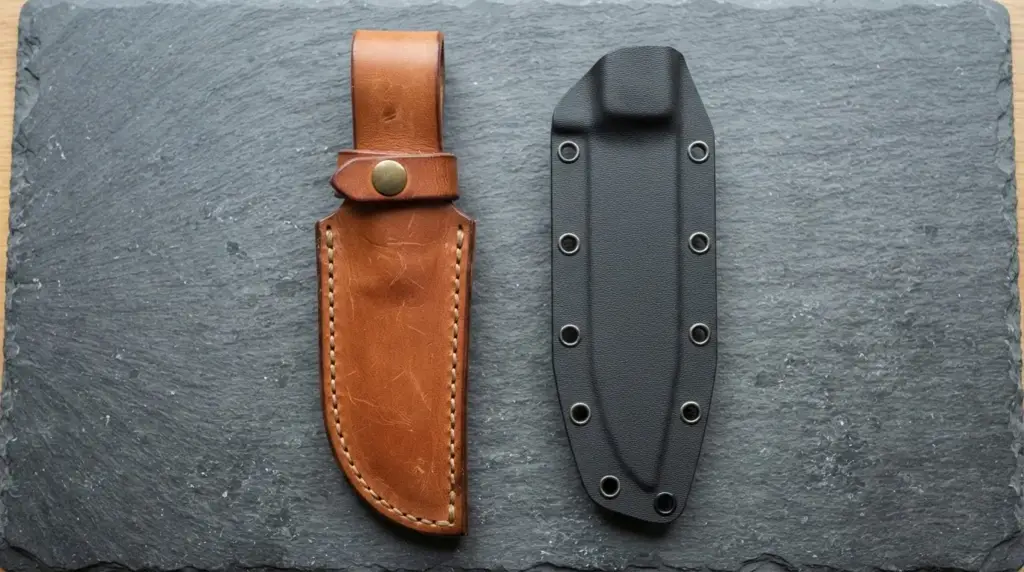
Kydex or Leather: Choosing a Fixed Blade Sheath
Corrosion, retention, thickness, welts and repair compared, and the cases where our own leather is the wrong choice.
Forged or Ground: The Two Ways a Knife Is Made
The two ways a blade is shaped, what each one does to the steel, and what neither can do.
Knife Blade Shapes Explained
What each blade profile is actually built to do, and which one you want.
