


Description
Pattern first
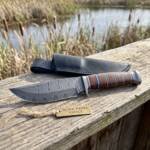
Everything about Grove Serpent starts at the forge. Alternating bars of high and low nickel steel are stacked, welded under heat, drawn out, folded and drawn again until the layer count runs into the hundreds, then the billet is forged to shape and etched. The acid bites the two alloys at different rates, and what comes up is the flowing, contoured banding you can see running the length of this blade — depth you can feel with a fingernail, not a picture printed on flat steel. If you want to know how to tell one from the other, our field test for genuine pattern-welded steel is the short version.
This is a hunting knife first and a beautiful object second, which is the right order. The drop point carries an integral gut hook, the tang runs full width through the handle, and the olive wood scales are fitted to a polished stainless bolster that takes the knock when the knife goes down on rock.
| Overall Length | 9 inches |
|---|---|
| Blade Length | 4.5 inches |
| Handle Length | 4.5 inches |
| Blade Steel | Hand-forged Damascus, acid etched |
| Blade Finish | Acid etched Damascus |
| Blade Style | Drop point with integral gut hook |
| Handle Material | Olive wood |
| Bolster | Polished stainless steel |
| Fittings | Mosaic pin inlay, lanyard hole |
| Tang | Full tang |
| Sheath | Handmade oxblood leather belt sheath with stud closure (included) |
Olive wood
Olive is dense, oily and slow growing, and its grain wanders in a way that no plantation timber manages — pale honey ground crossed by dark chocolate veining, different on every set of scales. Because the wood carries its own oil it stands up to handling far better than an open-pored hardwood, and it warms in the palm within a minute of picking the knife up. A mosaic inlay sits in the centre of the scale and a lanyard opening is drilled through the butt.
The working end
Damascus in a hunting blade is not only decorative. The billet is forged and normalised repeatedly before it is ever ground, which leaves a fine, even grain structure, and the finished blade is hardened to hold a keen working edge through a full field dressing. The hook’s inner curve is opened and polished by hand so it parts hide instead of chewing it, and the belly ahead of it is ground thin enough to skin cleanly. To understand what all that folding actually achieves, read how these billets are built.
Sheath
An oxblood leather belt sheath is included, cut to this blade, formed damp so it takes the exact shape, edge finished and stitched, with a snap strap over the handle. The colour deepens over a season of carry.
Forged and finished in Memphis
The billet is welded, the blade is forged and heat treated, the wood is fitted and the sheath is cut in our Memphis, Tennessee workshop. Layer patterns do not repeat, which means the blade you receive will be recognisably this knife and unmistakably its own — that is the nature of forged steel rather than a disclaimer.
Looking after Damascus
Pattern-welded steel is carbon steel, and carbon steel and moisture are old enemies. Dry the blade thoroughly whenever it has been used or handled, and give it a thin coat of oil before it goes into storage; fingerprints left overnight can etch a ghost into the surface. Never leave it inside the leather. Sharpen on a stone at a consistent angle — the pattern goes all the way through, so honing will never wear it off — and the gut hook takes a small round file. Prefer brass and rosewood to stainless and olive? Vermillion Coil is the other Damascus gut hook in this run.
Who buys this one
Hunters who have already owned a plain working knife and want something with more presence, and collectors who would rather own a forged blade that gets carried than one that lives behind glass. It handles deer, hog and antelope comfortably, and it is a natural choice for a milestone gift where the recipient will notice the difference between forged and stamped.
Model: BMK-1171

Amy Clark –
Ended up ordering a second one after how happy I was with the first. Handle has a great grip even with wet or gloved hands. This has quickly replaced my old go to knife for field dressing. Steel has a gorgeous pattern that looks different in every light. 10/10 would buy again.
Deborah Smith –
Ordering again from this seller the second I finish writing this review. Sheath snaps shut securely and doesn’t feel flimsy at all. Will definitely order again for another one.
Derek Collins –
So happy I finally pulled the trigger on this one. Zero complaints from me on this purchase.
Gary Kim –
This knife is nice but not quite perfect. Nice that it’s US made out of Memphis with solid shipping times.
Emma Murphy –
Best knife I’ve ever owned. Hands down. Weight and balance make it feel like a real working knife not some cheap import. Blade geometry makes it glide through cuts with barely any effort. This is the kind of purchase that makes online shopping worth it.
Dorothy Wells –
Did not expect this level of quality for the price. Zero complaints from me on this purchase.
Joseph Wright –
Ordering again from this seller the second I finish writing this review. Blade holds a razor edge right out of the box. Even the small details in the damascus pattern are crisp and clean. Worth every penny.