
Description
A different way to hold a knife
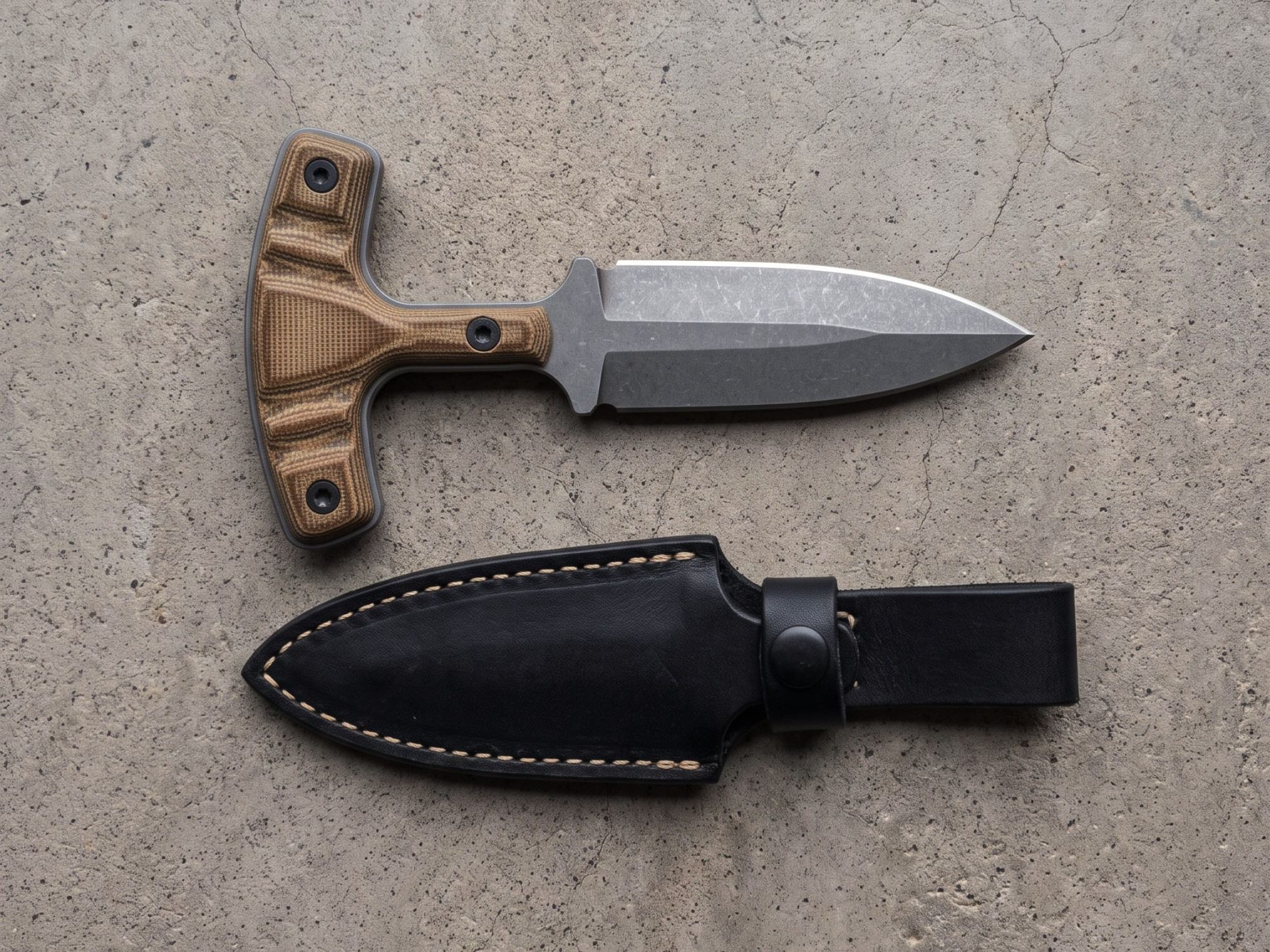
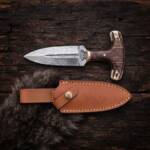
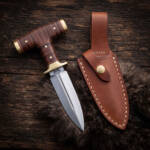
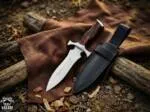
Every other knife in this catalogue is held along its length. The Sand Wraith is not. Its handle crosses your palm at a right angle and the blade emerges from between your middle and ring fingers, which changes the mechanics of the tool completely. You do not grip a push dagger so much as close your fist around it. Force travels up the forearm and straight out through the point instead of being transmitted through your fingers, and because the T-bar is captured behind your knuckles the knife cannot be twisted out of your hand, rotate under load, or slip forward onto the edge when your palm is wet or cold. For anyone whose grip strength is a limiting factor, that is a meaningful difference rather than a marketing line.
The trade is that it has one job and does it in one direction. This is not a slicer, a food knife, or a camp tool. It is a compact, purpose-built defensive and collector piece, and it should be bought as that.
| Overall Length | 7 inches |
|---|---|
| Blade Length | 4 inches |
| Handle Width | 3.5 inches (T-grip) |
| Blade Steel | D2 tool steel |
| Blade Finish | Stonewashed matte gray, non-reflective |
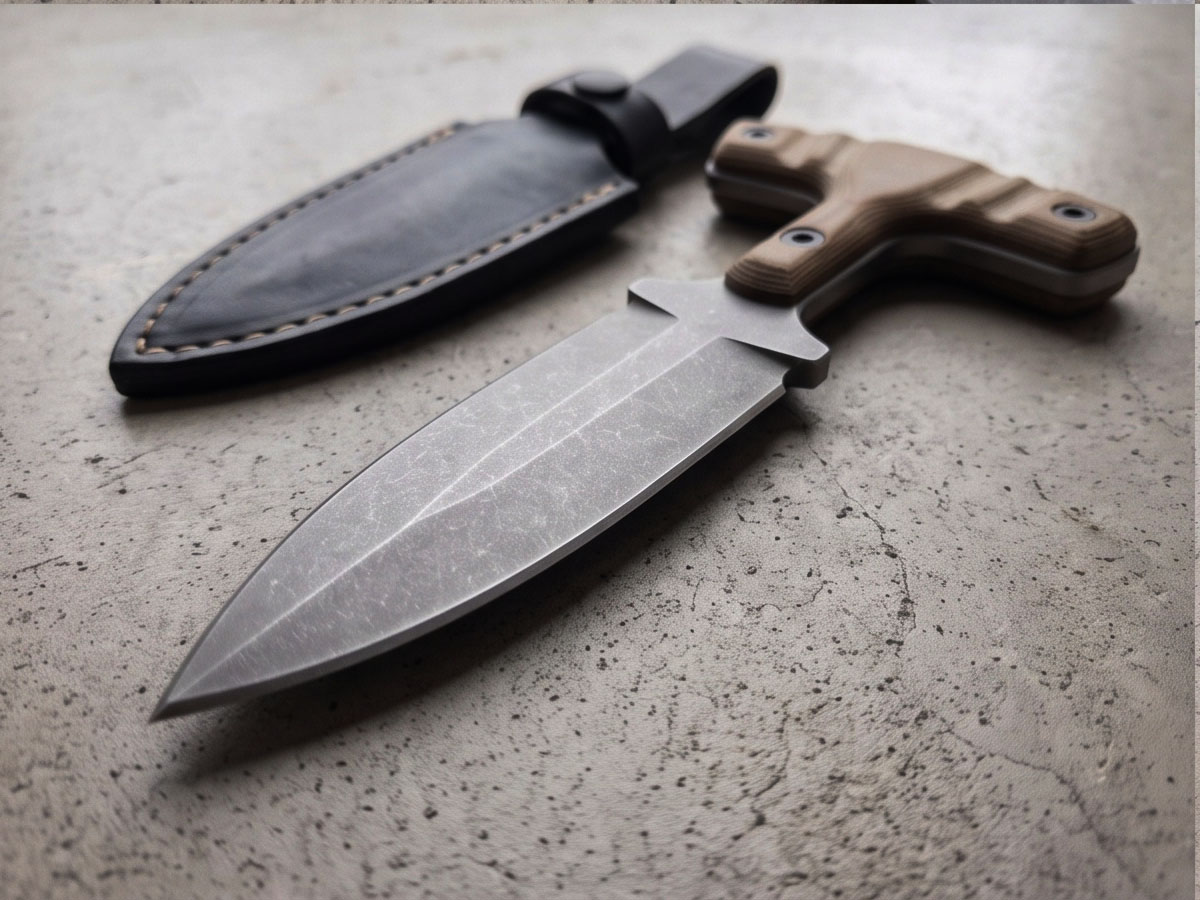
| Blade Style | Double-edged spear point, center fuller |
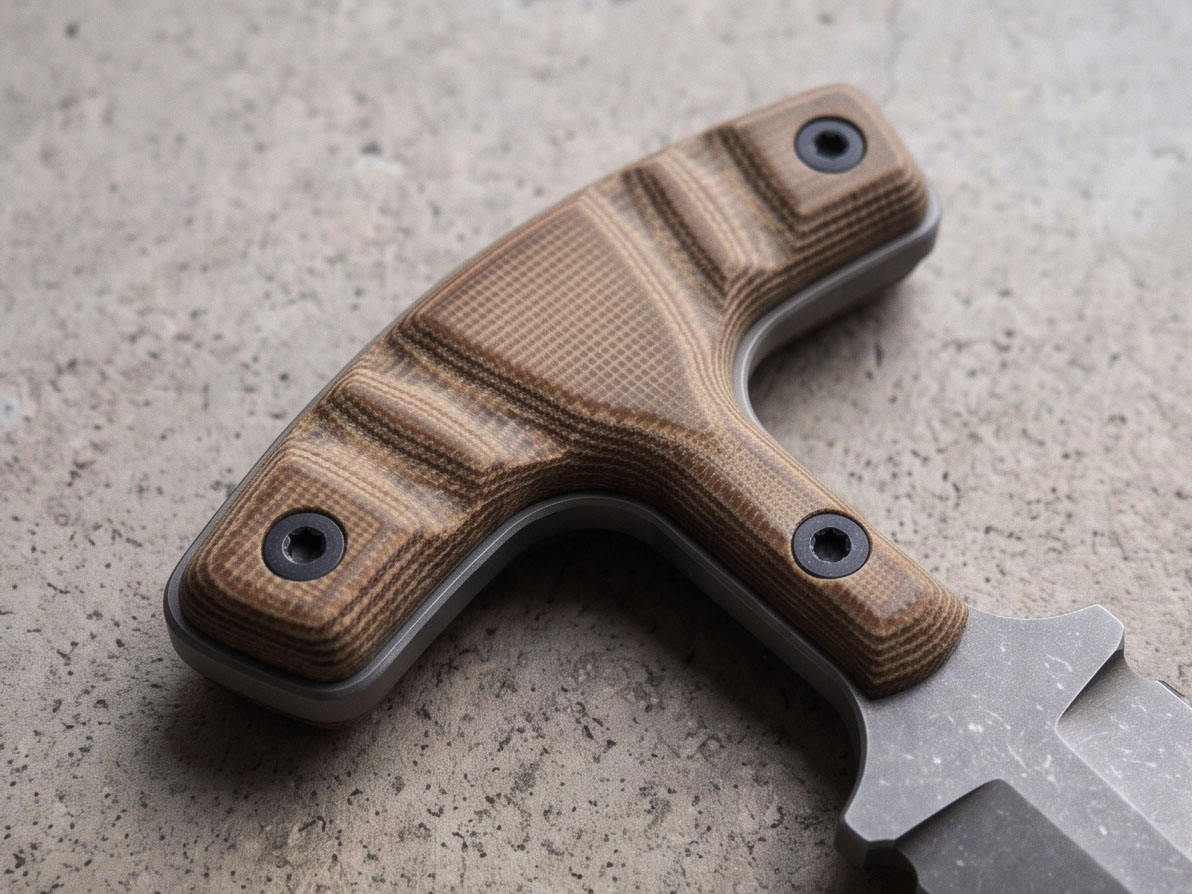
| Handle Material | Coyote tan canvas Micarta with dark liners |
| Fittings | Black socket screw hardware |
| Tang | Full tang |
| Sheath | Handmade black leather sheath with contrast stitching, snap strap and belt loop (included) |
The blade
Four inches of D2 ground as a symmetrical spear point, sharpened on both sides so the profile is the same whichever way up the knife sits in your hand. The bevels converge on a centered tip with material behind it on every side, which is the strongest tip geometry available and the reason the pattern has survived since the nineteenth century. The steel is thick at the spine and thins quickly through the grind, giving the blade rigidity in the middle without leaving a wedge at the edge.
The finish is a stonewash tumbled to a pale, dead grey. It throws almost no light, which matters if you would rather the knife stayed unremarkable, and it hides handling marks permanently, since the surface is already a field of small random scratches. New marks simply join the crowd rather than glaring at you from a polished flat.
Why D2 for this pattern
D2 is an air-hardening tool steel carrying a heavy load of chromium carbides. Those carbides make it very resistant to wear, which is why it was originally used for punches and forming dies, and they are also why it takes patience on a stone. Sharpen it on diamond or on a hard ceramic and it will reward you; use a soft natural stone and it will glaze the surface before it cuts. The chromium content also makes it semi-stainless: far more corrosion-resistant than a plain carbon steel, but not immune, so it should not be stored wet. The comparison against the stainless alloys we use elsewhere is set out in our steel comparison.
Coyote tan Micarta
The T-grip is cut from coyote tan canvas Micarta over dark liners and held with black socket screws. Micarta is woven cloth cured in phenolic resin, so the material is dimensionally stable in heat, cold and damp, and the ground weave produces a texture that becomes grippier as your hands get wet. The cross piece is radiused on every edge so it beds into the palm rather than digging into it, and the shoulders are relieved where your fingers straddle the blade.
Sheath
Black leather, hand-cut and saddle-stitched with contrast thread, wet-formed around this exact blade so the knife seats with an audible click. A snap strap crosses the grip and a wide belt loop rides it flat against the body. Everything about it was made in our Memphis, Tennessee shop, on the same bench as the knife.
Legality, honestly
Push daggers are restricted or prohibited in a number of states and cities, and the rules are inconsistent across the country. Buying one is your responsibility, and we ask you to check your local statute before ordering. Our overview of the knife patterns most commonly restricted in the United States is a starting point, and if you are unclear on where the line between a knife and a dagger falls in legal language, this explainer covers the terminology.
Care
Dry the steel whenever it has been wet, and leave a whisper of oil across the flats if it is going away for a while. Micarta needs soap and water and nothing else. Check the three socket screws every few months and snug them with the correct hex driver if they have backed off. Keep the leather out of direct heat, and do not leave the knife sheathed for months at a time, since trapped moisture is what starts corrosion. If you want a fixed blade with the same stonewashed finish for genuine outdoor work, look at the Moss Talon tracker.
Model: BMK-1223
Buying for groomsmen? This dagger also comes as a matched set of 6, 15% less than buying six singly, and each one can carry its own engraved name.
Carl Thomas –
Absolutely seriously impressed by this pocket knife.
Logan Coleman –
Would call this a solid pickup for the price. Action is good though it needed a little breaking in. Glad I made this purchase.
Devin Lee –
This pocket knife is a genuine work of art. Blade centering is perfect right out of the box. Action smoothed out even more after a few days of carry. This has become my daily carry piece without question. This is going straight into my daily rotation.
Rachel Alvarez –
This pocket knife has already earned a permanent spot in my collection. Lockup is rock solid with no wiggle in any direction. Already added a few more items from this shop to my cart.
Frank Wilson –
So happy I finally pulled the trigger on this one. Detent is snappy without being stiff to open. Liner lock is tight with zero blade play. Fits great in the pocket without feeling bulky. So worth it.