
The push dagger, also called a push dirk or T-handle knife, puts the blade in line with your fist rather than your grip, so force travels straight down the forearm instead of through the fingers. It was the concealed knife of choice in nineteenth-century American gambling halls and remains one of the strongest small-blade designs ever made.
Black Mamba grinds each push dagger from D2 tool steel, hand-forged Damascus or high-carbon steel hardened to 58 to 60 HRC, full tang through the T-handle, with scales in rose wood, stag antler, buffalo horn, ebony, stabilised burl, Micarta or G10, and a hand-stitched leather sheath shaped for horizontal belt or boot carry. Looking for a straight double-edged blade instead? See our Damascus daggers.
Why the T-handle matters. A conventional knife can twist or slip in the hand under load. A push dagger cannot, the handle sits across the palm, so the grip stays secure even with wet or gloved hands. It is the one blade shape that does not care how tired your hand is.
-
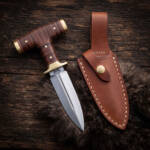
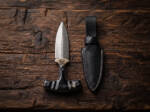
Bronze Fist Handmade D2 Steel Mirror Polished Push Dagger with Rosewood Handle, Brass Bolster & Leather Sheath | Classic EDC Knife | BMK-1194
Original price was: $158.00.$126.00Current price is: $126.00. -
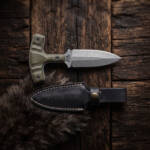
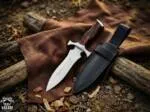
Trenchline Handmade D2 Steel Stonewashed Push Dagger with Olive Green Micarta Handle & Leather Sheath | Tactical EDC Knife | BMK-1192
Original price was: $138.00.$110.00Current price is: $110.00. -
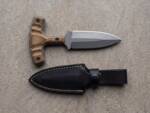
Sand Wraith Handmade D2 Steel Stonewashed Spear Point Push Dagger with Coyote Tan Micarta Handle & Black Leather Sheath | Tactical EDC Gift | BMK-1223
Original price was: $106.00.$85.00Current price is: $85.00. -
Brass Sentinel Handmade D2 Steel Push Dagger with Stacked Leather Handle, Brass Guard & Pommel | Traditional Collector Knife | BMK-1202
Original price was: $167.00.$134.00Current price is: $134.00. -
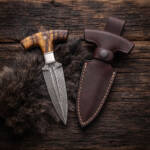
Shadow Fang Handmade D2 Steel Dagger Knife | Rose Wood Handle | Steel Clip | Leather Sheath | Camping & Hunting Gift | BMK-690
Original price was: $220.00.$176.00Current price is: $176.00. -
Nightspike Handmade Damascus Push Dagger with Black G10 Handle, Red Liners & Leather Sheath | Collector EDC Knife | BMK-1191
Original price was: $187.00.$150.00Current price is: $150.00. -
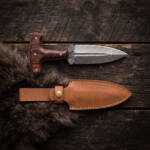
Blackhorn Handmade High Carbon Steel Push Dagger with Buffalo Horn Handle & Leather Sheath | Traditional EDC Knife | BMK-1200
Original price was: $133.00.$106.00Current price is: $106.00. -
Snowburl Handmade D2 Steel Mirror Polished Push Dagger with Stabilized Burl Wood Handle & Leather Sheath | Collector EDC Knife | BMK-1198
Original price was: $162.00.$130.00Current price is: $130.00. -
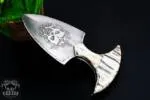
Kippah 4 Inches Blade D2 Steel Push Dagger Deep Skull Engraved Knife with Antique Tooth Handle | BMK-1100
Original price was: $320.00.$256.00Current price is: $256.00. -
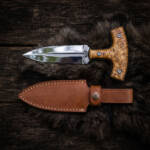
Stagwedge Handmade Damascus Push Dagger with Stag Antler & Walnut Handle, Brass Bolster & Leather Sheath | Collector Knife | BMK-1197
Original price was: $216.00.$173.00Current price is: $173.00. -
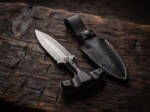
Ironfist Handmade Damascus Push Dagger with Black Micarta Handle, Brass Spacer & Leather Sheath | Tactical Collector Knife | BMK-1199
Original price was: $180.00.$144.00Current price is: $144.00. -
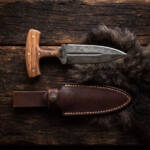
Forgepoint Handmade High Carbon Steel Push Dagger with Rosewood Handle, Brass Pins & Leather Sheath | Working EDC Knife | BMK-1201
Original price was: $129.00.$103.00Current price is: $103.00. -
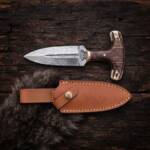
Rosethorn Handmade Damascus Push Dagger with Rosewood Handle, Brass Pins & Leather Sheath | Collector EDC Knife | BMK-1196
Original price was: $184.00.$147.00Current price is: $147.00. -
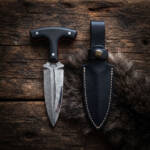
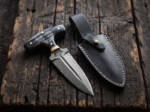
Ravenpoint Handmade Damascus Push Dagger with Ebony Wood Handle & Leather Sheath | Collector EDC Knife | BMK-1195
Original price was: $181.00.$145.00Current price is: $145.00.
Choosing between the steels
| Steel | Finish | Why people pick it | Upkeep |
|---|---|---|---|
| Damascus | Etched pattern, brass or steel bolsters | The collector choice, the pattern is the point | Wipe dry, light oil; will spot if stored damp |
| D2 tool steel | Mirror polished or stonewashed | Best edge retention; semi-stainless, so it forgives more | Low, dry it after use |
| High carbon | Forge finish or satin | The lowest price in the collection and the easiest to sharpen | Highest; it will patina, and that is normal |
Handle materials are a look, not a performance question, stag antler and buffalo horn are the traditional pairing, stabilised burl and resin photograph best, and Micarta or G10 are the ones you pick if the knife is actually going in a pocket.
Related: Damascus karambit knives for the other great secure-grip design, D2 steel knives, and our knife vs dagger guide if the terminology is new.
Questions people ask
What is a push dagger used for? Historically self-defence and last-ditch carry. Today most owners buy them as collector pieces, though the shape is genuinely useful for piercing and detail cutting tasks.
Are push daggers legal? Rules vary by state and country, and push daggers are specifically named in some state statutes. Please check your local law before ordering. We ship to all US states, but the responsibility for local compliance is the buyer's.
How big is a push dagger? Typically 4 to 7 inches overall with 2 to 3.5 inch blades, single or double edged. Each product page lists its own measurements.
Is a push dagger stronger than a normal knife? At the handle, yes, there is no wrist leverage trying to twist the blade out of your grip, and the tang runs straight through the T. The blades are short, so they are not pry bars, but for their size they are about as robust as a knife gets.
How does the sheath carry? The leather sheath is shaped for horizontal belt or boot carry rather than a vertical drop, because a T-handle sitting upright on a belt is uncomfortable and obvious.
What comes in the box? A fitted leather sheath and a certificate of authenticity.
Freshly finished and added here: Brass Sentinel D2 Steel Push Dagger with Stacked, Forgepoint High Carbon Steel Push Dagger with Rosewood, Blackhorn High Carbon Steel Push Dagger with Buffalo and Ironfist Damascus Push Dagger with Black Micarta.
The grip is the whole point
A push dagger sits in a closed fist with the blade coming out between two fingers and the handle across the palm. That means the force runs straight down your forearm instead of through your wrist and finger grip, so the knife cannot twist out of your hand and does not need a long handle to stay put. It is the reason the pattern turns up in gloves, in wet hands and in the back of a drawer as a last resort tool. The cost is that it does almost nothing else. You cannot carve with it, you cannot slice with it and you will not be dressing an animal with one.
What to check before you buy one
Three things separate a real push dagger from a novelty. The tang should run the full width of the handle rather than a pin pressed into a scale, because the whole load sits on that joint. The sheath should hold the knife by friction on the blade and not just on the crossbar, or it will fall out when the handle knocks against something. And the bolsters should be pinned and peened rather than glued. Everything here is full tang and ships with a fitted leather sheath. The steels differ, and that is what the table above is for.
Where a push dagger fits, and where it does not
If you want a small carry knife for opening, trimming and general use, a neck knife or something from the folding pocket knives will serve you far better. A push dagger is a specialist. Read the push dagger guide for the pattern, the grip and the legal position before you order, because double edged blades are restricted in some places. The rest of the range sits in fixed blade knives.
Buying for a wedding party? The groomsmen knife sets come as six matched knives, 15% less than buying them singly, and each one can carry its own engraved name.
