
Description
Rain on hot steel
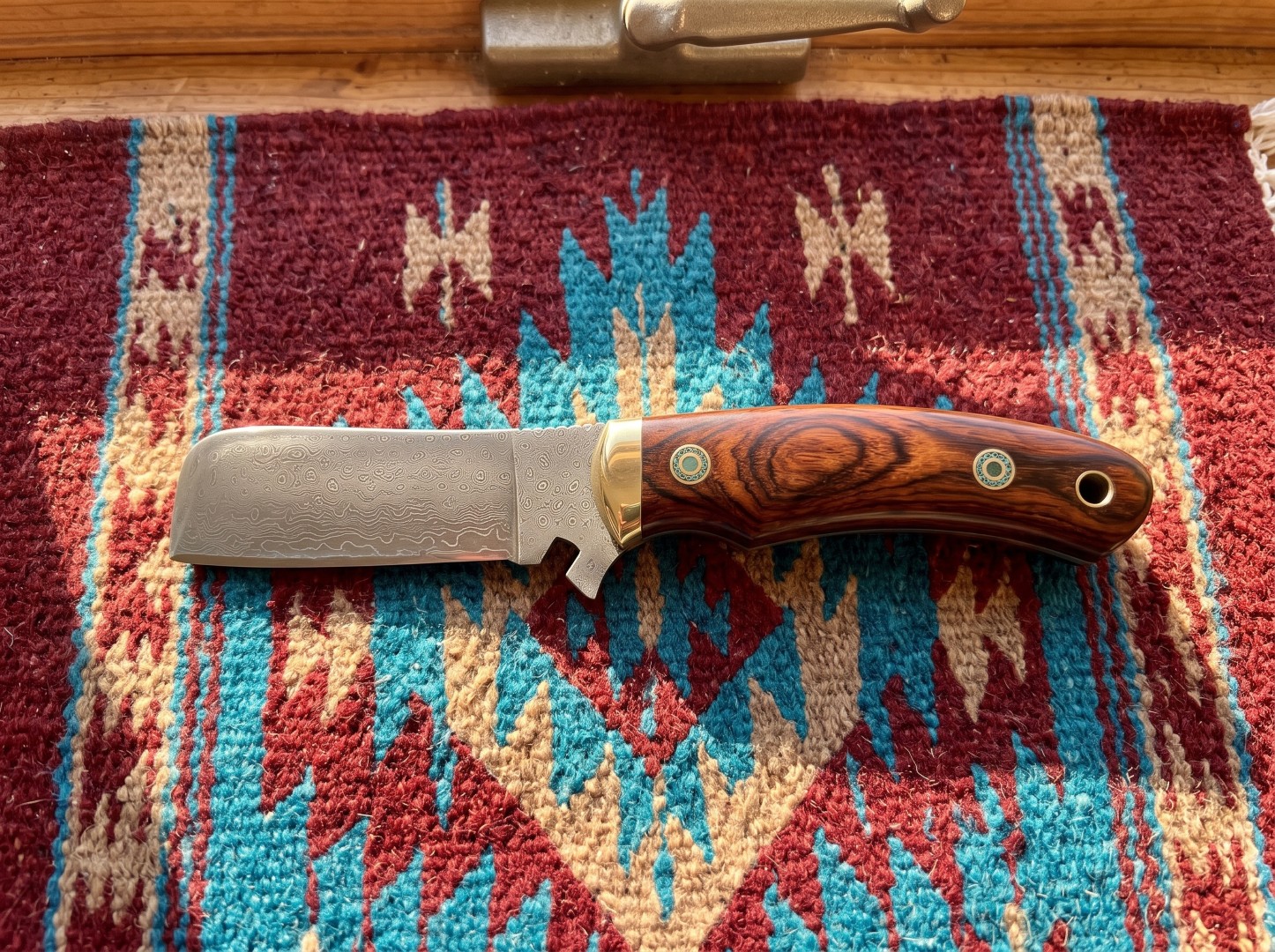
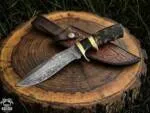
Look down the flat of this blade and you will find rings — dozens of small concentric halos scattered across a gray and silver ground, the way a stock pond looks in the first half minute of a summer shower. That is the raindrop pattern, and it is not decoration applied after the fact. Before any bevel is ground, the welded billet is drilled with a shallow grid of dimples and then forged back flat. Every layer underneath a dimple gets pushed down and re-exposed, so when the acid finally goes on, the etch reads as ripples. It is a slow way to treat a piece of steel, and there is no way to hurry it.
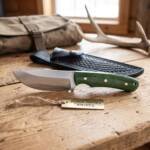
Underneath the pattern sits a cowboy bull cutter: a short, blunt-nosed sheepsfoot with a wide flat belly and a notched choil where your forefinger falls without being told. Ranch hands gravitated toward this outline because it has almost no point to catch on a hide, a cinch strap, or the inside of a feed sack. You push it, you rock it, you draw it toward yourself against a board — the whole edge stays in contact instead of just an inch behind the tip. For anyone who has fought a drop point through a stack of trimming work, the difference shows up in the wrists first.
The steel and the etch
Pattern-welded stock behaves like the carbon steel it is made from, because that is what it is: alternating bars of two high-carbon alloys forge-welded, folded, and drawn out again. The layers give you the picture. The heat treat gives you the edge. Ours is normalized three times before hardening so the grain settles, then quenched and tempered to a working hardness that takes a keen edge on a stone without chipping when it meets a bone or a staple. If you want the long version of how a billet becomes a blade, our write-up on how Damascus steel is made walks through the whole sequence, dimples included.
Rosewood, brass, and two mosaic rosettes
The scales are rosewood, chosen dark and heavily figured, with grain that runs in long chocolate streaks through a warmer orange body. Rosewood has natural oils in it, which is why it stays comfortable in cold weather when a synthetic scale would feel like a fence post. It is contoured with a slight palm swell and rolled at every edge, so there is nothing to bite you during a long session. A solid brass bolster caps the front, two mosaic pin rosettes sit in the middle of each scale, and a steel-lined lanyard hole is drilled through the butt for a wrist loop or a saddlebag tether.
| Overall Length | 7.5 inches |
|---|---|
| Blade Length | 3.5 inches |
| Handle Length | 4 inches |
| Blade Steel | Hand-forged raindrop pattern Damascus, acid etched |
| Blade Style | Sheepsfoot bull cutter with notched choil |
| Handle Material | Rosewood |
| Bolster | Solid brass |
| Fittings | Mosaic pin inlays, steel-lined lanyard hole |
| Tang | Full tang |
| Sheath | Handmade leather belt sheath (included) |
Model: BMK-1152
A hand-cut leather belt sheath comes with it, stitched and burnished at the shop rather than bought in. If you like the same working outline in a hand-forged twist pattern with antler scales instead, the Buckhorn Twist bull cutter is its closest cousin on the bench.
Keeping it honest
Carbon-bearing pattern steel is reactive by design; that reactivity is what makes the two alloys etch to different tones in the first place. Treat the finish as something that will change and you will enjoy it more. Rinse it when it has been in citrus, onion, or blood, dry it with a rag rather than letting it drip, and give the flats a thin smear of food-safe oil whenever the surface starts looking thirsty. Store it out of the leather between uses. If a haze ever creeps in, a gray kitchen pad and a little oil will take it off without touching the pattern. Sharpen on a whetstone at the angle it came to you, work the burr off both sides evenly, and this knife will still be cutting long after the person who bought it has stopped counting years.
Every one of these is built, ground, etched, and finished in our Memphis, Tennessee shop, one at a time.
Michael Cruz –
This is hands down one of the best knives I’ve bought online. Took it out camping right away and it handled everything I threw at it. Leather sheath is thick and well stitched. Not the cheap stuff you usually get. Already telling my friends to check this out.
Carlos Wood –
Wasn’t expecting to be this impressed but here we are. Edge retention has been great even after regular use in the field. Can’t recommend this enough.
Deborah Turner –
Got this as a birthday gift and it exceeded what I expected. Blade geometry makes it glide through cuts with barely any effort. Handle has a great grip even with wet or gloved hands. Steel has a gorgeous pattern that looks different in every light. Nice to support a Memphis based knife maker, shipping was fast even internationally. Would not hesitate to order again.
Todd Gutierrez –
This knife punches way above its price point. This is why Black Mamba Knives is my go to for anything knife related. This is the kind of purchase that makes online shopping worth it.
Malik Myers –
My skepticism about ordering online disappeared the second this arrived. Fit and finish is museum quality. You can tell real craftsmen made this by hand. Leather sheath is thick and well stitched. Not the cheap stuff you usually get. This is exactly why I keep coming back to this maker.
Brenda Stewart –
This knife looks even better in person than in the listing photos. Nice to support a Memphis based knife maker, shipping was fast even internationally.
Joseph Diaz –
This knife is amazing. No question about it. Blade holds a razor edge right out of the box. Blade geometry makes it glide through cuts with barely any effort. Edge retention has been great even after regular use in the field. Beyond happy with how this turned out.
Sharon Murphy –
Knew this knife was special the second I opened the box. Every piece of the fit and finish looks hand checked before it shipped. This company just earned a repeat customer.
Christopher Green –
Can’t stop showing this off to everyone who comes over. Edge retention has been great even after regular use in the field. This has quickly replaced my old go to knife for field dressing. This is exactly why I keep coming back to this store. This is my third order from Black Mamba Knives and they never disappoint.
Sharon Alvarez –
Been eyeing this knife for months and it did not disappoint. This seller clearly takes pride in their work.