Damascus steel patterns, and how each one is made
Raindrop, ladder, twist, feather, mosaic. The names get thrown around like colour swatches, but every one of them is the result of something specific done to the billet at the forge. Here is what each pattern is, how it is made, what it costs to make, and which ones are a sign the maker knew what they were doing.
A pattern is a record of what happened to the steel
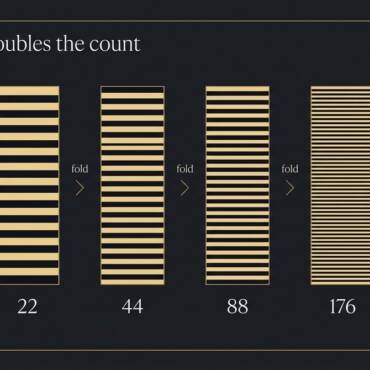
Damascus is two steels forge welded together. We use 1095, a high carbon steel that etches dark, and 15N20, which carries about two percent nickel and stays bright in the acid. Stack them, weld them, draw them out, fold them, and you have layers. So far every billet looks the same: straight lines.
 Damascus Balisong Butterfly Knife Original Traditional Filipino Butterfly Batanga Knife with Handmade Steel and Raindrop Handle Black Mamba Knives USA | DB-12
 Damascus Balisong Butterfly Knife with Beautiful Wooden Handle Rain Drop Pattern Handmade Original Traditional Filipino Butterfly Batanga Knife Black Mamba Knives USA | DB-29
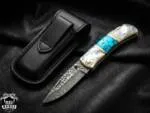 Azure Gem Hand Forged Rain Drop Damascus Pocket Knife | Sea Shell Turquoise Handle | And Leather Sheath Camping, Hunting, Christmas Gift & Him | BMK-682
The pattern appears when you deliberately disturb those lines before the blade is ground. Drill into them, press them, twist them, cut and restack them. Whatever you do to the billet is still there when the blade is etched, because you are looking at a cross-section of the layers. That is the whole trick. The pattern is not applied to the surface; it is the inside of the steel showing through.
Which also means this: if a pattern is identical on both sides of a blade in a perfectly repeating way, or it stops at the edge bevel instead of continuing through it, you are looking at an etched or printed imitation rather than forged Damascus.
Seven patterns, and what each one takes
| Pattern | How it is made | Difficulty | Looks like |
|---|---|---|---|
| Random or wild | Fold and draw with no deliberate disturbance | Baseline | Flowing irregular lines, no repeat |
| Ladder | Grooves cut or pressed across the billet, then flattened | Moderate | Regular rungs running across the blade |
| Raindrop | Round dimples drilled or pressed into the billet, then flattened | Moderate | Concentric rings, like rain on water |
| Twist | The bar is heated and physically twisted along its length | Hard | Spiralling rope-like bands |
| Feather | Billet split down the middle and folded open around a core | Very hard | A central spine with barbs running out from it |
| Mosaic | Small patterned bars cut and restacked into a design | Very hard | Repeating tiles, stars, letters, geometry |
| Explosion or starburst | Deep central press or punch that drives layers outward | Hard | Rays radiating from a point |
Difficulty is not marketing. A twist bar can delaminate if the heat is uneven. A feather billet is split, opened and rewelded, and if the weld fails anywhere along that seam the whole bar is scrap. That is why feather Damascus knives cost what they cost, and why a shop that sells a lot of them is telling you something about its capability.
Does the pattern change how the knife cuts?
Barely, and anyone who tells you otherwise is selling something. Edge performance comes from the alloys, the layer count within reason, the heat treatment and the geometry of the grind. A raindrop blade and a ladder blade cut identically if both are 1095 and 15N20 at 58 to 60 HRC.
There is one honest exception. Aggressive manipulation on a very high layer count can leave the pattern crossing the edge at a slight angle, which some people claim gives a microscopically toothier edge. It is real, it is tiny, and you will not notice it while dressing a deer. Buy the pattern you like the look of.
Four ways to tell a forged pattern from a printed one
Follow it over the bevel
Forged pattern continues through the edge bevel, because the layers go all the way through the steel. A printed pattern stops where the grinder cut, or distorts unnaturally.
Compare the two sides
Real Damascus is never identical front and back. It is a cross-section, so each face is a different slice. Perfect symmetry is a printed sheet.
Look at the spine and the tang
The pattern should be visible on the spine and, if the tang is exposed, along that too. Printing stops at the polished faces.
Ask for the alloys
A maker who forges will name them without hesitating: 1095 and 15N20 here. If the answer is just "Damascus steel", that is not an answer.
The pattern needs the etch, and the etch needs care
The contrast you are looking at is an acid etch. The 1095 layers are eaten slightly deeper and go dark; the nickel-bearing 15N20 resists and stays bright. Over years of sharpening and polishing, the etch on the flats can fade, particularly near the edge.
Fixing it is straightforward: degrease, a short dip in dilute ferric chloride, neutralise, rinse, dry and oil. We do this for customers on knives we made, at no charge, for as long as the knife exists. Do not use a bench grinder or a buffing wheel on the flats unless you want the pattern gone.
Everyday care is smaller than people expect. Dry it. Wipe a little mineral oil along the blade if it will sit for a while. That is it. Full detail is in caring for a Damascus blade.
Questions people ask
What is the most difficult Damascus pattern to make?
Feather and mosaic, for different reasons. Feather requires splitting a billet, opening it around a core and rewelding it, and a single failed weld along that seam scraps the bar. Mosaic requires cutting patterned bars and restacking them into a design, where every join is another chance to fail.
Does the Damascus pattern affect how well a knife cuts?
Almost not at all. Cutting comes from the alloys, the heat treatment and the grind geometry. Two blades of the same steel at the same hardness cut the same whether the pattern is raindrop or ladder. Choose the pattern you like looking at.
How is a raindrop Damascus pattern made?
Round dimples are drilled or pressed into the surface of the billet, then the billet is forged flat again. Flattening exposes deeper layers in rings around each dimple, which is why the finished blade looks like rain landing on water.
What is ladder pattern Damascus?
Grooves are cut or pressed across the billet at regular intervals and then the bar is flattened. The layers exposed at the bottom of each groove appear as rungs running across the width of the blade.
Can a Damascus pattern be fake?
Yes, and a great deal of what is sold online is. The pattern is laser etched, printed or chemically applied to a plain steel blade. Follow the pattern over the edge bevel and compare both faces; a forged pattern continues through the steel and is never identical on both sides.
Why does my Damascus pattern look faded?
The contrast comes from an acid etch, and sharpening or polishing slowly removes it. It can be re-etched. We do it free of charge on any knife we made.
Which steels do you use for Damascus?
1095 and 15N20. The 1095 etches dark, the 15N20 carries nickel and stays bright, and that difference is what makes the pattern visible at all. Our standard billet is 352 layers.
Is a higher layer count better?
Up to a point. Past roughly three hundred layers the returns flatten and you are buying appearance rather than performance. There is a longer version of this answer in what 352 layers actually means.
See the patterns on real blades
Every pattern above is forged in our own Memphis shop. Nothing here is etched on afterwards.
Shop the knives
Damascus Balisong Butterfly Knife Original Traditional Filipino Butterfly Batanga Knife with Handmade Steel and Raindrop Handle Black Mamba Knives USA | DB-12Damascus Balisong Butterfly Knife with Beautiful Wooden Handle Rain Drop Pattern Handmade Original Traditional Filipino Butterfly Batanga Knife Black Mamba Knives USA | DB-29Azure Gem Hand Forged Rain Drop Damascus Pocket Knife | Sea Shell Turquoise Handle | And Leather Sheath Camping, Hunting, Christmas Gift & Him | BMK-682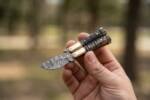 Damascus Balisong Butterfly Knife with Ram Horn and Beautiful Brass Handle with Ladder Pattern Handmade Original Traditional Filipino Butterfly Batanga Knife Black Mamba Knives USA | DB-19
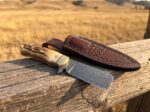 Buckhorn Twist Handmade Twist Damascus Cowboy Bull Cutter Knife with Stag Antler Handle, Brass Bolster & Tooled Leather Sheath | Hunting Ranch Gift | BMK-1150
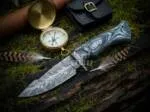 Pathfinder Handmade Feather Damascus Steel Blade Bowie Knife, EDC Knife, Best Birthday & Anniversary Gift, Christmas Gift | BMK-667