
What 352 layers of Damascus steel actually means
The number sits on almost every Damascus knife listing on the internet — ours included. Here is the honest version: where 352 comes from, what the layer count genuinely buys you, and the point past which more folds stop making a better knife.
352 is a folding count, not a quality score
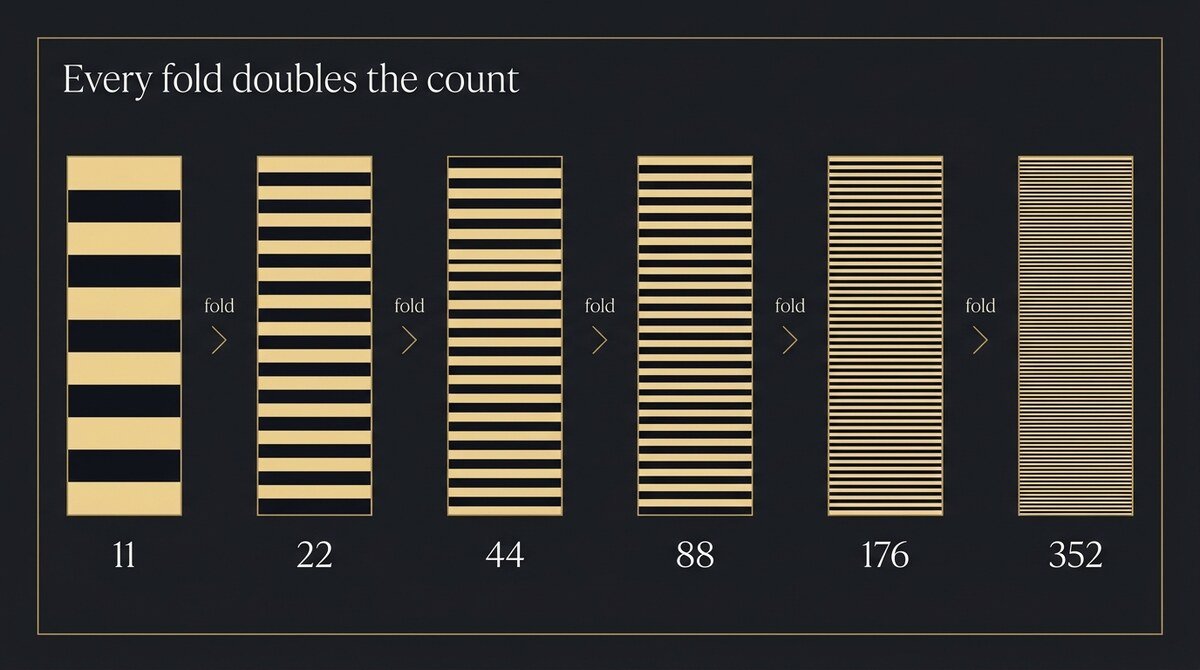
352 layers means the smith stacked alternating bars of two different steels — usually eleven of them — forge-welded that stack into one solid billet, and then folded it five times. Every fold doubles the count: 11, 22, 44, 88, 176, 352. That is the entire story behind the number. It describes how many times the steel was folded, and nothing else.
What the number does not tell you: which steels are in the billet, how the blade was heat treated, what hardness it finished at, or how thin the edge was ground. Those four things decide how a knife cuts and how long it keeps cutting. The layer count decides what the pattern looks like.
Where the number comes from
Pattern-welded steel begins as a stack of two alloys that react differently to acid. One is a plain high-carbon steel that etches dark. The other carries nickel, which resists the acid and stays bright. Weld them together, fold them, and that contrast becomes the pattern you can see.
 BLACK MAMBA KNIVES Fallen 3 Inches Blade Damascus Folding Pocket Knife Hunting Tool USA Made | BMK-120
 Chihuahuan Snake 8.7 Inches Long 4.6 Inches Blade 5.6 Ounce Damascus Gut Hook Hunting Fixed Blade Knife Damascus Hand Made World Class USA Made | BMK-167
 Black Mamba Knives Dragon Knife 12″ Long 7“ Blade 13oz Damascus Steel Fixed Blade Hunting Knife Hand Made World Class Knives USA MAde | BMK-105
| Stage | Layers | What is happening |
|---|---|---|
| Starting stack | 11 | Bars cut, cleaned and clamped into a billet |
| Fold 1 | 22 | Billet drawn out, cut, folded back on itself |
| Fold 2 | 44 | Pattern still coarse and very legible |
| Fold 3 | 88 | The classic wavy look starts to appear |
| Fold 4 | 176 | Tight, even flow across the whole blade |
| Fold 5 | 352 | Fine, dense grain — the usual stopping point |
Every one of those folds is a separate forge welding operation. The billet has to come back up to welding heat, be struck true, and be kept clean enough that nothing traps between the layers. A single bad weld anywhere in that chain shows up later as a visible flaw, which is why the billet gets inspected between folds rather than at the end.
Why more layers stop helping past about 300
This is the part most listings leave out. Folding does two useful things early on: it distributes the two alloys evenly, and it refines the grain of the steel. Both of those jobs are essentially finished within the first few folds. Keep going and you are no longer improving the steel — you are only making the pattern finer.
The layers get too thin to see
Blade stock is only a few millimetres thick. Divide that across 352 layers and each one is thinner than a human hair. Double it again to 704 and the acid can no longer resolve them cleanly — the pattern starts to grey out into a flat wash instead of sharpening up.
Grain refinement has a floor
Forging refines grain, but so does a properly controlled heat treat, and the heat treat is what sets the final structure anyway. Once the grain is fine and even, another fold does not make it finer. It just adds another welding operation that can go wrong.
Every fold is another risk
Each extra fold means another cycle at welding heat. That means more decarburisation at the surface, more chance of an inclusion, and more chance of a cold shut hiding inside the billet. More folds is more exposure, not more insurance.
So why do so many knives say 352?
Because five folds off an eleven-bar stack is the sweet spot the trade settled on. It is fine enough that the pattern reads as flowing rather than striped, coarse enough that it still etches with real depth and contrast, and it is reachable without pushing the billet through welding heat more times than necessary. It became a convention because it works — not because 352 is a magic number.
If you see a knife advertised at 1,000 or 5,000 layers, nothing dishonest is necessarily going on. Those counts are real and they are achievable. But past a certain density you are buying a different look, not a sharper or tougher blade. Anyone telling you a 5,000-layer blade cuts better than a 352-layer blade of the same steel, hardness and geometry is selling you the number.
The four things that decide how it cuts
If you are comparing two Damascus knives and want to know which one will perform better, ignore the layer count and ask about these instead.
Steel choice
Which alloys are in the billet, and what the cutting edge is made of. A high-carbon core will take a keener edge than a stainless one; a stainless core will shrug off moisture that would spot a carbon blade overnight. Neither is better in the abstract — they are better at different jobs.
Heat treatment
The single biggest variable, and the least advertised. The same steel can finish soft enough to roll or hard enough to chip depending on how it was quenched and tempered. A well heat-treated common steel beats a badly heat-treated exotic one every time.
Geometry
How thick the blade is behind the edge. This is what makes a knife feel like it is falling through material rather than wedging into it. Two knives with identical steel and hardness can feel like different tools entirely because of a fraction of a millimetre here.
Finishing and fit
Whether the handle is properly bedded, the tang fully supported, the plunge lines even, the etch deep enough to survive a few sharpenings. This is where hand work shows up and where mass production usually does not.
How to tell a forged pattern from a printed one
Real pattern-welded steel is a physical structure that runs all the way through the blade. Laser-etched or acid-stencilled patterns sit on the surface of a single piece of steel. Four checks separate them, and you can do all four in a shop.
Signs of the real thing
- The pattern continues over the spine and the tang. A surface print usually stops at the flats because that is all anyone was meant to look at.
- The pattern is not repeating. Forged layers distort around the bevel and the tip. Printed patterns tile.
- You can feel it. A proper etch leaves the dark layers very slightly recessed. Run a fingernail across the flat.
- It changes at the plunge. Where the grind meets the ricasso, real layers get cut at an angle and the pattern shifts with them.
Warning signs
- A pattern that is perfectly identical on both sides of the blade
- Pattern that stops dead at the handle or at the spine
- A completely flat, glassy surface with no etch relief at all
- A layer count quoted with no mention of which steels were used
- A price that does not account for days of forge work
One caveat, in fairness: a very high polish can reduce the etch relief on a genuine blade, so the fingernail test is supporting evidence rather than proof. The spine and tang check is the reliable one.
Keeping the pattern visible for years
The pattern is an etch, and an etch is a surface condition. It will fade with heavy use, aggressive polishing compounds, or a run through a dishwasher. None of that is damage to the steel — but it does mean the thing you paid for stops showing.
Dry it, then oil it
Wipe the blade dry after every use and put a thin film of mineral oil on it. On a carbon-cored blade this is not optional — surface rust will eat the contrast before it eats the steel.
Never the dishwasher
Detergent is alkaline and the cycle is long and hot. It strips the etch, dulls the contrast and attacks the handle at the same time. Hand wash, always.
Sharpen the edge, not the flat
Keep the stone on the bevel. Dragging abrasive across the flats is what wears a pattern out fastest, and it is almost always avoidable.
Bringing a faded pattern back
A dulled etch can usually be revived at home. Clean the blade completely of oil with rubbing alcohol, wipe it evenly with a mild acid — strong instant coffee, vinegar or a proprietary ferric chloride solution diluted per its instructions — leave it a few minutes, rinse thoroughly in water with a little baking soda to neutralise, dry it fully and re-oil. Work in short passes and check as you go; the contrast comes back before you think it will. Tape off the handle first, and do not attempt this on a blade you are not comfortable refinishing.
If you would rather not do it yourself, talk to us before you try anything abrasive. A faded etch is normal wear rather than a warranty fault, but we would still rather look at the knife than watch someone sand the pattern off it. Our warranty and returns page sets out what is and is not covered.
Questions we actually get asked
Is a 352-layer knife better than a 176-layer knife?
Not inherently. It has a finer pattern. If both blades use the same steels, the same hardness and the same grind, they will cut the same. Choose on the pattern you prefer and on the specification of the cutting edge, not on the count.
Does folding make the steel stronger?
It did historically, when the raw material was inconsistent and folding was how a smith evened it out. Modern steel arrives clean and uniform, so folding today is mainly about the pattern. The strength comes from the alloy and the heat treat.
Will the pattern wear off?
The etch can fade with heavy use or aggressive cleaning. The layers themselves go all the way through the blade, so the pattern can be re-etched. It is a surface finish, not a coating.
Why is Damascus more expensive than a plain blade?
Because of the hours. Before a Damascus blade is even a blade, the billet has been through five welding cycles, each one hand-worked and inspected. A monosteel blade skips all of that. You are paying for forge time.
Is Damascus steel high maintenance?
A carbon-cored Damascus blade needs drying and oiling — roughly the same care a cast iron pan needs. That is the whole routine. Skip it for months in a humid kitchen and you will get spotting.
Do you say 352 layers on your own knives?
On many of them, yes, and now you know exactly what that describes. We are working through our catalogue so each listing states the steels and the pattern for that specific knife rather than repeating one number. If a listing you are looking at is not specific enough, email us and we will tell you what is in it.
Forged by hand, since 2009
Every Black Mamba blade is hand-forged and hand-finished in our Memphis, Tennessee shop, and carries a free lifetime craftsmanship warranty. Expedited shipping within the USA is free on every order, with no minimum.
Layer count is only half the story. For what actually creates the visible pattern, and how each one is forged, read Damascus steel patterns explained.
Shop the knives
BLACK MAMBA KNIVES Fallen 3 Inches Blade Damascus Folding Pocket Knife Hunting Tool USA Made | BMK-120Chihuahuan Snake 8.7 Inches Long 4.6 Inches Blade 5.6 Ounce Damascus Gut Hook Hunting Fixed Blade Knife Damascus Hand Made World Class USA Made | BMK-167Black Mamba Knives Dragon Knife 12″ Long 7“ Blade 13oz Damascus Steel Fixed Blade Hunting Knife Hand Made World Class Knives USA MAde | BMK-105 Zeus 6.5 Long High End Damascus Pocket Knives Mokume Bolsters, Antique Animal Tooth, Red Ruby, Pure White Diamond USA Made | BMK-1008