

Description
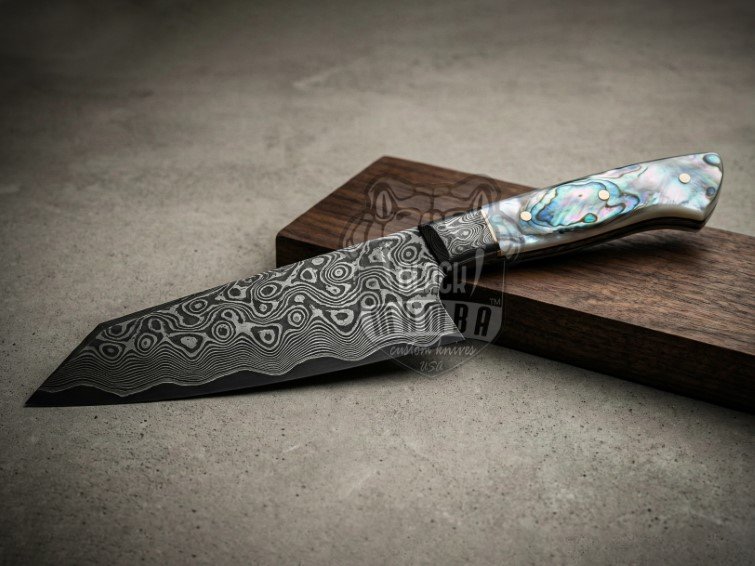
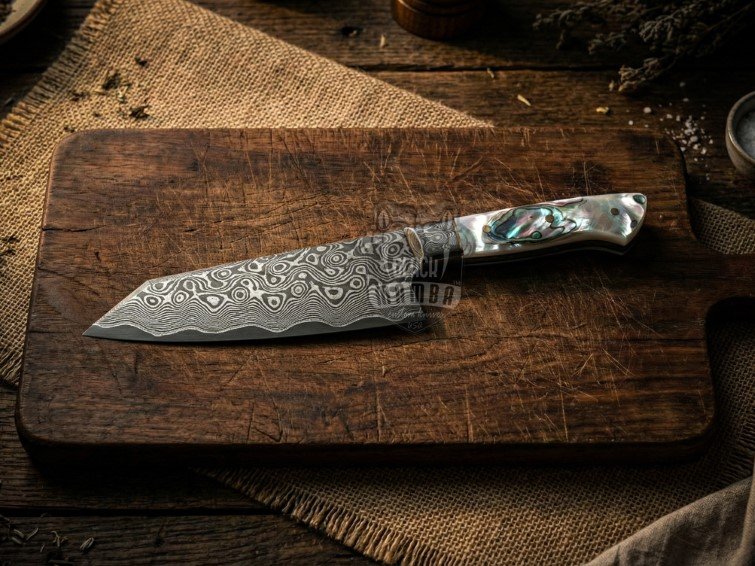
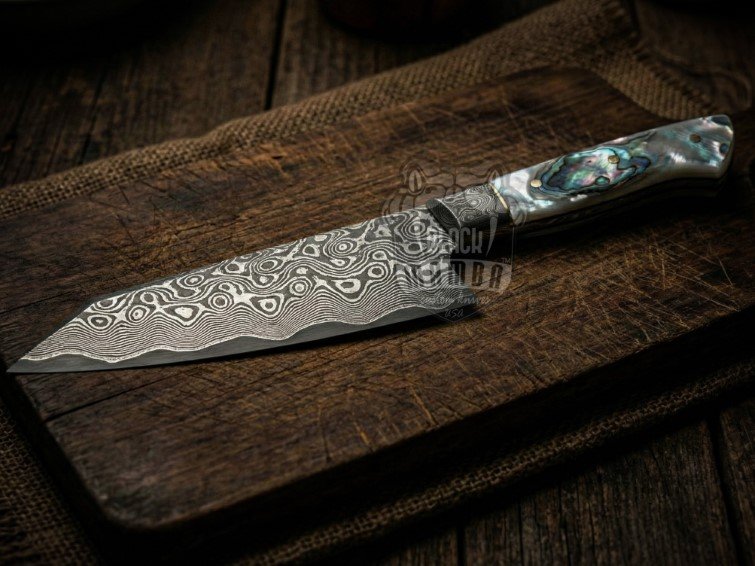
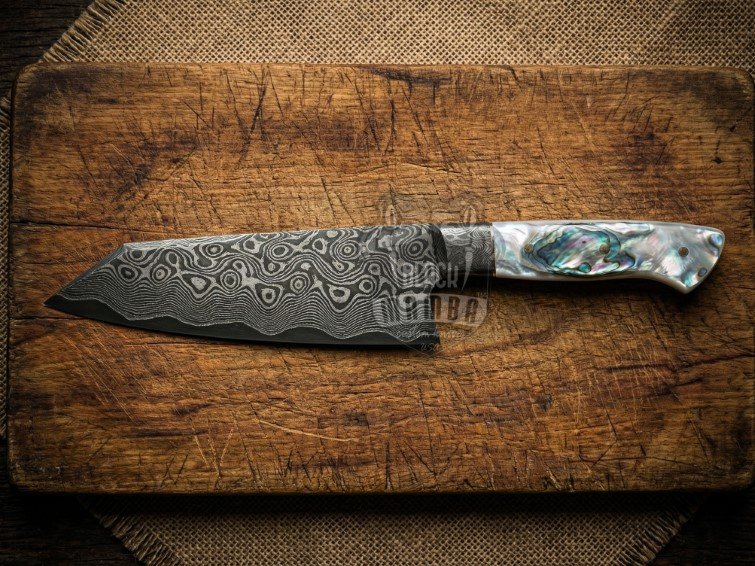
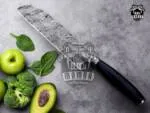
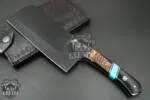
A bunka: flat edge, angled k-tip, seven inches of it, over a handle of abalone that changes color as you turn it under a light.
| Overall length | 12 inches |
| Blade length | 7 inches |
| Handle length | 5 inches |
| Steel | 1095 + 15N20 Damascus |
| Hardness | 58–60 HRC, oil tempered |
| Handle | Sea Shell |
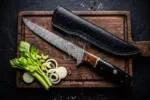
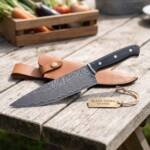
| Included | Hand-stitched leather sheath |
Put it to work on: board prep. Onions, herbs, garlic, boneless proteins, anything you push-cut rather than rock through. The flat edge means the whole length contacts the board at once, which is what makes a bunka fast at repetitive chopping once you stop trying to rock it.
Care: hand wash it the moment you finish, in warm water, and dry it before it goes back in the block. That is not optional advice for a carbon steel kitchen knife. It should never sit in a sink and never go into a dishwasher, where detergent hazes shell and heat works on the resin holding the scales. Cut on wood or plastic only. Glass, stone and ceramic plates will chip the thin edge before they dull it, and the k-tip is the first part to go.
What a bunka does that a chef knife does not
Two things. The flat edge gives you clean push cuts with no rocking motion and no gap at the heel, so nothing survives a pass half-cut. The angled tip puts a fine, flat point where a chef knife has a curve, which is what you want for scoring, for splitting a shallot, and for any job done with the last inch of the blade. What you give up is rock chopping, which this shape simply does not do, and any work involving bone, which this shape should not do.
Living with an abalone handle
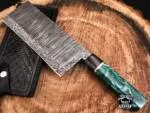
It is the most striking material we fit and the least forgiving. Shell is brittle, so this is not a handle to use as a mallet on a chicken carcass and not a handle to leave resting on a hot pan edge. Keep it out of standing water. In exchange you get a handle whose color shifts through green and blue as the light moves, and which no other knife in the drawer will match, because every piece of shell is cut from a different animal.
Seven inches on a home board
Twelve inches overall means the tip clears the board on a full stroke, which is comfortable on a 15 inch board and cramped on anything smaller. This is a one-cook knife: enough length for a full dinner’s prep, short enough that it stays controllable near the fingers of your guide hand. If you want more reach for breaking down larger work, the Yukio chef knife runs considerably longer.
Questions from the kitchen
Can I rock chop with it? No. There is no curve to rock on. Push and pull cuts are what the profile is built around.
Will the blade discolor? Yes, against onions, tomato and citrus. That is carbon steel behaving as carbon steel does, not a fault. Our carbon versus stainless comparison covers the trade honestly.
How do I sharpen the angled tip? Keep the same angle you use on the flat and do not lift the handle as you reach the k-tip, which is how people round it off. Our chef knife bevel guide explains the geometry.
Model: BMK-675



Logan Cooper –
So happy I finally pulled the trigger on this one. Edge held up great through a full week of daily cooking. This is the kind of purchase that makes online shopping worth it.
Jessica Bailey –
Solid knife. Glad I ordered it. Handle feels good, just a little heavier than I expected. Still very happy with it and would recommend.
Nicole Long –
Stellar craftsmanship on this one. Handle stays comfortable even after prepping a big meal. Already added a few more items from this seller to my cart. Not my first order from Black Mamba Knives and it won’t be my last.
Antoine Myers –
Wasn’t sure what to expect but this knife nailed it. Edge held up great through a full week of daily cooking. Would send this as a gift again in a heartbeat.
Xavier Jones –
Kept picking this knife up just to admire it after it arrived. Cleans up easy and hasn’t shown any rust or staining. Exactly the kind of quality that keeps me coming back.
Mark Ortiz –
Not going to lie. This exceeded my expectations by a lot. Edge held up great through a full week of daily cooking. Can’t wait to see what else this company has to offer.