


Description
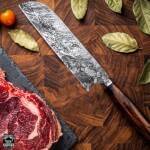
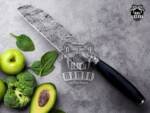
An eight-inch chef knife with copper laid into the forged billet, canvas micarta scales pinned in brass, and a full flat grind meant for a home board rather than a display cabinet. This is the kitchen knife for someone who already knows they prefer carbon steel and is not going to be upset when it changes colour.
| Overall length | 13 inches |
| Blade length | 8 inches |
| Handle length | 5 inches |
| Steel | 1095 + 15N20 Damascus |
| Hardness | 58–60 HRC, oil tempered |
| Handle | Micarta with Brass Pins |
| Included | Hand-stitched leather sheath |
Seven inches is a deliberate choice
Most knives sold as chef knives measure eight inches. Seven is shorter, and on a home cutting board that is usually an advantage: the tip clears a standard board without hanging over the edge, the belly rocks in a tighter arc, and it is far less intimidating for anyone who has not spent years behind a knife. Where you feel the loss is on long push cuts through a big cabbage or a watermelon, where a longer blade covers more ground per stroke. Five inches of handle behind the blade puts the balance close to a pinch grip. How a kitchen bevel is ground covers what is happening at the edge itself.
Copper Damascus meets acidic food
The copper layers in this billet are decorative and they are also reactive. Cut lemons, tomatoes, onions or anything vinegared and both the steel and the copper begin to discolour within minutes. That is not damage, but it is a visible change, and it is the normal life of a carbon-steel kitchen knife: it settles into a grey-blue film that protects the metal underneath. If you want a knife that looks identical in year three to the way it looked on day one, this is the wrong knife and you should be honest with yourself about that. Carbon versus stainless in the kitchen sets out the real trade.
Micarta earns its place here
Micarta is linen or canvas suspended in resin, and its texture actually improves when wet, which is the whole argument for it in a kitchen where your hands are greasy or covered in raw chicken. Brass pins hold the scales to the tang. Wash by hand, dry immediately, and never leave it standing in a sink. For a stainless alternative at a similar overall length, the 440C Yukio chef knife asks less of you.
The grind
It is a full flat grind, thin behind the edge, with the bevel finished by hand and stropped before packing. Thin geometry is most of what makes a knife feel sharp; a thick blade with a keen edge still wedges in a sweet potato. The trade is that you keep the tip out of frozen food and bones, and you use a wooden or composite board rather than glass or stone.
Keeping the edge
Simple high-carbon layers sharpen quickly and forgivingly. A few minutes on a medium stone and a strop brings it back, and a honing rod between sessions will stretch that out considerably. If the pattern ever fades under a year of scrubbing, a light re-etch restores it, and we are happy to do that here.
Sheath, gifting and the bench it came from
A stitched leather blade cover ships with it for storage and travel, and laser engraving on the flat is offered at checkout if this is going to someone as a present. The billet is forged, folded, ground, oil quenched and tempered in Memphis, the scales are shaped and pinned here, and a lifetime warranty on our workmanship travels with it.
Model: BMK-805B


Edward Wilson –
This knife looks even better in person than in the listing photos. Made in the USA and shipped worldwide with no issues on my end.
Antoine Baker –
Perfect gift. Perfect quality. No complaints. This maker clearly takes pride in their work.
Robert Smith –
This knife looks even better in person than in the listing photos. Made in the USA right in Memphis, and it shipped worldwide without any long wait. Has become my main prep knife in the kitchen since it arrived. Balance in hand is perfect for detail work at the cutting board. This store nailed it with this one.
Terrell Jones –
Ordered late at night on a whim and woke up glad I did. Edge held up great through a full week of daily cooking. This will not be my last order from this seller.
Gregory Ross –
Perfect gift. Perfect quality. No complaints. Already planning my next pickup from this store.
Chloe Thomas –
Ordering again from this seller the second I finish writing this review. Cleans up easy and hasn’t shown any rust or staining. Handle stays comfortable even after prepping a big meal. Edge geometry makes thin slicing so much easier than my old knife. Love it.
Travis West –
Ordered late at night on a whim and woke up glad I did. Balance in hand is perfect for detail work at the cutting board. Cleans up easy and hasn’t shown any rust or staining. Shipping was fast and everything arrived well packaged.
John Hunt –
Wasn’t expecting to be this impressed but here we are. Has become my main prep knife in the kitchen since it arrived. This maker just earned a repeat customer. Black Mamba Knives has earned a repeat customer with this one.
Sophia Sanchez –
This thing is a beast in the best way. This will not be my last order from this maker.