


Description
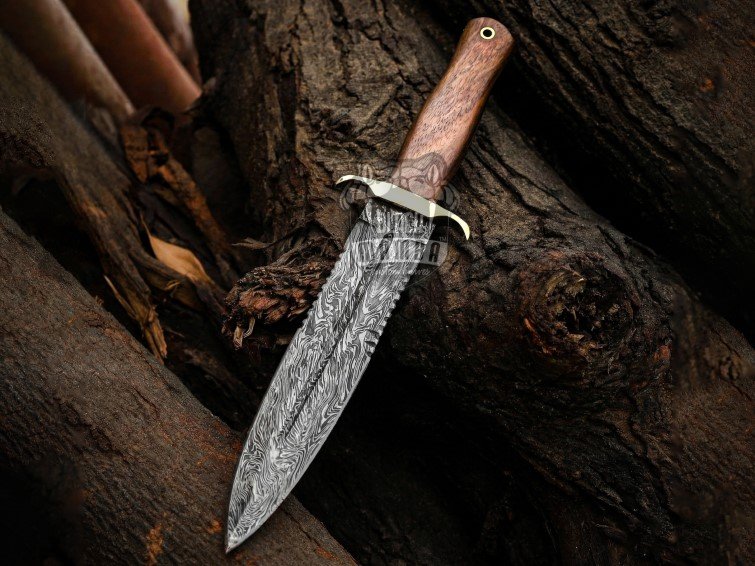
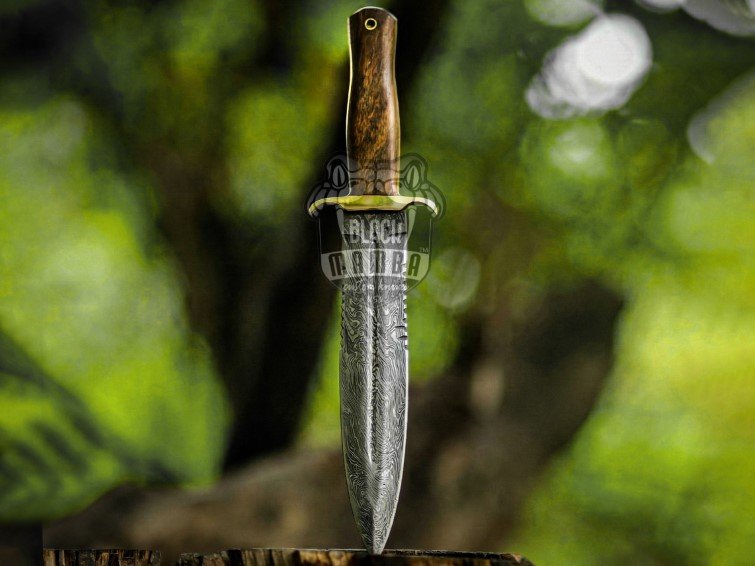
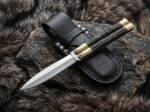
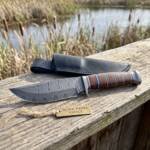
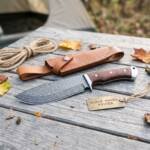
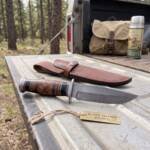
Eight inches of pattern-welded blade on a five-inch rosewood grip. The Titan Spear is the largest piece in our dagger line, and it makes no pretence of being practical.
| Overall length | 13 inches |
| Blade length | 8 inches |
| Handle length | 5 inches |
| Steel | 1095 + 15N20 Damascus |
| Hardness | 58–60 HRC, oil tempered |
| Handle | Rose Wood |
| Included | Hand-stitched leather sheath |
Built for: display, and for people who want the pattern at a scale where it can actually be read. On a three-inch blade the layering registers as texture. At this length it becomes a landscape.
Why 1095 and 15N20 are paired
The two steels are chosen for contrast, not for some lost metallurgical secret. 15N20 carries nickel, which resists the acid etch and stays bright. 1095 has none, so it darkens. Fold them together, forge, etch, and the difference in nickel content is the whole of what you are looking at. Both are simple high-carbon steels. Both take a very good edge. Neither is remotely stainless, which is the entire maintenance story in one sentence. Telling a forged pattern from a printed one comes down to the same chemistry.
Hardness is a deliberate compromise
Taken harder, the edge would last longer and chip more readily. Taken softer, it would roll instead of chipping and need constant steeling. Oil tempered into the high fifties is the sensible middle for a blade this long: hard enough to keep a working edge, soft enough that a big thin blade flexes rather than snaps if it takes a knock. You give up some edge retention against a modern powder steel. In exchange you get a blade you can sharpen on almost anything, anywhere.
Who should not buy this
Anyone who wants a knife for the kitchen, the tackle box or a pocket. A thirteen-inch double-edged blade is a specialist object with legal restrictions in some places and no everyday use anywhere. If what you actually want is something handmade you will carry and use, a small drop-point everyday knife will serve you better and cost less.
Care: this is high-carbon steel with no corrosion resistance worth the name. Fingerprints etch it. Sweat etches it. Keep it oiled, thin and often, and store it out of the leather. The etch that makes the pattern visible is a surface treatment, so aggressive polishing or a rust eraser will flatten the contrast. Lift any spotting gently with oil and a soft cloth instead of an abrasive. The rosewood is the easy half: a dry cloth, nothing more, and keep it out of a hot car.
FAQs
How many layers is this blade? We publish layer counts where we have them on record. This model’s sheet lists the steels and the hardness but no layer figure, so we are not going to print a number we cannot stand behind.
Will the pattern wear off? No. It runs all the way through the steel. Sharpen it for twenty years and the pattern is still there, because it is structural rather than applied.
Can it be sharpened at home? Easily. Simple carbon steels are the friendliest thing on a stone. Match your angle on both edges and go slowly where the two grinds converge at the point. Our whetstone guide covers holding an angle consistently.
Model: BMK-694
Antoine Nelson –
Really happy with this knife overall. Handle looks great though it’s a little smaller than I imagined. Good product. Just not quite perfect. Good to see it’s made in the USA in Memphis, shipping was quick too.
Xavier Bryant –
This knife looks even better in person than in the listing photos. Edge retention has been great even after regular use in the field. Great buy overall.
Hunter Mendoza –
Was nervous ordering something like this online but so glad I did. Exactly the kind of quality that keeps me coming back. Made in the USA right in Memphis, and it shipped worldwide without any long wait.
Frank Richardson –
Wasn’t expecting to be this impressed but here we are. Black Mamba Knives’ attention to detail is honestly unmatched. Couldn’t be happier with this.
Antonio Johnson –
Photos don’t do this knife justice at all. Edge retention has been great even after regular use in the field. Leather sheath is thick and well stitched. Not the cheap stuff you usually get. This is exactly why I keep coming back to this company.
Amy Garcia –
This knife looks even better in person than in the listing photos. Made in the USA and shipped worldwide with no issues on my end. Blade geometry makes it glide through cuts with barely any effort. Definitely bookmarking this company for future orders.