


Description
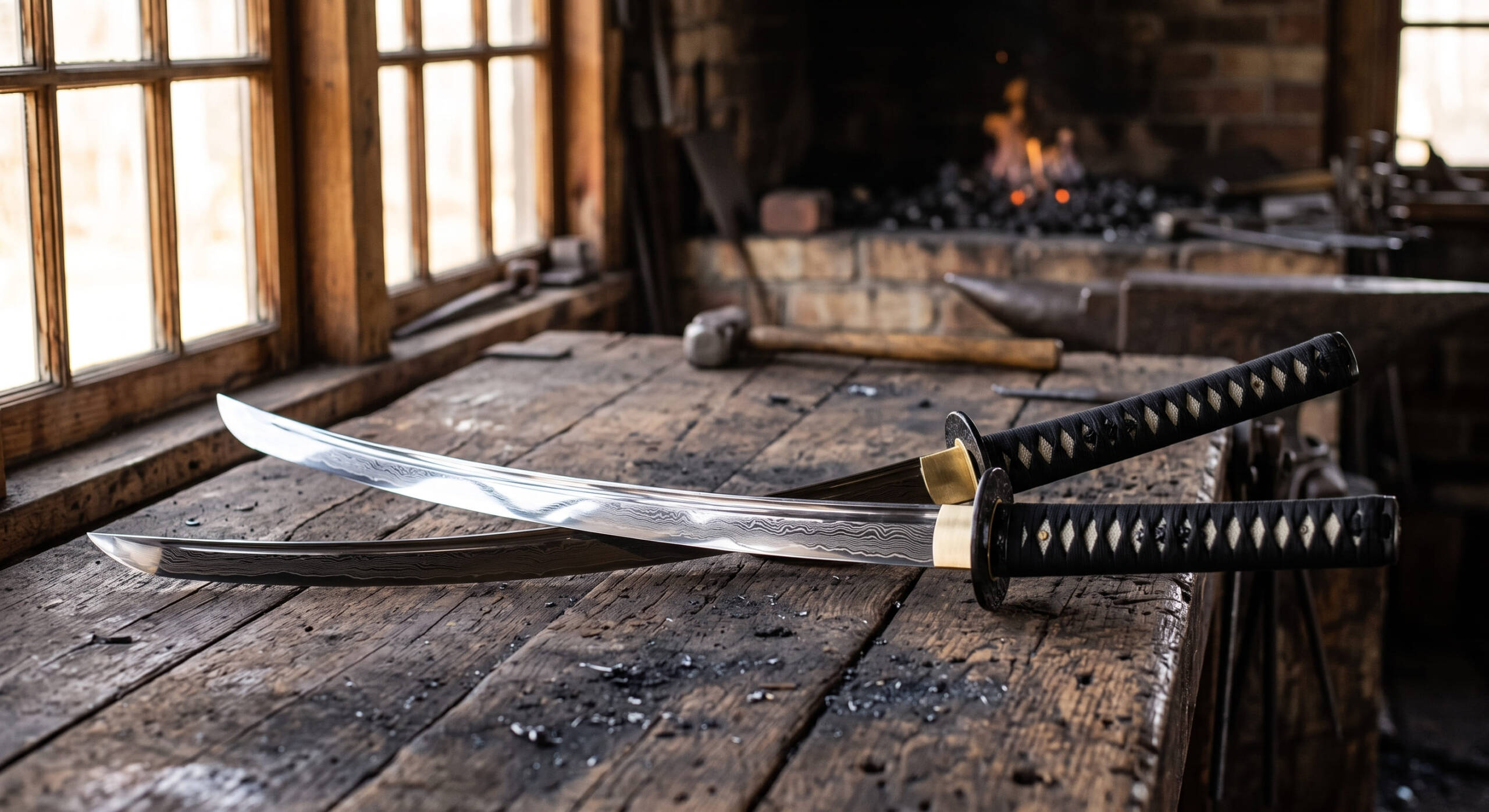
Twenty-eight inches of curved Damascus, polished bright enough that the layer pattern shows as a moving band along the lower third of the blade where the geometry catches light.
| Blade length | 28 inches |
| Overall length | Approx. 40 inches |
| Steel | Hand-forged Damascus |
| Finish | High polish |
| Tsuka (handle) | Black silk ito wrapped over white rayskin |
| Tsuba (guard) | Blackened iron, round |
| Habaki | Brass blade collar |
| Included | Fitted scabbard |
Made for: collectors and display. This is a decorative and collectible sword built to traditional Japanese proportions and fitted with traditional components, and it should be treated as a sharp object to be handled, admired and stored — not as a cutting tool for tatami or bamboo practice.
The fittings are the traditional set, and each has a name
The tsuba is the round guard, here in blackened iron, and its job is to stop the hand from running onto the blade. The habaki is the brass collar at the base of the blade, and it is the piece that actually holds the sword tight in the scabbard — the fit at the habaki is what makes a katana click home rather than rattle. The tsuka is the handle, and on this one it is black silk ito wrapped in alternating diamonds over white rayskin.
Rayskin is functional, not ornamental
The white nodules you can see through the gaps in the wrap are samegawa, the skin of a ray, applied under the cord. It is there because it is covered in hard mineral nodules that grip the ito and stop the wrap from rotating on the handle under load. A wrap over bare wood loosens. A wrap over rayskin does not.
Curvature and length
The blade carries a continuous curve from the habaki to the tip rather than a bend at one point. Twenty-eight inches of blade puts this at full katana length, around forty inches overall with the handle, which is why it needs a stand or a wall mount rather than a shelf.
Care: a polished sword blade is a fingerprint magnet, and fingerprints on high-polish steel are acidic enough to etch permanently if left for months. Never touch the flat with bare hands — hold it by the tsuka, and wipe the blade with a soft dry cloth using strokes that run from the habaki toward the tip, never back and forth across the edge. Keep a very light film of oil on the steel. Store it horizontally with the edge upward, and never leave it sheathed in a humid room, because a scabbard traps moisture against a blade far more effectively than open air.
Questions about this katana
Is it sharp? It is finished with an edge. Handle it accordingly and keep it out of reach of anyone who has not been shown how to draw a sword safely.
Can I use it for cutting practice? We do not recommend it. This is built and finished as a collector’s piece. Our Damascus katana and samurai sword guide explains what separates a display sword from a cutter.
How should I display it? On a padded horizontal stand, out of direct sun and away from heating vents. How to store knives properly applies to blades of every length. For a longer blade in the same family, see the 32-inch Damascus katana.
Model: BMK-1130
Buying for groomsmen? This sword also comes as a matched set of 6, 15% less than buying six singly, and each one can carry its own engraved name.

Kyle Martin –
This knife is really solid. No question about it. This is my new favorite in the collection.
Jose Garcia –
Best knife I’ve ever owned. Hands down. Came in a nice gift box which made it feel even more special. Blade geometry makes it glide through cuts with barely any effort. Black Mamba Knives keeps setting the bar higher with each order. This is going straight into my daily rotation.
Walter Green –
This is hands down one of the best knives I’ve bought online. Handle has a great grip even with wet or gloved hands. Edge retention has been great even after regular use in the field. Shipping was fast and everything arrived well packaged.
William Hunt –
This knife completely won me over the moment I picked it up. Even the small details in the damascus pattern are crisp and clean. Fit and finish is museum quality. You can tell real craftsmen made this by hand. Took it out camping right away and it handled everything I threw at it. Exactly the kind of quality that keeps me coming back.
Zachary Hill –
I collect knives and this one is really solid. You can tell it’s real American craftsmanship out of Memphis. Shipping was quick too. No hesitation recommending this to anyone looking.
Laura Reed –
Absolutely really impressed by this knife. Black Mamba Knives has earned a repeat customer with this one.
Olivia Stewart –
This blade came razor sharp right out of the box. Handle has a great grip even with wet or gloved hands. Would send this as a gift again in a heartbeat.
Alejandro Nguyen –
This knife is a genuine work of art. Every piece of the fit and finish looks hand checked before it shipped. Pommel and guard are solid, no wobble anywhere on the knife. Fit and finish is museum quality. You can tell real craftsmen made this by hand. Zero complaints from me on this purchase.
Wyatt Cook –
Amazing quality for the price point. Came in a nice gift box which made it feel even more special. Handle has a great grip even with wet or gloved hands. Will definitely order again for another one.