


Description
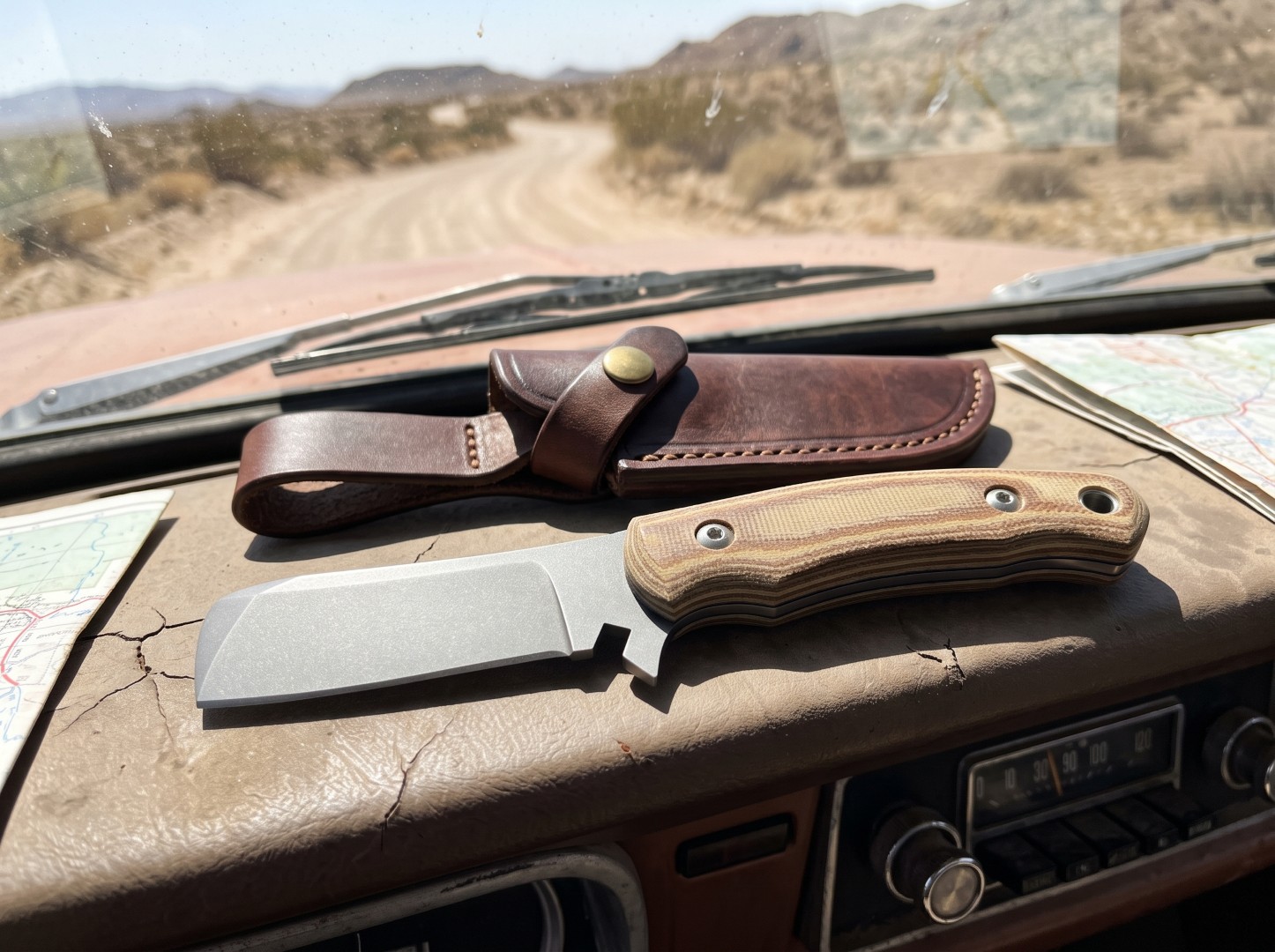
Some knives are made to be looked at. This one is made to live in a door pocket, ride two hundred miles of washboard road, and come out ready to open a case of water or trim a frayed recovery strap. Dust Devil is the plain-spoken member of our cowboy bull cutter run — no bolster, no polish, nothing to fuss over — and it earns its place by never asking for attention.
Why the blunt nose is the whole point
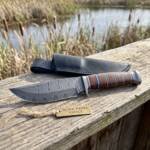
A bull cutter is a sheepsfoot: the spine runs dead straight and then drops in a short curve to meet a flat, level edge. There is effectively no tip. That sounds like a limitation until you have used one for a week. You can bear down on the spine with your off hand and shear through cardboard, hose, twine, or gasket material without the front of the blade wandering. You can lay the full three and a half inches flat on a tailgate and slice something in a single pass. And you can hand it to somebody in the dark without worrying about where the point ended up. The notched choil ahead of the handle gives you a forward grip for detail work, which is where the shape borrows from the old cattle knives it descends from.
D2 in a stonewash
D2 is a high-carbon, high-chromium tool steel that industry has used for punches and dies for the better part of a century. Roughly twelve percent chromium puts it on the edge of stainless without quite crossing over, and a heavy load of chromium carbides makes it genuinely hard to dull — you can cut abrasive material all afternoon and still shave paper. The trade is that it takes patience to sharpen; a diamond plate or a good ceramic rod gets there faster than a soft natural stone. If you are weighing it against the alternatives, our side-by-side look at D2 and the other common blade steels lays out where each one earns its keep.
The stonewash finish is not cosmetic either. Tumbling the ground blade in media leaves a soft matte gray that scatters light instead of throwing it, so nothing flashes when you are working in the open. It also hides the scratches you are going to put in it. A mirror finish records every mistake; a stonewash absorbs them and looks better at year five than it did at week one.
| Overall Length | 7.5 inches |
|---|---|
| Blade Length | 3.5 inches |
| Handle Length | 4 inches |
| Blade Steel | D2 tool steel |
| Blade Finish | Stonewashed satin gray, non-reflective |
| Blade Style | Sheepsfoot bull cutter with notched choil |
| Handle Material | Desert tan canvas Micarta, contoured, with black fiber liners |
| Fittings | Black screw hardware, steel-lined lanyard hole |
| Tang | Full tang, black fiber between tang and scales |
| Sheath | Handmade leather belt sheath with stud closure (included) |
Model: BMK-1153
Micarta that grips when your hands are filthy
The scales are canvas Micarta in a layered desert tan — cloth soaked in resin, compressed, cured, then ground to shape and hand-sanded so the weave shows through as a faint tooth. That texture is the reason to choose it. Wet, dusty, greasy, forty degrees: Micarta keeps its grip when polished wood turns slick. Each scale is contoured across the palm, chamfered along the top and bottom edges, and separated from the tang by a thin dark fiber liner that reads as a clean line down the profile. Fasteners are screws rather than peened pins, and a lined lanyard hole sits at the butt.
The knife rides in a hand-stitched leather belt sheath with a snap strap over the handle, made to sit tight enough that it stays put on a rough two-track. If you want the same working philosophy in a longer field-dressing blade, the Dunewalker gut hook shares the steel, the finish, and the same tan Micarta.
Living with it
Care here is nearly nothing. D2 resists rust well enough for ordinary use, but it is not stainless, so a rinse and a towel after salt, citrus, or a wet week are worth the ten seconds. Micarta cleans with soap and warm water. The leather does better with an occasional coat of conditioner and a night out of the sheath after it gets soaked. A few passes on a ceramic rod every couple of weeks and you may never have to reset a bevel at all. Ground, heat treated, and assembled in Memphis, Tennessee.



Aaron Cox –
Feels way more premium than the price suggests. Blade geometry makes it glide through cuts with barely any effort. This is the kind of purchase that makes online shopping worth it.
Antonio Jimenez –
Bought this on a whim and it turned out to be one of my favorite purchases in ages. Blade holds a razor edge right out of the box. Handle feels amazing and the balance is perfect. Every piece of the fit and finish looks hand checked before it shipped. So worth it.
Derek Mitchell –
This knife completely won me over the moment I picked it up. Blade holds a razor edge right out of the box. Can’t wait to see what else this shop has to offer.
Trevor Bryant –
This exceeded what I pictured in my head before ordering. Handle feels amazing and the balance is perfect. Took it out camping right away and it handled everything I threw at it. Can’t say enough good things about this purchase.
Wayne Gonzalez –
This is one of those purchases that just makes you smile. This is my third order from Black Mamba Knives and they never disappoint. Good to know real Memphis craftsmen are behind this, and shipping was quick too. This seller just earned a repeat customer.
Jerome Bryant –
My son couldn’t stop talking about this after I unboxed it. Weight and balance make it feel like a real working knife not some cheap import. This is the kind of purchase that makes online shopping worth it.
Matthew Chavez –
This store clearly knows what they’re doing with quality like this. Black Mamba Knives is quickly becoming my go to shop for knives. You can tell it’s real American craftsmanship out of Memphis. Shipping was quick too.
Elizabeth Jimenez –
Not going to lie. This exceeded my expectations by a lot. Good to know real Memphis craftsmen are behind this, and shipping was quick too.
Dennis Turner –
Couldn’t ask for a better knife honestly. Blade holds a razor edge right out of the box. Beyond happy with how this turned out.
Laura Mendoza –
This knife has quickly become my favorite piece in the collection. So worth it. Proud to support American made goods out of Memphis with this purchase.