


Description
Antler, brass and pattern-welded steel
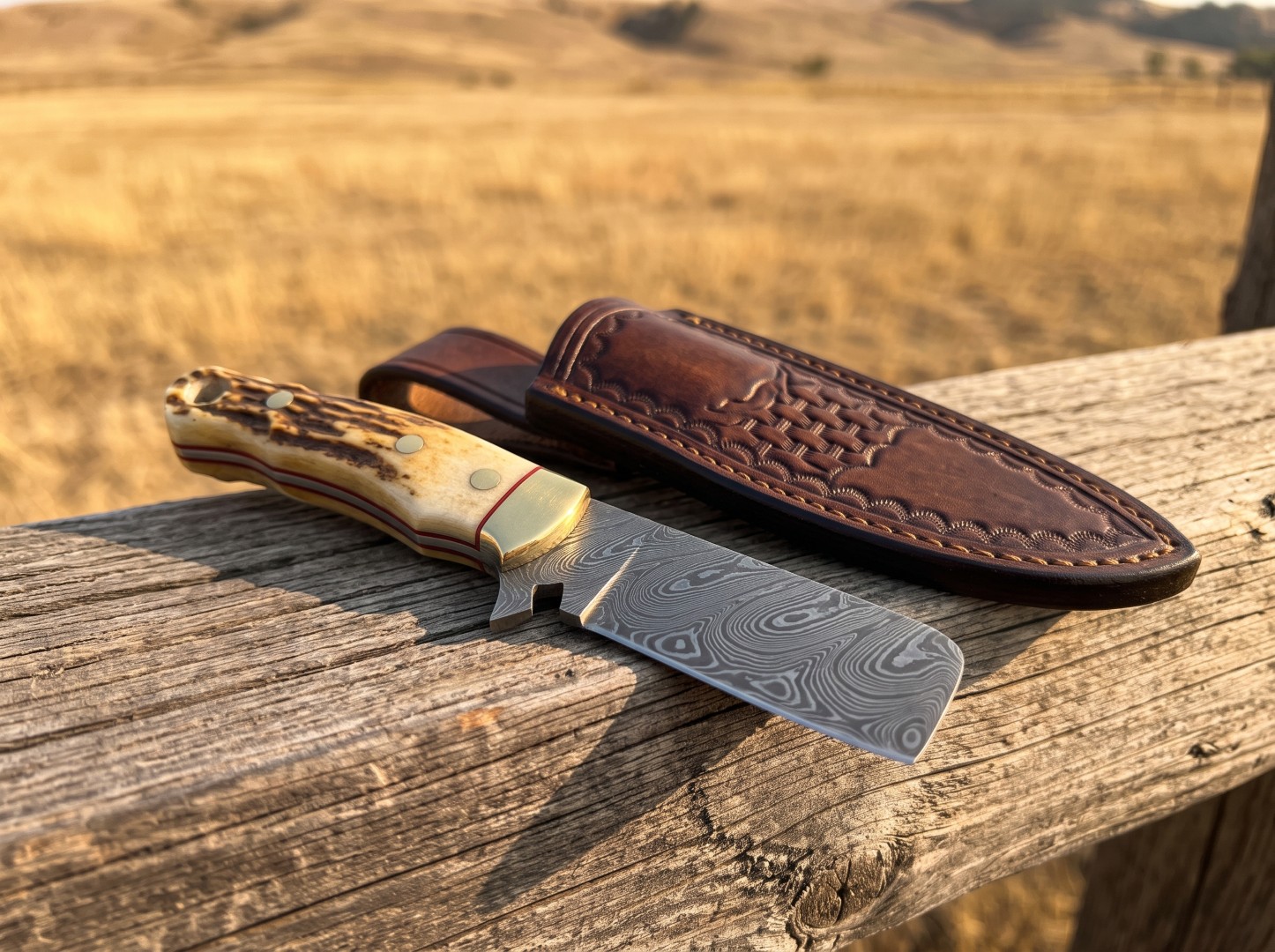
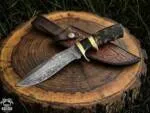
This is the collector’s knife in the bull cutter range, and it announces itself before you pick it up. The blade carries a hand-forged Damascus pattern etched into flowing rings and swirls that run the full length of the flat, and the handle is genuine stag antler with the natural crown texture left rough at the butt where the animal grew it. Between them sits a solid brass bolster with a red fiber spacer. Nothing about it is understated.
| Overall Length | 7.5 inches |
|---|---|
| Blade Length | 3.5 inches |
| Handle Length | 4 inches |
| Blade Steel | Hand-forged twist pattern Damascus, acid etched |
| Blade Style | Sheepsfoot bull cutter with notched choil |
| Handle Material | Genuine stag antler with red fiber liners |
| Bolster | Solid brass with red fiber spacer |
| Fittings | Brass pins, lanyard hole |
| Tang | Full tang |
| Sheath | Handmade tooled leather belt sheath (included) |
Real pattern-welded steel
The billet is built from alternating layers of two different steels, forge welded together, then twisted along its axis before being drawn out and ground. Twisting is what turns straight bands into the rotating rosettes you can see on the finished blade, and because the pattern goes all the way through the billet, grinding the bevel cuts a different slice of it than the flat shows. Etching in acid darkens one alloy and leaves the other bright, which is what makes the layers visible at all. The process is genuinely laborious and we documented it start to finish if you want to see what goes into a billet before it becomes a knife.
Underneath the decoration it is still a working high carbon blade, ground to a sheepsfoot with a straight edge, a blunt front and a notched choil. It cuts like the plainer knives in this family because it is the same geometry, and it will need the same stone at the same intervals. Pattern welding buys you appearance and a small amount of toughness across the weld lines; it does not exempt the steel from any of its obligations.
Stag
Antler is shed naturally and no two pieces are the same. The scales here are cut so the smooth interior faces your palm and the textured bark faces out, and the butt keeps a section of crown with its knurled, almost coral-like surface. Red fiber liners run under the scales and show as a thin line of colour at the edges. Stag is warm in the hand in a way that no synthetic manages, and the natural texture means it stays put when wet without needing checkering cut into it.
Colour varies from cream through tan to the burnt brown of the crown. The set you receive will not be identical to the photograph and cannot be, because we do not get to choose what the antler looks like inside until we cut it.
Sheath and origin
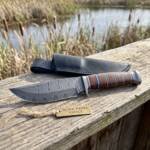
A dark brown basketweave-tooled leather belt sheath is included, hand stamped and hand sewn. All of the work happens in our Memphis, Tennessee shop.
Keeping the pattern crisp
The Damascus contrast is an etch, and it is on the surface. Abrasive polish, scouring pads and aggressive metal cleaners will take it off and leave you with a grey blade, so use none of them. Warm water, a soft cloth, and dry it immediately. High carbon Damascus will rust if left wet, so a thin film of oil before storage is worth the ten seconds. If the etch does fade over years of use it can be brought back, and our care notes explain how. Stag needs nothing beyond staying out of extreme dryness. For a different pattern in the same collector class, the feather Damascus Plume Canyon takes a harder route to an even more dramatic result.
Model: BMK-1150
Larry Young –
Was nervous ordering something like this online but so glad I did. Black Mamba Knives’ attention to detail is honestly unmatched. Edge retention has been great even after regular use in the field. Sheath snaps shut securely and doesn’t feel flimsy at all. Made in the USA right in Memphis, and it shipped worldwide without any long wait. Weight and balance make it feel like a real working knife not some cheap import. Already added a few more items from this store to my cart.
Jerome Sanders –
Knew this knife was special the second I opened the box. Even the small details in the damascus pattern are crisp and clean. Nice to support a Memphis based knife maker, shipping was fast even internationally. Can’t recommend this enough.
Shane Gomez –
Got this for a retirement gift and now I want one for myself too. Steel has a gorgeous pattern that looks different in every light. This will not be my last order from this company.
Tyrone Rivera –
The moment I saw this in person I knew it was a keeper. Steel has a gorgeous pattern that looks different in every light. Love it.
Blake Phillips –
Ended up ordering a second one after how happy I was with the first. Leather sheath is thick and well stitched. Not the cheap stuff you usually get. Already telling my friends to check this out.
Craig Peterson –
Turned out better than I expected going in. Handle looks great though it’s a little smaller than I imagined. Still very happy with it and would recommend. Been ordering from Black Mamba Knives for a while now and this fits the pattern.
Colton Freeman –
Honestly one of my better purchases in a while. Leather sheath is thick and well stitched. Not the cheap stuff you usually get. Took it out camping right away and it handled everything I threw at it. Blade holds a razor edge right out of the box. This is why Black Mamba Knives is my go to for anything knife related. So worth it.
Christopher Moore –
Ended up ordering a second one after how happy I was with the first. Handle has a great grip even with wet or gloved hands. Blade holds a razor edge right out of the box. Worth every penny.