


Description
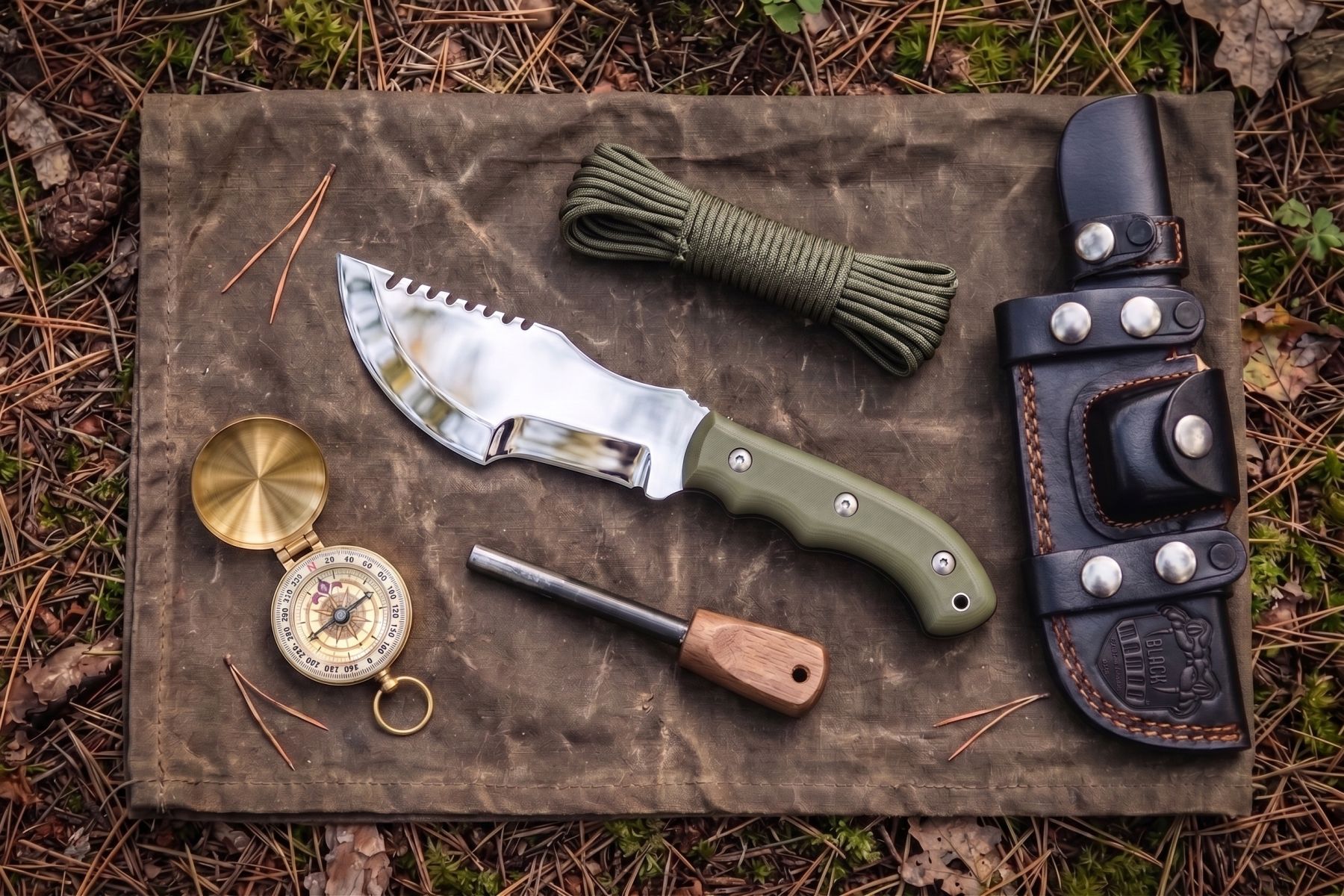
Hand polishing a tracker blade to a mirror is awkward work, because every one of those changes in direction has to be brought up separately.
| Overall length | 11.88 inches |
| Blade length | 6.38 inches |
| Blade thickness | 0.25 inches |
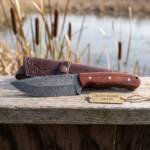
| Steel | D2 tool steel, hand mirror polished |
| Grind | Tom Brown tracker profile — chopping belly, straight fine-work section, sawback spine |
| Handle | Olive green G10 with stainless steel screws |
| Lanyard | Drilled lanyard hole through the butt |
| Included | Black leather tracker sheath |
Right for: someone who wants the tracker geometry but plans to look at the knife as much as use it. The mirror finish shows the grind lines in the belly clearly, and the flat olive G10 sets against it without competing.
Mirror polish, honestly
A mirror finish has one practical advantage and two real costs. The advantage is that a polished surface has less for moisture to key into, so it is marginally slower to spot than a rough one. The costs are that it shows every fingerprint and every fine scratch, and that it flashes in sunlight in a way a matte blade does not — which matters if you are near game. Anyone who wants the same profile without the shine should compare the stone washed Moss Talon tracker in micarta, which hides wear instead of displaying it.
G10 versus the alternatives
G10 is fiberglass cloth in epoxy, and it is the most chemically indifferent handle material we use. Water, solvents and blood do not touch it, it will neither shrink in a hot truck nor swell on a wet trip, and it stays dimensionally stable for the life of the knife. What it gives up is warmth: G10 feels harder and cooler than micarta or wood, and in real cold that shows through thin gloves. The olive here is a through color, so a nick reveals more olive rather than white glass.
Balance and the lanyard hole
With a quarter inch spine over 11.88 inches, this knife balances forward of the guard — you feel it want to swing. That is deliberate for a chopping profile and it is also the reason the drilled lanyard hole matters. A wrist loop lets you loosen your grip through a swing and catch the handle on the return, which is safer and less tiring than gripping hard for an hour.
Care specific to this one
D2 is high chromium tool steel, not stainless — it tolerates neglect far better than carbon steel but will still freckle if put away wet. Dry it, then wipe the polished flats to lift fingerprints, which are acidic enough to etch a mirror finish over months. If the polish dulls, a light metal polish on cotton brings it back; never use abrasive paper. The G10 wants only soap and water. Keep the blade out of the leather sheath for long storage — our guide to storing knives explains why tanned leather and steel are a poor long-term pairing. Sharpen on diamond; D2 chews softer stones.
Questions buyers ask
Will the mirror survive real use? No, and it is not meant to. It will pick up a working patina of fine scratches. That is a used knife, not a damaged one.
Are the screws structural? Yes. The scales are bolted rather than glued, so a damaged scale can be replaced without destroying the knife. Our blade shapes guide covers how a tracker profile differs from a standard bushcraft grind.
Is 0.25 inches too thick to slice with? For food, yes. For wood and rope, it is the reason it works.
Model: BMK-1118
Buying for groomsmen? This knife also comes as a matched set of 6, 15% less than buying six singly, and each one can carry its own engraved name.
Trevor Moore –
This exceeded what I pictured in my head before ordering. Sheath snaps shut securely and doesn’t feel flimsy at all. Steel has a gorgeous pattern that looks different in every light. Would send this as a gift again in a heartbeat.
Thomas Jimenez –
Perfect gift. Perfect quality. No complaints. Good to know real Memphis craftsmen are behind this, and shipping was quick too.
Thomas White –
Honestly one of my better purchases in a while. You can tell it’s real American craftsmanship out of Memphis. Shipping was quick too.
Carl Barrett –
Best knife I’ve ever owned. Hands down. Every piece of the fit and finish looks hand checked before it shipped. Telling everyone I know to check this shop out. Black Mamba Knives’ attention to detail is honestly unmatched.
Colton Ruiz –
Fantastic craftsmanship on this one. Edge retention has been great even after regular use in the field. Can’t say enough good things about this purchase.