


Description
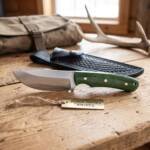
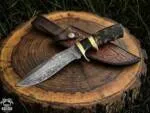
White-handled knives have a long history in the American hunting camp, and there is a reason they keep coming back: bone reads as honest. Chalk Meadow is built on that idea — creamy camel bone with its natural speckling left visible, a thin red fiber spacer, a solid brass bolster, and a bright satin D2 blade with an integral gut hook.
Camel bone
Camel bone is dense, close grained and considerably tougher than the cow bone usually used for knife scales, which is why it holds up to being drilled, pinned and shaped without chipping at the edges. Sanded and polished, it comes up ivory to warm cream, with the faint natural mottling that tells you it grew rather than got moulded. Over years of handling it takes on a soft, aged tone that no finish can imitate. It is comfortable in cold weather, it does not go slippery, and it is easy to clean.
| Overall Length | 9 inches |
|---|---|
| Blade Length | 4.5 inches |
| Handle Length | 4.5 inches |
| Blade Steel | D2 tool steel |
| Blade Finish | Polished satin |
| Blade Style | Drop point with integral gut hook |
| Handle Material | Camel bone with red fiber spacer |
| Bolster | Solid brass |
| Fittings | Brass pins, lanyard hole |
| Tang | Full tang |
| Sheath | Handmade tan leather belt sheath with brass stud (included) |
Brass and a red line
The bolster is solid brass, fitted to the tang and polished, which puts weight at the front of the handle and balances the blade back toward your palm. Between the bolster and the bone sits a sliver of red fiber spacer, one clean stripe of colour, the sort of detail that traditional knifemakers have used for a hundred years to break up a pale handle. The brass will not stay bright unless you want it to — leave it and it drifts to a warm bronze, rub it and it comes straight back.
Steel and grind
D2 tool steel, four and a half inches, flat ground, polished satin. High carbon and high chromium make for a hard, wear-resistant blade that holds a working edge through an entire field dressing, and the same chemistry means it wants a diamond or ceramic surface when it finally does need attention rather than a soft stone. Full tang runs the length of the handle — our explanation of tang construction covers why that matters on a knife that gets levered against bone. The gut hook is opened out and polished inside the curve so it draws through hide rather than snagging on it.
Sheath, and where it was made
The included belt sheath is tan leather with a brass stud closure, cut and wet formed around this blade, stitched and burnished. Knife and sheath both come out of our Memphis, Tennessee workshop, where the blank is profiled, hardened, ground and hand finished, and the bone is fitted and shaped by hand to that particular tang.
Care that keeps it white
Bone is porous at the surface, so wipe it clean rather than soaking it, and do not leave it sitting in blood. A damp cloth and a dry buff is the whole routine; a touch of wax once a year keeps it from drying out in a heated house. Dry the blade completely after use — the inside of the hook first — and oil it before any long spell in storage. Keep the knife outside the sheath between trips. Sharpen the main edge at a consistent angle; our whetstone walkthrough covers the basics, and the hook itself wants a small round file or tapered rod. For the same traditional feel with a stacked leather handle and brass pommel, see Old Guard.
Why the bolster is worth having
Beyond the look, a bolster does real work. It closes the joint where handle meets blade so blood and grit cannot pack into the seam, it stiffens the front of the handle against knocks, and it shifts a little mass forward so the knife falls into a natural cutting attitude when you pick it up. On a bone-handled knife it also protects the most vulnerable part of the scale.
Model: BMK-1177
Brenda Hughes –
Didn’t think a knife at this price could feel this premium. Even the small details in the damascus pattern are crisp and clean. Blade geometry makes it glide through cuts with barely any effort. Handle feels amazing and the balance is perfect. Would not hesitate to order again.
Dustin Bailey –
Absolutely extremely happy by this knife. Blade holds a razor edge right out of the box. Can’t wait to see what else this shop has to offer.
Stephen Jackson –
So happy I finally pulled the trigger on this one. Blade geometry makes it glide through cuts with barely any effort. Can’t recommend this enough.
Rebecca Clark –
This knife has already earned a permanent spot in my collection. Every piece of the fit and finish looks hand checked before it shipped. Ordered from Black Mamba Knives before and the quality stays consistent every time. Sheath snaps shut securely and doesn’t feel flimsy at all. Came in a nice gift box which made it feel even more special. This will not be my last order from this maker.
Jessica Adams –
This showed up faster than expected and looked incredible. Weight and balance make it feel like a real working knife not some cheap import. So worth it. You can tell it’s real American craftsmanship out of Memphis. Shipping was quick too.
Stephen Ortiz –
Photos don’t do this knife justice at all. Made in the USA right in Memphis, and it shipped worldwide without any long wait.
Zachary Wells –
This knife has already earned a permanent spot in my collection. Weight and balance make it feel like a real working knife not some cheap import. Great buy overall.
John Sanders –
Kind of disappointing given the price tag. Black Mamba Knives usually does better than this in my experience. Just an average purchase. Wouldn’t rush to buy again.
Kevin Robinson –
Got this as an anniversary gift and it exceeded what I expected. This has quickly replaced my old go to knife for field dressing. This maker nailed it with this one.
Justin Miller –
Didn’t think a knife at this price could feel this premium. Came in a nice gift box which made it feel even more special. Love it.
Laura Flores –
Been eyeing this knife for months and it did not disappoint. Blade holds a razor edge right out of the box. This is the kind of purchase that makes online shopping worth it.
Jamal Alvarez –
This is one of those purchases that just makes you smile. Took it out camping right away and it handled everything I threw at it. Fit and finish is museum quality. You can tell real craftsmen made this by hand. Weight and balance make it feel like a real working knife not some cheap import. This store clearly takes pride in their work.