


Description
Antler, brass, and a forged pattern
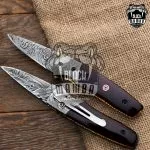
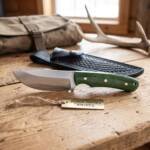
Royal Stag is the piece in this run that people buy to mark something — a first season, a retirement, a fiftieth birthday, a trophy that will hang on a wall for the rest of a life. A forged and etched pattern-welded blade, a solid brass bolster, and scales cut from genuine stag antler with the natural bark texture left intact on the outside. It looks like the knives in the glass case at an old sporting goods store, and it is built to be used rather than looked at.
The antler
Stag antler is not bone and it is not horn. It is a solid, mineralized outgrowth that a deer regrows and sheds every year, and the outer surface carries a rough, furrowed bark that no manufacturing process reproduces convincingly. The scales here are cut from the shed with that bark facing out and the interior sanded flat against the tang, so the outside of the handle is textured, cream-and-brown, and irregular in exactly the way it was on the animal. It grips extraordinarily well with wet hands because the furrows do the work, and it is warm to hold in cold weather. It is also the reason each of these knives is genuinely one of one: the ridges, the color mottling, and the depth of the grooves are whatever the antler was.
The blade
Four and a half inches of forged pattern-welded steel in a drop point profile whose spine is interrupted by a sharpened crescent a short way behind the point. The pattern is made by forge-welding two steels of differing alloy content into a single bar, folding and drawing it out to build layers, and then etching the finished flat so one alloy darkens and the other stays bright. On this blade the layers run in long, flowing bands that follow the profile and wrap around the hook — nothing repeats, because nothing was printed. If you want to know how to tell a genuine forged pattern from a surface print, our page on spotting real pattern-welded steel covers the tests you can do with your own eyes.
| Overall Length | 9 inches |
|---|---|
| Blade Length | 4.5 inches |
| Handle Length | 4.5 inches |
| Blade Steel | Hand-forged Damascus, acid etched |
| Blade Finish | Acid etched Damascus |
| Blade Style | Drop point with integral gut hook |
| Handle Material | Genuine stag antler |
| Bolster | Solid brass |
| Fittings | Stainless pins |
| Tang | Full tang |
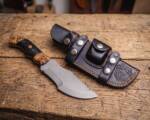
| Sheath | Handmade tan leather belt sheath with stud closure (included) |
Model: BMK-1165
What the hook does
The sharpened crescent in the spine has one job and it does it better than a knife tip can. Slipped beneath the hide where the ribs finish and pulled steadily back, it opens the abdominal wall from underneath while the rounded outer edge slides along the paunch, keeping the point away from anything you do not want to open. Everything after that — skinning, quartering, caping — happens on the drop point, which has a full belly for long sweeping cuts and a lowered tip that will not dive. The tang is full length and full width, brass pins hold the scales, and a solid brass bolster caps the front and gives the knife its balance just ahead of the hand.
Sheath
Tan leather from a vegetable tannage, worked over the blade while damp and stitched by hand along the welt, with a press stud strap across the handle and a broad loop for the belt. Veg-tan starts light and tans through use into a deep honey, so a sheath that has been carried for a decade looks nothing like a new one. Collectors looking at antler on a shorter working outline should also see the Buckhorn Twist bull cutter, which pairs the same material with a twist-pattern blade.
Keeping it right
An etched blade and a natural handle both want the same basic courtesy: clean, dry, and stored loose. Wash the knife the day it is used, work a soft brush into the hook where residue hides, dry it fully, and put a thin film of oil across the flats before it sits for the off season. Antler needs almost nothing — keep it out of dishwashers and away from long soaks, and if the bark ever looks chalky, a trace of clear wax rubbed in with a cloth restores it. Do not store the knife in the leather; tanned hide holds humidity and steel does not enjoy that conversation. Sharpen the main edge at the angle it arrived, dress the hook with a rat-tail ceramic from the inside of the curve, and strop the burr off at the end.
Forged, etched, fitted, sheathed, and sharpened in our Memphis, Tennessee shop.

Reviews
There are no reviews yet.