


Description
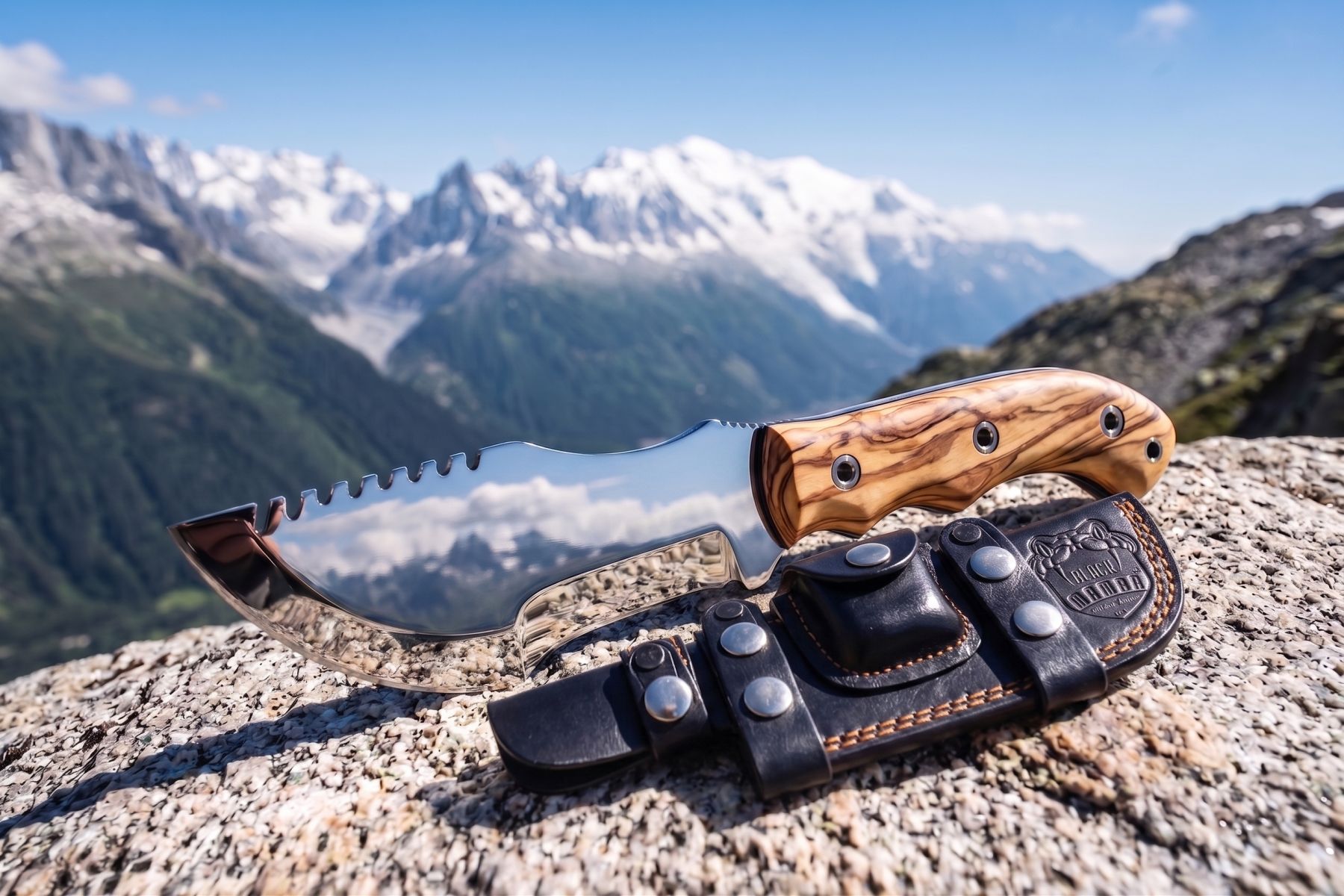
Summit Burl runs olive burl the full length of the handle, with stainless pipe inlays set through it and a lined hole through the butt for a cord. The blade is a mirror-polished D2 tracker, a quarter inch thick and 6.38 inches long. Pale gold wood with dark streaks against bright steel is the entire idea.
| Overall length | 11.88 inches |
| Blade length | 6.38 inches |
| Blade thickness | 0.25 inches |
| Steel | D2 tool steel, hand mirror polished |
| Grind | Tom Brown tracker profile — chopping belly, straight fine-work section, sawback spine |
| Handle | Olive burl wood |
| Inlay | Stainless steel pipe inlay through the handle |
| Lanyard | Lined lanyard hole through the butt |
| Included | Black leather tracker sheath |
Best used for: bushcraft that involves removing a lot of wood. Splitting kindling, shaping poles, cutting notches, batoning rounds down to something that will catch. The forward curve chops, the straight section shapes, and the teeth open grooves and shave a ferro rod.
The two things tracker geometry is good at
Chopping above its weight, first: concentrating the belly into a short arc lands the energy of a swing on an inch or two of edge instead of spreading it down a straight blade. Second, switching jobs without switching knives — the straight run of edge behind the belly is a controlled carving surface a few inches from your grip, so shelter building becomes one knife instead of a knife and a hatchet.
The two things it is not
It is not a slicer: the belly rolls the edge out of the material before you finish a long stroke. And it is not a detail knife, because a tracker tip is thick by design. Sharpening asks more attention than a straight blade, since the angle changes through the curve; the sharpening guide covers a curved belly.
Pipe inlays and burl
A pipe inlay is a metal tube set through the handle rather than a solid pin. It reinforces the wall of the hole, gives the epoxy more bonding surface than a plain pin, and leaves a bright ring on both faces. Because burl comes from a knotted growth, no two handles carry the same figure — yours will be its own. Our handle parts guide covers the terminology.
Care: Dry the steel after use and put a thin film of mineral oil on it monthly. Clean the mirror with a soft cloth and skip anything abrasive. Give the wood a light wipe of oil once or twice a year and keep it out of standing water. Store the knife outside the leather sheath.
FAQs
What is olive burl? Wood taken from a knotted growth on the tree instead of the straight trunk, which is why it swirls rather than running in lines. Unusually dense for a pale wood.
Is wood a bad idea on a hard-use knife? Not on a dense wood that gets an occasional wipe of oil. For zero maintenance, Ember Burl uses the same burl only as bolsters.
What is included? The knife, its black leather tracker sheath, and a gift-ready box.
Make it a gift: add laser engraving at checkout. Every order ships from Memphis, TN with a lifetime warranty — backed by 2,000+ verified customer reviews.
Model: BMK-1115
Tyrone Ramos –
This is one of those purchases that just makes you smile. Blade geometry makes it glide through cuts with barely any effort. Steel has a gorgeous pattern that looks different in every light. Shipping was fast and everything arrived well packaged.
Sophia Morgan –
Didn’t think a knife at this price could feel this premium. Love that this comes out of Memphis and still ships worldwide this quickly.
Jeffrey Kim –
Happy with this one for the most part. Blade quality is solid. Arrived a bit less sharp than expected but a few passes on a strop fixed it. Glad I made this purchase.
John Ortiz –
Got this as a retirement gift and it exceeded what I expected. This will not be my last order from this company.
Samantha Rivera –
This turned out to be way better than I thought it would be. Edge retention has been great even after regular use in the field. This seller clearly takes pride in their work. Made in the USA right in Memphis, and it shipped worldwide without any long wait.
Carol Anderson –
Not what I paid for. Build quality felt cheaper than the pictures suggested. Would not recommend based on my experience.
Wyatt Brooks –
Couldn’t ask for a better knife honestly. This has quickly replaced my old go to knife for field dressing. Would not hesitate to order again.
Carol Hill –
This knife completely won me over the moment I picked it up. Handle feels amazing and the balance is perfect. Steel has a gorgeous pattern that looks different in every light. Zero complaints from me on this purchase.
Carl Hayes –
This knife is a genuine work of art. Sheath snaps shut securely and doesn’t feel flimsy at all. Handle has a great grip even with wet or gloved hands. Already telling my friends to check this out.
Nicholas Kim –
Set my expectations low going in and this blew right past them. Every piece of the fit and finish looks hand checked before it shipped. Shipping was fast and everything arrived well packaged.
Samantha King –
My skepticism about ordering online disappeared the second this arrived. Sheath snaps shut securely and doesn’t feel flimsy at all. Pommel and guard are solid, no wobble anywhere on the knife. Even the small details in the damascus pattern are crisp and clean. This is exactly why I keep coming back to this company.
Matthew Rogers –
This thing is a beast in the best way. Fit and finish is museum quality. You can tell real craftsmen made this by hand. Blade geometry makes it glide through cuts with barely any effort. Will definitely order again for another one.
Craig Howard –
Feels way more premium than the price suggests. This maker nailed it with this one.
Betty Gray –
This is exactly what I wanted and then some. Sheath snaps shut securely and doesn’t feel flimsy at all. Good to know real Memphis craftsmen are behind this, and shipping was quick too. Couldn’t be happier with this.
Justin Campbell –
Amazing craftsmanship on this one. Steel has a gorgeous pattern that looks different in every light. Would send this as a gift again in a heartbeat.
DeShawn Brooks –
Ordered late at night on a whim and woke up glad I did. Blade holds a razor edge right out of the box. This one’s a keeper for sure.
Nancy Ward –
Expected better quality for the price. Leather sheath was thinner than shown in the pictures. Just an average purchase. Wouldn’t rush to buy again.
Olivia Robinson –
My brother was speechless when I showed them this knife. Highly recommend this one.
Michelle Jimenez –
Stellar quality for the price point. Even the small details in the damascus pattern are crisp and clean. Steel has a gorgeous pattern that looks different in every light. Would not hesitate to order again.
Amanda Cole –
Got this for a wedding gift and now I want one for myself too. This has quickly replaced my old go to knife for field dressing. Took it out camping right away and it handled everything I threw at it. Beyond happy with how this turned out.
Cynthia Adams –
This is hands down one of the best knives I’ve bought online. This has quickly replaced my old go to knife for field dressing. This will not be my last order from this store.
Susan Smith –
This exceeded what I pictured in my head before ordering. Took it out camping right away and it handled everything I threw at it. Love it.
Linda Morales –
This exceeded what I pictured in my head before ordering. This has quickly replaced my old go to knife for field dressing. If you’re on the fence just get it. You won’t regret it. Every piece I’ve gotten from Black Mamba Knives has been solid.