


Description
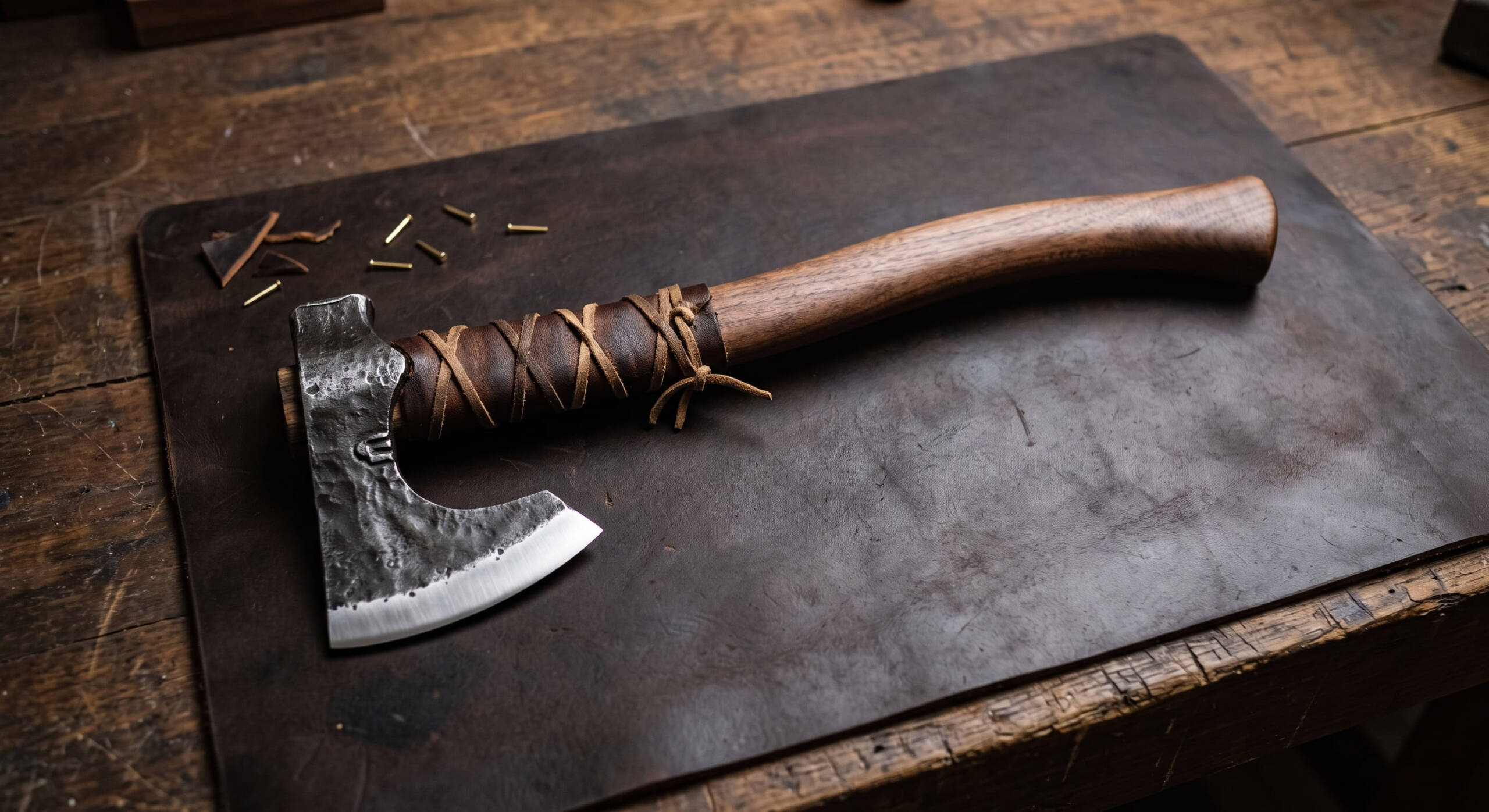
Iron Beard is built the old way and looks it. The head is hand-forged high carbon steel in a bearded pattern, hammer texture left standing on both cheeks and only the bevel ground and polished bright. The haft is curved dark walnut with a swelled butt, wrapped in brown leather and laced over the top with rawhide in a criss-cross. Nineteen inches overall.
| Overall length | 19 inches |
| Head | Hand-forged high carbon steel, bearded pattern |
| Finish | Hammer texture on the cheeks, polished bevel |
| Haft | Curved dark walnut with swelled butt |
| Grip | Brown leather wrap, criss-cross rawhide lace |
| Included | Fitted leather edge sheath |
In the hand: carving, splitting and the sort of camp work where you want to be close to the edge. A bearded head lets you slide your hand right up under the blade and use it like a large drawknife, which is how these were used before anyone called it bushcraft.
What the beard is actually for
The beard is the section of edge hanging below the eye, and it is not decoration. It buys cutting length without buying head weight, because you extend the edge downward into space rather than forward into more steel. It gives you a hook for pulling and draw cuts. And it opens the space directly behind the blade, so you can choke your hand against the head and cut with the edge inches from your fingers. A conventional head fills that space with metal.
A curved haft, and how the head is hung
The curve indexes the tool: with a straight haft you have to look to know which way the bit faces, and with a curve and a swelled butt your hand tells you. Underneath the leather the head is hung traditionally — driven up a tapered haft until the wood locks in the eye, no wedge and no adhesive. Because nothing glues it on, the fit tracks the humidity. Rock the head sideways before use, and if it moves, hold it head upward and strike the butt onto a stump once or twice. That is re-seating. Hand forged versus factory covers what else forging changes.
Care: High carbon steel with no meaningful chromium, so rust is the standing threat — dry the head and keep oil on it. Leave the hammer texture alone; polishing it out removes the character you paid for. Rawhide shrinks tight as it dries but rots if it lives wet. Oil the walnut annually. The storage guide covers a long off-season.
FAQs
Is the rawhide structural? It tensions the leather wrap. The head is held by the taper fit in the eye, not by the lacing.
Is this a reproduction? No. It is built on the bearded pattern associated with Norse axes, but it is a working tool made now, not a copy of an excavated piece.
Can I choke up behind the beard? Yes — that is the point of the shape. Your grip sits immediately behind a long edge.
Is there a modern equivalent? Storm Breacher is the same idea in one piece of D2 with G10 scales and no wood at all.
Make it a gift: add laser engraving at checkout. Every order ships from Memphis, TN with a lifetime warranty — backed by 2,000+ verified customer reviews.
Model: BMK-1123


Brenda Cox –
Knew this knife was special the second I opened the box. Fit and finish is museum quality. You can tell real craftsmen made this by hand. Blade holds a razor edge right out of the box. Telling everyone I know to check this store out.
Jessica Wright –
This is one of those purchases that just makes you smile. Can’t wait to see what else this maker has to offer.
Walter Chavez –
This knife punches way above its price point. This has quickly replaced my old go to knife for field dressing. Every piece of the fit and finish looks hand checked before it shipped. Love it.
Dustin Watson –
Showed up right on time and looked even better than the photos. Weight and balance make it feel like a real working knife not some cheap import. Can’t say enough good things about this purchase. Love that this comes out of Memphis and still ships worldwide this quickly.
Carl Mendoza –
Been eyeing this knife for a while and it did not disappoint. Edge retention has been great even after regular use in the field. Zero complaints from me on this purchase.
Derek Wilson –
Decent buy overall, a couple small nitpicks aside. Blade quality is solid. Arrived a bit less sharp than expected but a few passes on a strop fixed it. Would still tell others to give this a try.
Diego Wells –
So happy I finally pulled the trigger on this one. Handle has a great grip even with wet or gloved hands. Handle feels amazing and the balance is perfect. Blade holds a razor edge right out of the box. Already telling my friends to check this out.
Harold Rodriguez –
My skepticism about ordering online disappeared the second this arrived. Came in a nice gift box which made it feel even more special. No hesitation recommending this to anyone looking.
Deborah Nelson –
This is hands down one of the best knives I’ve bought online. Blade holds a razor edge right out of the box. Can’t wait to see what else this maker has to offer.
Michelle Stewart –
My skepticism about ordering online disappeared the second this arrived. Took it out camping right away and it handled everything I threw at it. This seller clearly takes pride in their work.
Elizabeth Brooks –
Wasn’t expecting to be this impressed but here we are. Took it out camping right away and it handled everything I threw at it. Sheath snaps shut securely and doesn’t feel flimsy at all. Can’t wait to see what else this store has to offer. You can tell it’s real American craftsmanship out of Memphis. Shipping was quick too.
Malik Thomas –
I collect knives and this one is amazing. Weight and balance make it feel like a real working knife not some cheap import. Love it.
William Freeman –
My son was speechless when I showed them this knife. Came in a nice gift box which made it feel even more special. Handle has a great grip even with wet or gloved hands. This will not be my last order from this company.