
Description
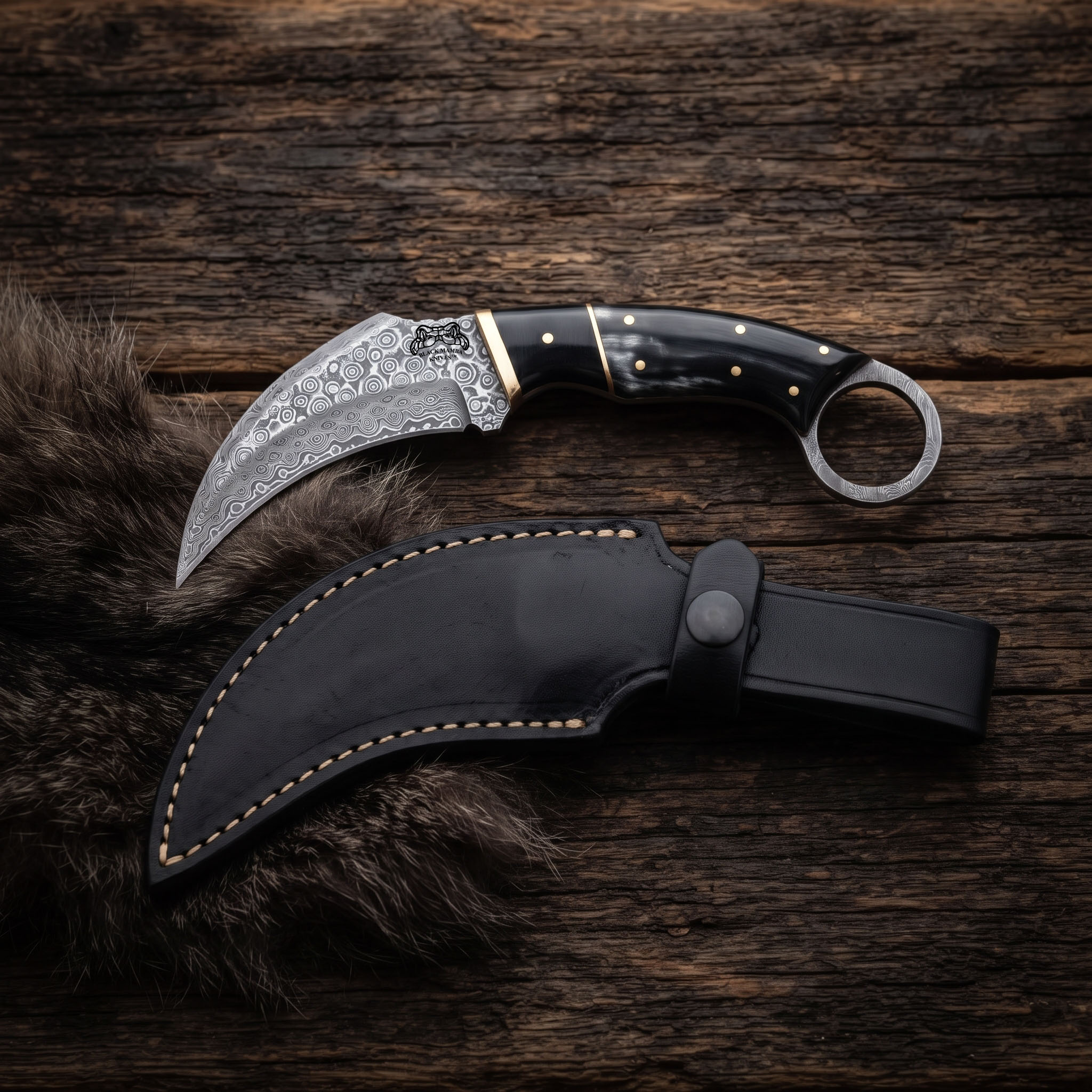
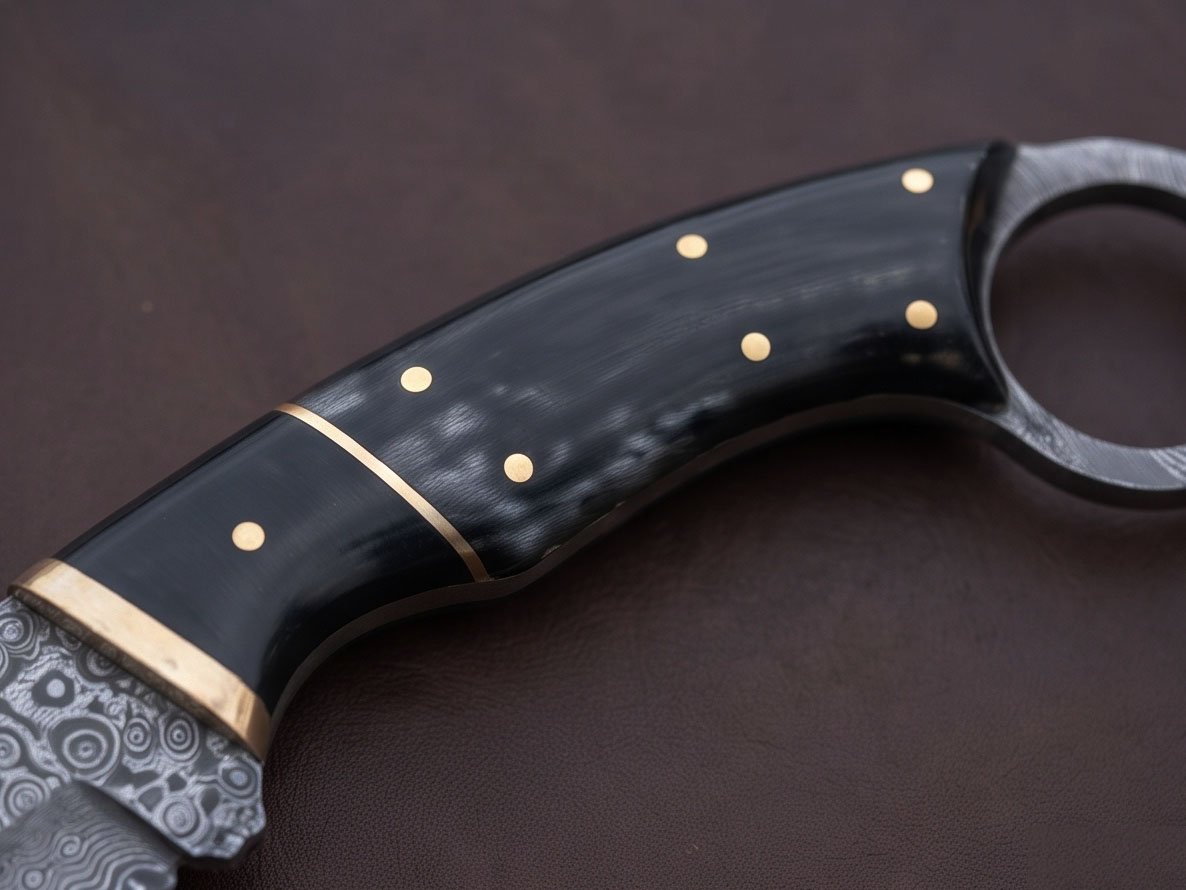
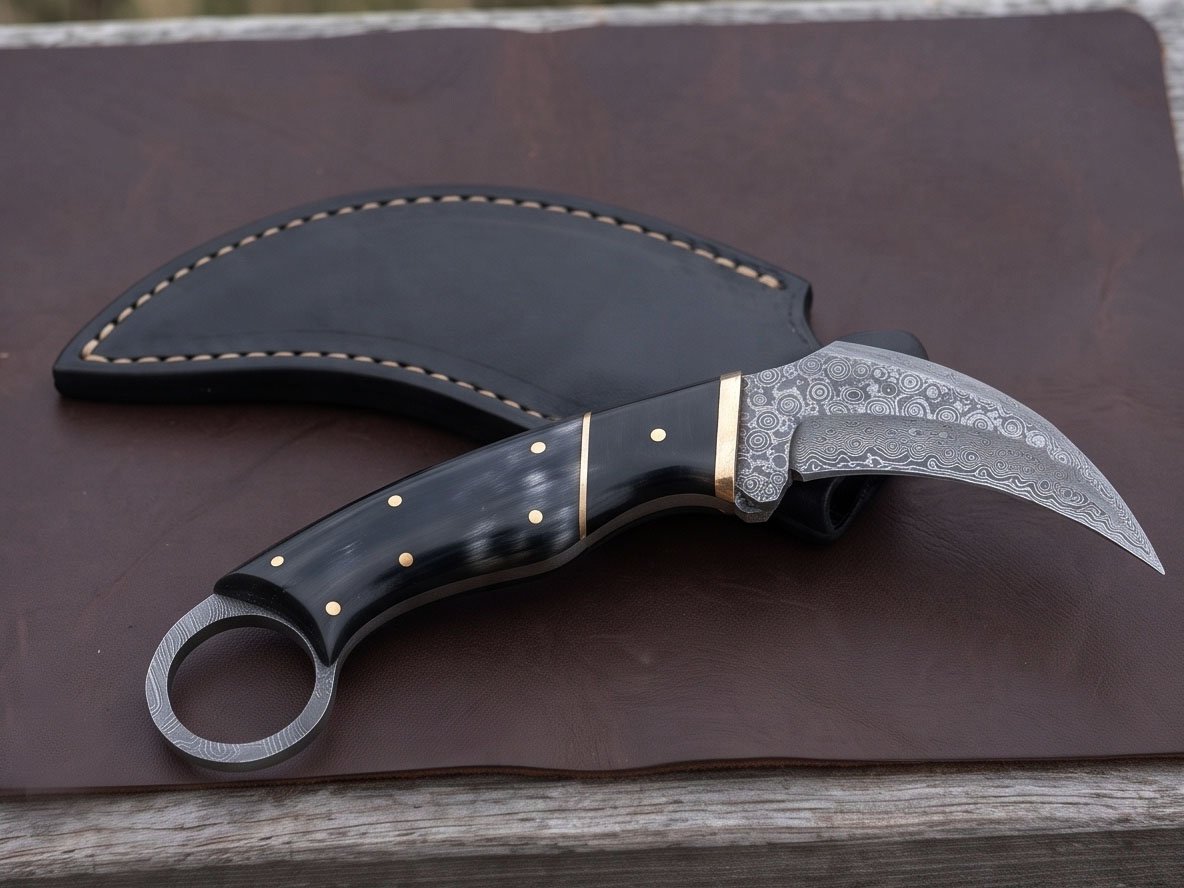
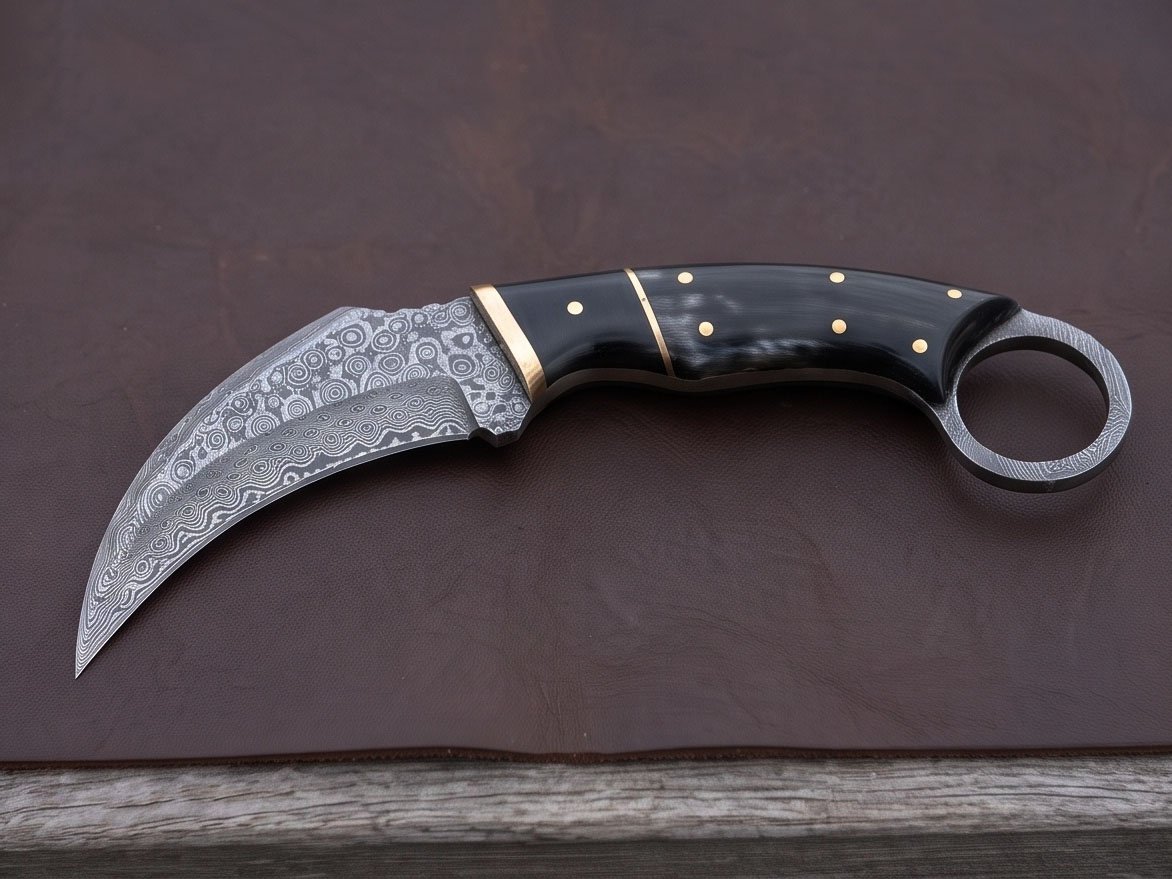
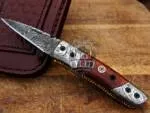
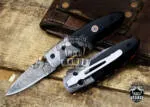
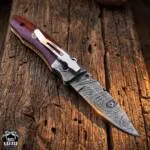
Onyx Fang is the piece in this run that we would keep for ourselves. Raindrop Damascus in the blade and in the finger ring, polished buffalo horn between two brass spacers, brass pins set through the horn, and a black leather crescent stitched in cream to carry it. There is nothing understated about it and no apology offered.
Raindrop
Most Damascus patterns come from how the billet was folded and twisted. Raindrop comes from what was taken away. After the layers are welded and drawn, shallow round depressions are drilled or punched into the surface of the billet, and then the whole thing is forged flat again. Flattening those dimples drags the buried layers up toward the surface in concentric rings, so when the blade is finally ground and etched you get rows of ripples like rain hitting still water. Every ring is a cross-section through a real interface between two steels — it exists through the thickness of the blade, not on it.
The same pattern runs through the finger ring, which is the detail that makes this knife. Most makers use plain steel there because the ring is a load-bearing part and Damascus is fussy to forge into a closed loop. Doing it properly means the pattern flows continuously from the tip of the hook all the way around the back of your finger. There is more on how the material gets made in our account of forging Damascus steel.
| Overall Length | 8.7 inches |
|---|---|
| Blade Length | 3.6 inches (measured along the curve) |
| Blade Steel | Hand-forged Damascus, acid etched |
| Blade Finish | Acid etched raindrop Damascus |
| Blade Style | Curved karambit hawkbill |
| Handle Material | Polished buffalo horn |
| Finger Ring | Damascus finger ring, integral |
| Fittings | Brass pins and brass spacers |
| Tang | Full tang |
| Sheath | Handmade black leather belt sheath with contrast stitching (included) |
Buffalo horn
Water buffalo horn is a keratin, the same family of material as fingernail and hoof, and it takes a polish that no wood can match — a deep wet-looking black with faint translucent striations that catch the light from certain angles. It has been used for knife handles for as long as there have been knives, because it is tough, warm to the touch, and completely unlike anything synthetic in the hand. Two brass spacers frame the horn where it meets the blade and where it meets the ring, and brass pins run through the body of it. Horn is a natural material and it does move a little with humidity; a smear of oil once or twice a year keeps it from drying out.
The shape and what it is for
A karambit’s edge faces inward. That means the cut happens on the pull: hook a rope, a length of webbing, a strip of hide or a heavy carton, draw the knife back, and the arc feeds whatever you are cutting down toward the throat of the curve, which is where the leverage lives. It is enormously efficient at the jobs it is designed for and useless at the ones it is not. The ring is retention — index finger through it and the knife is locked to your hand whether your grip is closed or open, wet or gloved. This is also a collector’s knife, and a good many of these will spend their lives on a stand rather than a belt; that is a perfectly honourable use for it.
The leather
Black veg-tan, wet formed to the exact curve of this blade so it seats firmly, hand saddle stitched in contrasting cream thread, with a belt loop behind. The stitching is the same technique used on saddlery — two needles, one thread, every stitch locked, so a cut thread cannot unzip the seam.
Care
Damascus is high carbon steel and the etch is a thin surface. Clean with a cloth and mild soapy water, never with an abrasive pad or a polish containing grit, and dry it completely before it goes away. Leave a trace of oil on the flats and on the ring. Get fingerprints off promptly, since skin acid will etch its own marks into a pattern given a week. Keep it out of the sheath in storage, and give the horn the occasional drop of oil. Anyone hesitating over the upkeep should read our honest take on whether Damascus is worth it.
Built in Memphis, Tennessee
Billet forged, blade ground and etched, ring formed, horn fitted, sheath cut and stitched, all in our own shop. Because the raindrop pattern depends on where the dimples went and how far the billet was drawn afterwards, and because horn is a natural material, yours will be recognisably this knife without being a copy of the photograph. A companion in the same forged steel with a very different personality is the maple burl Sunfire Claw. Gift presentation is available on request when you order. Faults in material or making are covered without a time limit, and the shop carries better than 2,000 verified five-star reviews.
Model: BMK-1190
Buying for groomsmen? This knife also comes as a matched set of 6, 15% less than buying six singly, and each one can carry its own engraved name.
Diego Anderson –
Bought this on a whim and it turned out to be one of my favorite purchases this year. Detail on this ring is incredibly crisp for something handmade. 10/10 would buy again.
Carol Vance –
This exceeded what I pictured in my head before ordering. Proud to support American made goods out of Memphis with this purchase.
Caleb Cruz –
This blade came razor sharp right out of the box. Fits perfectly and the damascus pattern looks amazing in person. Can’t recommend this enough.
Lisa Morris –
This ring punches way above its price point. Good to know real Memphis craftsmen are behind this, and shipping was quick too. Pattern in the metal catches the light beautifully. Can’t wait to see what else this seller has to offer.
Rebecca Rogers –
Couldn’t ask for a better ring honestly. Fits perfectly and the damascus pattern looks amazing in person. Gets compliments every time I wear it. Exactly the weight and finish I wanted. Feels substantial without being bulky. Already added a few more items from this maker to my cart.