
Description
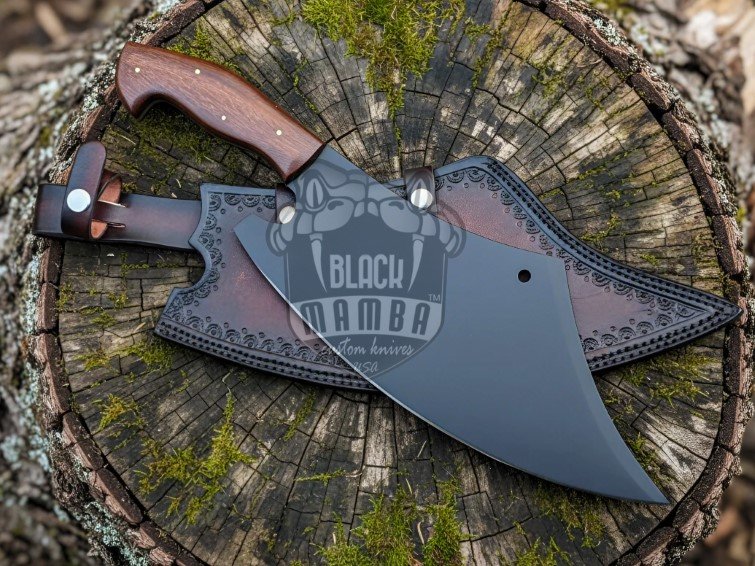
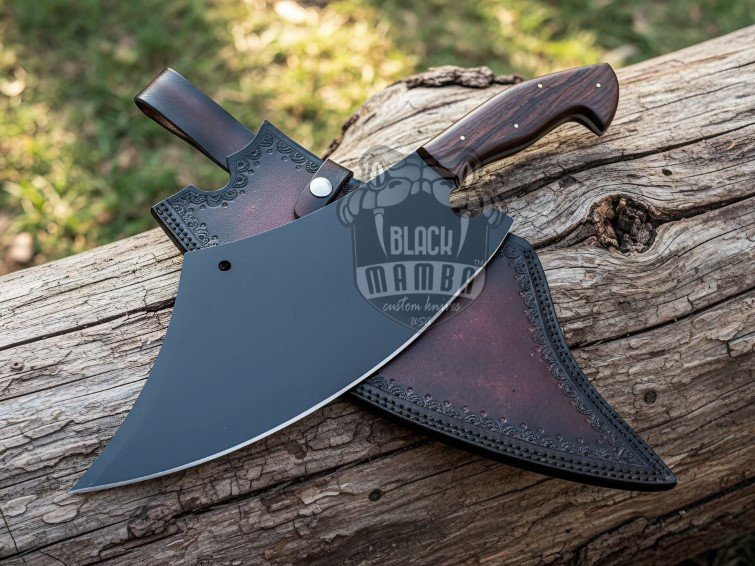
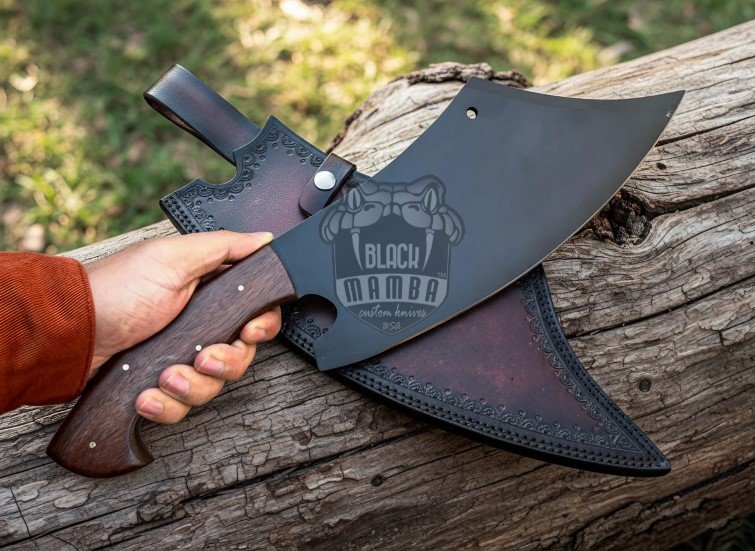
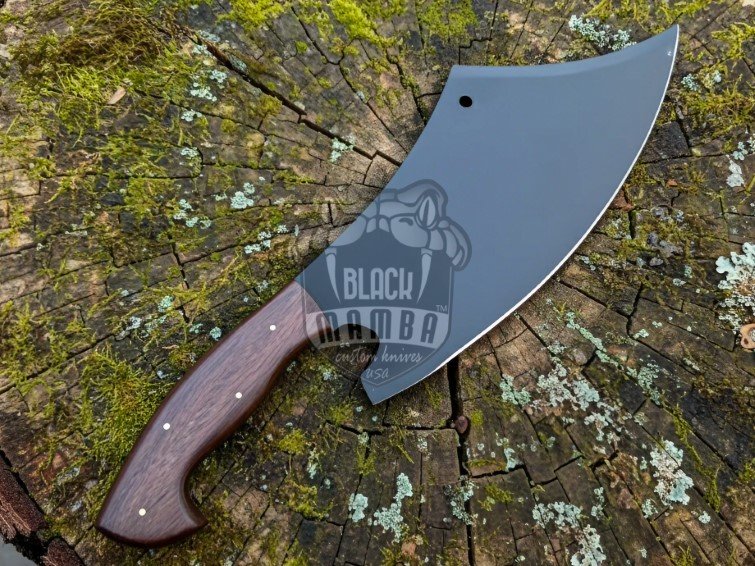
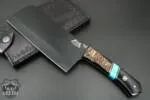
Twelve inches of blade under a flat black coating, with a sweeping belly that drops to a point rather than ending in the square nose most cleavers have. It is a chopper that can also skin and break down an animal, which is an unusual pair of jobs for one tool.
| Overall length | 18 inches |
| Blade length | 12 inches |
| Handle length | 6 inches |
| Handle | Wood riveted with steel pins |
| Steel | High carbon steel, black carbon coating |
| Hardness | 58–60 HRC, oil tempered |
| Pattern | Black carbon coating; no forged pattern |
| Included | Hand-stitched leather sheath |
Put to work: heavy butchery and camp processing. This is the knife for jointing, splitting ribs, quartering and cutting through the resistance that would stall a chef knife. The mass sits forward of your hand, so the swing does the cutting and you steer rather than force.
The blade is coated, and that is the point
The finish here is a uniform matte black carbon coating laid over the whole flat, right to the edge bevel. It is not a pattern and it is not an etch — there is no visible layering anywhere on this blade. The coating exists to keep moisture off high-carbon steel in the worst environment a knife can live in, which is a wet game pole or a butcher block. It also kills glare, which matters more than it sounds when you are working outdoors.
Details you only notice in the hand
There is a hole through the blade near the spine, positioned for a lanyard or for hanging on a hook rather than for weight reduction. The wood handle is riveted with steel pins over a tang that runs the full width, and the belly of the blade sweeps far enough that you can use the last three inches like a skinner without changing grip.
The sheath is tooled, not plain
Twelve inches of edge needs real leather around it. This one is stitched, stamped with a decorative border along both edges, and fitted with a belt loop and a snap strap over the handle.
Care: a coating protects the flats and nothing else. The moment you sharpen this knife you expose bare high-carbon steel along the whole edge, and that thin strip is where rust will start. Dry the edge properly after every wash, and put a trace of oil along the bevel specifically before the knife goes away. Do not scour the flats with an abrasive pad — you will thin the coating and the first bare patch will be the one that pits. Store it out of the leather.
Questions about this cleaver
Will the coating wear off? Along the edge, immediately and by design. Across the flats it will scuff where it contacts bone and board, and that scuffing is cosmetic. Removing rust from a knife covers what to do if a bare patch does freckle.
Can I cut through bone with it? Through joints and through rib and poultry bone, yes. Do not use it as a splitting maul on heavy leg bone.
What angle do I sharpen it to? Keep it obtuse, around twenty degrees per side, because a chopper meets bone. Our guide to chef knife bevels explains why thin edges fail on this kind of work. If you would rather see the steel than a coating, the African Buffalo Damascus cleaver leaves the pattern exposed.
Model: BMK-647

Anna Garcia –
Honestly one of my better purchases in a while. Cool knowing this was handmade right in Memphis and shipped out fast.
Olivia Anderson –
So happy I finally pulled the trigger on this one. Has become my main prep knife in the kitchen since it arrived. Shipping was fast and everything arrived well packaged. This is my third order from Black Mamba Knives and they never disappoint.
Donna Morgan –
This is hands down one of the best knives I’ve bought online. Has become my main prep knife in the kitchen since it arrived. Would send this as a gift again in a heartbeat.
Cynthia Cooper –
Set my expectations low going in and this blew right past them. Slices through everything like butter, no sawing needed. Already added a few more items from this maker to my cart.
Diego Bennett –
Five stars isn’t even enough honestly. Slices through everything like butter, no sawing needed. Beyond happy with how this turned out.
Barbara Cruz –
Perfect gift. Perfect quality. No complaints. Slices through everything like butter, no sawing needed. This is exactly why I keep coming back to this store.
Barbara Foster –
Been eyeing this knife for a while and it did not disappoint. Cleans up easy and hasn’t shown any rust or staining. Slices through everything like butter, no sawing needed. Handle stays comfortable even after prepping a big meal. This maker just earned a repeat customer.
Christopher Jackson –
Ordering again from this shop the second I finish writing this review. Made in the USA right in Memphis, and it shipped worldwide without any long wait.
Brandon Brooks –
This knife is a genuine work of art. Edge held up great through a full week of daily cooking. Cleans up easy and hasn’t shown any rust or staining. Would send this as a gift again in a heartbeat.
Kevin Moore –
Turned out better than I expected going in. Cuts well though it needed a quick touch up on the edge. Handle feels good, just a little heavier than I expected. Would buy from this shop again.
Alexander Richardson –
This is one of those purchases that just makes you smile. Has become my main prep knife in the kitchen since it arrived. This seller just earned a repeat customer.
Susan Kim –
This is exactly what I wanted and then some. Edge geometry makes thin slicing so much easier than my old knife. This shop clearly takes pride in their work.
Ryan Rogers –
This showed up faster than expected and looked incredible. Handle stays comfortable even after prepping a big meal. So worth it.
Angela Thompson –
Not going to lie. This exceeded my expectations by a lot. Slices through everything like butter, no sawing needed. Has become my main prep knife in the kitchen since it arrived. Can’t recommend this enough.
Pamela Hernandez –
A bit disappointed with this one honestly. Handle felt slippery when wet. On the fence about ordering here again.