
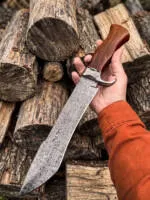
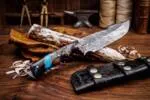
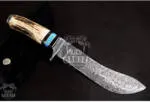
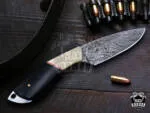
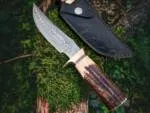
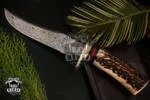
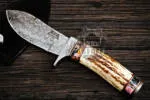
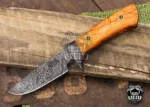
A hunting knife is judged in the field, not on a shelf. What matters is whether the edge is still cutting when you are halfway through the job and your hands are cold and wet. These are our fixed-blade hunting knives: full tang from butt to tip, hand-forged rather than stamped from sheet, and shipped with a fitted leather sheath.Steel. Most carry our own 1095 and 15n20 Damascus at 58 to 60 HRC, which takes a very fine edge and comes back quickly on a stone. Where damp is the bigger enemy, 440C stainless is the sensible pick. D2 tool steel sits between the two.Blade length. Three to four inches handles small game and general camp work. Four to six inches is the usual all-round choice for deer. Anything past six inches is really a camp knife, better at splitting and chopping than at fine work around a joint.Handle. Stag and buffalo horn grip well when wet and each one is different. Wood is warmer in the hand and colder to look at. Micarta and G10 shrug off blood and water entirely.
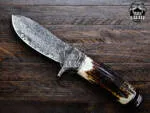
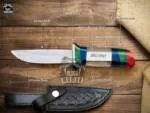
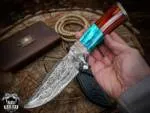
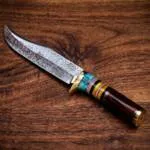
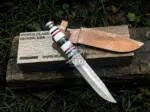
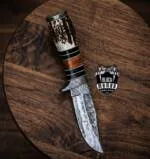
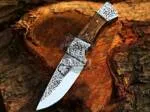
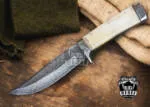
This hunting knives collection is built around fixed blades made in Memphis. Most of them are hand forged Damascus in 1095 and 15N20, and there are D2, 440C and stainless hunters here too, each one shipped with a hand stitched leather sheath. Choose a drop point for field dressing, a bowie for camp work or a skinner with a gut hook, then pick the handle that suits your grip.
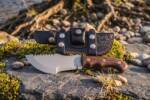
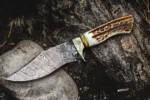
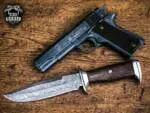
How do I stop a Damascus blade rusting? Wipe it dry, put a film of mineral oil on the steel, and never store it wet in a leather sheath. Leather holds moisture against the blade.Which knife for field dressing? A four inch drop point does almost everything. Add a gut hook only if you dress a lot of animals; most people never use it.Can these be engraved? Yes, up to 20 characters for a flat 29 dollar fee. Engraved knives cannot be returned.
More reading. Read our guides on telling real Damascus from a printed pattern, what 352 layers means and caring for a Damascus blade. These are the custom hunting knives our customers order most – each handmade hunting knife here is field-tested, hand-forged and made in the USA. If you want a custom hunting knife built to your own spec, we take those orders too.
More reading. Read our guides on telling real Damascus from a printed pattern, what 352 layers means and caring for a Damascus blade. These are the custom hunting knives our customers order most – each handmade hunting knife here is field-tested, hand-forged and made in the USA. If you want a custom hunting knife built to your own spec, we take those orders too.
Every fixed blade ships with a hand-stitched leather sheath
A hunting knife without a sheath is a knife you leave in the truck. Every fixed blade in this category comes with a leather sheath included, cut for that exact blade rather than pulled off a rack of universal sizes. Full-grain cowhide, saddle-stitched by hand with waxed thread, a welt down the edge so the blade never saws through the seam, and a belt loop sized for a standard 1.5 inch belt. Wet-formed to the knife, so it holds on the draw and holds on the walk back.
Left-handed carry, dangler loops and cross-draw versions are available on request. If you already own one of our knives and the sheath has finally given up after a decade of blood, rain and river crossings, we make replacements.
Do your hunting knives come with a sheath? Yes. Every fixed blade ships with a hand-stitched full-grain leather belt sheath, wet-formed to that specific blade. There is no extra charge and no upsell.
Is the leather sheath left-hand friendly? Tell us at checkout and we will build it for a left-side draw at no extra cost.
How do I look after the leather sheath? Keep the knife dry before it goes back in, and rub in a little leather conditioner once a season. Never store a wet blade in leather; the tannins will spot even stainless.
Can I buy a replacement sheath on its own? Yes. Send us the model and we will cut and stitch a new one for it.
Which hunting knife for which job
Most hunters carry one knife and make it do everything, which works until the day it does not. If you are buying your second, buy for the job the first one handles badly rather than a slightly different version of what you already own.
| Blade | Length | Shape | Best at | Poor at |
|---|---|---|---|---|
| Drop point | 3.5 to 4.5 in | Curved spine, strong tip | The all-rounder, field dressing anything | Nothing badly, master of nothing |
| Skinner | 3 to 4 in | Deep sweeping belly | Taking a hide off fast without cuts | Piercing and detail work |
| Gut hook | 3.5 to 4.5 in | Drop point plus hook | Opening the cavity without nicking organs | Anything needing a clean spine |
| Caping knife | 2.5 to 3 in | Fine point, short | Head and cape work for a mount | Heavy cutting, joints |
| Bowie or camp knife | 6 to 10 in | Clip point, heavy | Chopping, quartering, camp work | Anything delicate |
| Bushcraft or tracker | 4 to 6 in | Thick spine, flat grind | Batoning, shelter, fire prep | Fine dressing work |
Steel, chosen by where you hunt
| Steel | Edge holding | Rust | Buy it if |
|---|---|---|---|
| 440C stainless | Very good | Excellent resistance | You hunt wet, coastal or humid country |
| D2 tool steel | Excellent | Good | You hunt dry and sharpen properly |
| 1095 and 15N20 Damascus | Very good | Reactive, needs oil | You look after your gear and want the pattern |
| 1095 carbon | Good | Reactive | You want maximum toughness for chopping |
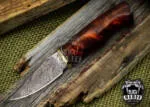
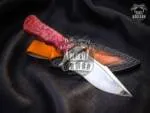
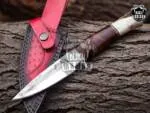
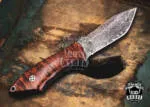
Freshly finished and added here: Crimson Vein D2 Steel Bushcraft Knife, Obsidian Crest D2 Steel Tracker Knife, Ember Burl D2 Steel Tracker Knife and Trail Legion D2 Steel Tracker Knife Set.
Every knife on this page is also listed in the wider fixed blade knives collection, alongside the bowies, trackers and daggers.
