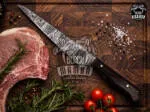
A fillet knife is the one knife where flex is the whole point. The blade has to bend along the ribs and follow the spine, lifting the fillet in one pass instead of sawing it into three pieces. Everything here is hand-forged in our Memphis, Tennessee workshop.
How much flex you want
Soft flex suits panfish and trout, where the frame is delicate and the blade needs to ride the bone. Medium flex is the all-rounder and handles walleye, bass and most saltwater fish. Stiff blades belong on large fish and heavy work where you are cutting through rather than around. A blade that flexes too much on a big fish just wanders.
Length by fish size
Six inches for panfish and trout. Seven to nine inches for walleye, bass and most inshore species. Nine inches and up for salmon, big catfish and offshore fish. A blade that is too short forces you into multiple passes, and every extra pass is where the flesh tears.
Steel and the wet problem
A fillet knife spends its life wet, often in salt. Our Damascus is 1095 and 15N20 hardened to 58 to 60 HRC, which sharpens beautifully and holds a very keen edge, but it is carbon steel and it will spot if you leave it in a sink overnight. Rinse it, dry it, oil it. If the knife lives on a boat, the 440C stainless blades are the more forgiving choice.
Handles that stay put
Wet hands and fish slime defeat a smooth handle. Micarta and textured G10 hold grip when everything else is slick. Wood looks better and needs a firmer hand.
Questions people ask
Can I use a fillet knife for boning meat? Yes, a stiffer one. A soft flex blade will fight you against a beef bone.
How sharp does it need to be? Sharper than any other knife you own. A dull fillet knife tears the flesh and costs you yield. Strop it before each session.
Is a sheath included? Check the specification table on the product. Most fixed-blade fillet knives here ship with leather.
Can I have it engraved? Yes, in house before it ships.
Related: all fishing knives, care and sharpening.
Please check your local law before ordering.
-
Penta Fold Pocket Knife | Super Steel 5 Blades Camel Bone Knife Black Mamba Knife Hunting Knife Steak Knife Multi Purpose USA Made Gift | BMK-006
Original price was: $239.00.$191.00Current price is: $191.00. -
Pine Marten Pine Cone Beautiful Skinner Knife Perfect for Hunting Hand Forged Steel Knife Best Quality Knife Gift USA Made | BMK-220
Original price was: $129.00.$103.00Current price is: $103.00. -
Penta Fold Pocket Knife | Super Steel 5 Blades Color Bull Horn Knife Black Mamba Knife Hunting Knife Steak Knife Multi Purpose USA Made Gift | BMK-008
Original price was: $251.00.$201.00Current price is: $201.00. -
Painted Mesa Turquoise Spacers Damascus Steel Hunting Knife with Leather Sheath, 9″ Damascus Skinner Knife, Camping / Boot Knife, USA Made Fixed Blade Knife | BMK-225
Original price was: $142.00.$114.00Current price is: $114.00. -
Handmade 32″ Japanese Damascus Katana Samurai Ninja Sword – A Premium USA-Made Gift with Wooden Sheath | BMK-561
Original price was: $708.00.$566.00Current price is: $566.00. -
Limited Edition Ka-Bar Style Damascus Knife – 12″ Feather Pattern Blade with Camel Bone Handle | BMK-1006-L1
Original price was: $457.00.$366.00Current price is: $366.00. -
Plains Hawk Native American Custom Hunting Skinner Knife Twist Damascus Stag Antler Brass Guard Camping Knife Gift USA Made | BMK-230
Original price was: $186.00.$149.00Current price is: $149.00. -
D2 Steel Balisong Butterfly Knife with Camel Bone Handle Handmade Original Traditional Filipino Butterfly Batanga Knife Black Mamba Knives USA | DB-30
Original price was: $229.00.$183.00Current price is: $183.00. -
Railroad Spike Hand Forged Knife, Engraved Knife, Hunting Dagger, Rail Road Spike Knife, Viking Dagger, Anniversary Gifts, USA | BMK-320
Original price was: $164.00.$131.00Current price is: $131.00. -
Antler Ridge Damascus Hunting Knife, Bowie Knife, Fixed Blade Knife with Leather Sheath, Stag Horn Handle, Damascus Steel Knife, Father’s Day Gift | BMK-131
Original price was: $599.00.$479.00Current price is: $479.00. -
Woolly Tusk Handmade Damascus Steel Bowie Knife Hunting Knife 17 Inches Blade Made in USA Fifteen Thousand Year Old Fossil Handle Gift | BMK-130
Original price was: $751.00.$601.00Current price is: $601.00. -
Sea Urchin Pro Kitchen Knife Fillet Knife 13 Inch Fish Fillet Knives Damascus Steel Sharp Knife with Wenge Wood USA Made | BMK-710
Original price was: $151.00.$121.00Current price is: $121.00. -
Tri Fold Pocket Knife | Super Steel 3 Blades Camel Bone Knife Black Mamba Knife Hunting Knife Steak Knife Multi Purpose | BMK-004
Original price was: $180.00.$144.00Current price is: $144.00. -
High Quality Made Stainless Steel Four Edge Cross Dagger Blade Knife with Leather Sheath, Hand Crafted Handle, Christmas Gift | BMK-562
Original price was: $468.00.$374.00Current price is: $374.00. -
Penta Fold Pocket Knife | Super Steel 5 Blades Color Camel Bone Knife Black Mamba Knife Hunting Knife Steak Knife Multi Purpose USA Made Gift | BMK-007
Original price was: $251.00.$201.00Current price is: $201.00. -
Handmade 32″ Damascus Katana Japanese Sword Damascus Samurai Ninja Sword – The Ultimate Gift – With a Wooden Sheath USA Made | BMK-560
Original price was: $708.00.$566.00Current price is: $566.00.