


Description
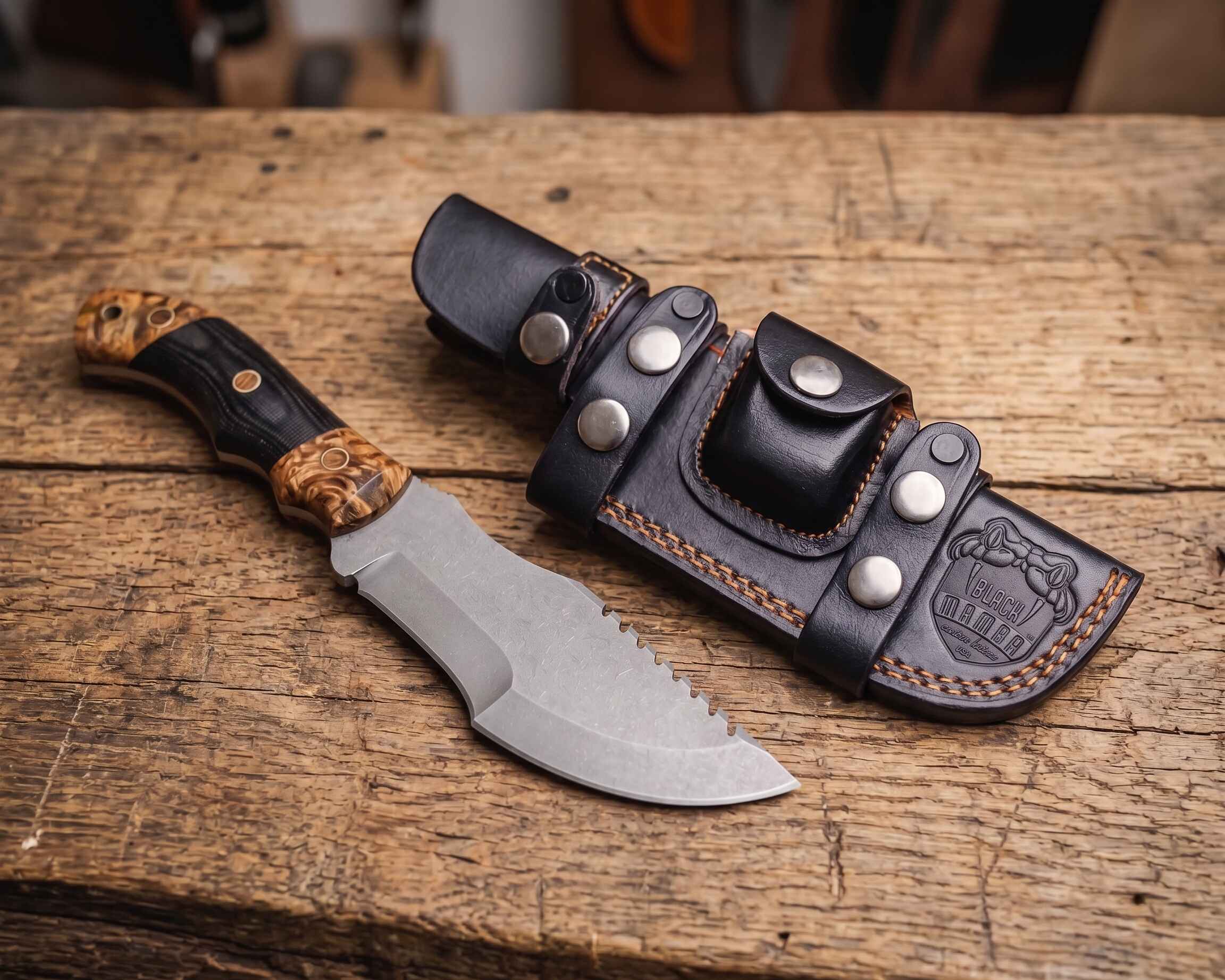
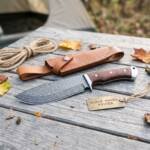
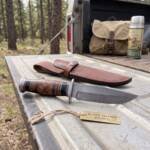
Ember Burl is the tracker for people who care what the handle is made of. A black canvas micarta center block, capped front and rear with olive burl bolsters, each parted from the micarta by a thin contrasting liner. A brass pipe inlay runs through the grip. The blade beneath is the standard D2 tracker, stone washed rather than polished.
| Overall length | 11.88 inches |
| Blade length | 6.38 inches |
| Blade thickness | 0.25 inches |
| Steel | D2 tool steel, stone washed matte finish |
| Grind | Tom Brown tracker profile — chopping belly, straight fine-work section, sawback spine |
| Handle center | Black canvas micarta |
| Bolsters | Olive burl wood, front and rear, with contrasting liners |
| Inlay | Brass pipe inlay through the handle |
| Lanyard | Brass-lined lanyard tube through the butt |
| Included | Black leather tracker sheath |
What it is for: wood. Shelter poles, firewood, tent pegs, trap triggers — anything that means taking material off a branch. The forward curve chops, the straight section carves, the teeth notch, and the stone washed finish means you stop caring what the blade looks like after the first afternoon.
Twin-edge geometry, and where it stops helping
A tracker asks you to change grip rather than change knife. Hold it back near the butt and the forward belly chops. Slide up to the ricasso and the straight edge ahead of your fingers becomes a controlled carver with your thumb on the spine. Where it stops working is any long uninterrupted slice, and any job needing a fine point — a tracker tip is blunt by intent, the leading corner of a chopping edge rather than a piercing tip.
Bolsters, liners and the pipe inlay
A bolster is a hard cap at the end of a handle: it adds mass forward, protects the vulnerable end grain of the scale, and closes the joint cleanly. The contrasting liner behind each one takes up unevenness where two flat surfaces meet, so the parts bed flat with no stress riser. The pipe inlay is a brass tube through the grip; the lined tube at the butt is the one meant for cord — our guide to handle parts puts names to all of it.
Care: Dry the blade and put a light coat of mineral oil on it after any wet day. The stone wash forgives scratches, so a cloth is all it needs. Give the burl a thin wipe of oil once or twice a year, and never soak the handle. Check the oil guide if you are unsure what to use.
FAQs
Is the handle wood or micarta? Both. Canvas micarta forms the center; olive burl forms the bolsters at each end, with contrasting liners between. The three materials meet in two clean joints, and getting those joints tight is most of the work in a handle like this.
Will my burl match the photograph? No. Burl is a growth cluster rather than straight grain, so the swirl is random. Same wood and tone, different picture.
Why is this blade not polished? Stone washed on purpose. A polish looks better on a shelf; a stone wash looks better after a year of use.
Is there an all-burl version? Summit Burl carries olive burl end to end instead of only at the bolsters, and a mirror-polished blade.
Make it a gift: add laser engraving at checkout. Every order ships from Memphis, TN with a lifetime warranty — backed by 2,000+ verified customer reviews.
Model: BMK-1111
John Wood –
My skepticism about ordering online disappeared the second this arrived. Telling everyone I know to check this store out.
Jose Carter –
I collect knives and this one is exceptional. Edge retention has been great even after regular use in the field. This will not be my last order from this store.
Logan Thompson –
This knife punches way above its price point. Highly recommend this one.
Eric Foster –
This is the kind of knife you show off without even meaning to. Weight and balance make it feel like a real working knife not some cheap import. Black Mamba Knives has earned a repeat customer with this one. Definitely bookmarking this seller for future orders.
Peter Morris –
Genuinely totally impressed with how this turned out. Made in the USA and shipped worldwide with no issues on my end. Definitely bookmarking this seller for future orders.
Travis Reed –
This thing is a beast in the best way. Black Mamba Knives’ attention to detail is honestly unmatched. Happy customer here, through and through.
Matthew Ortiz –
Beautifully made quality for the price point. Fit and finish is museum quality. You can tell real craftsmen made this by hand. Handle has a great grip even with wet or gloved hands. Can’t say enough good things about this purchase.
Megan Bailey –
This is the kind of knife you show off without even meaning to. This has quickly replaced my old go to knife for field dressing. Highly recommend this one.