


Description
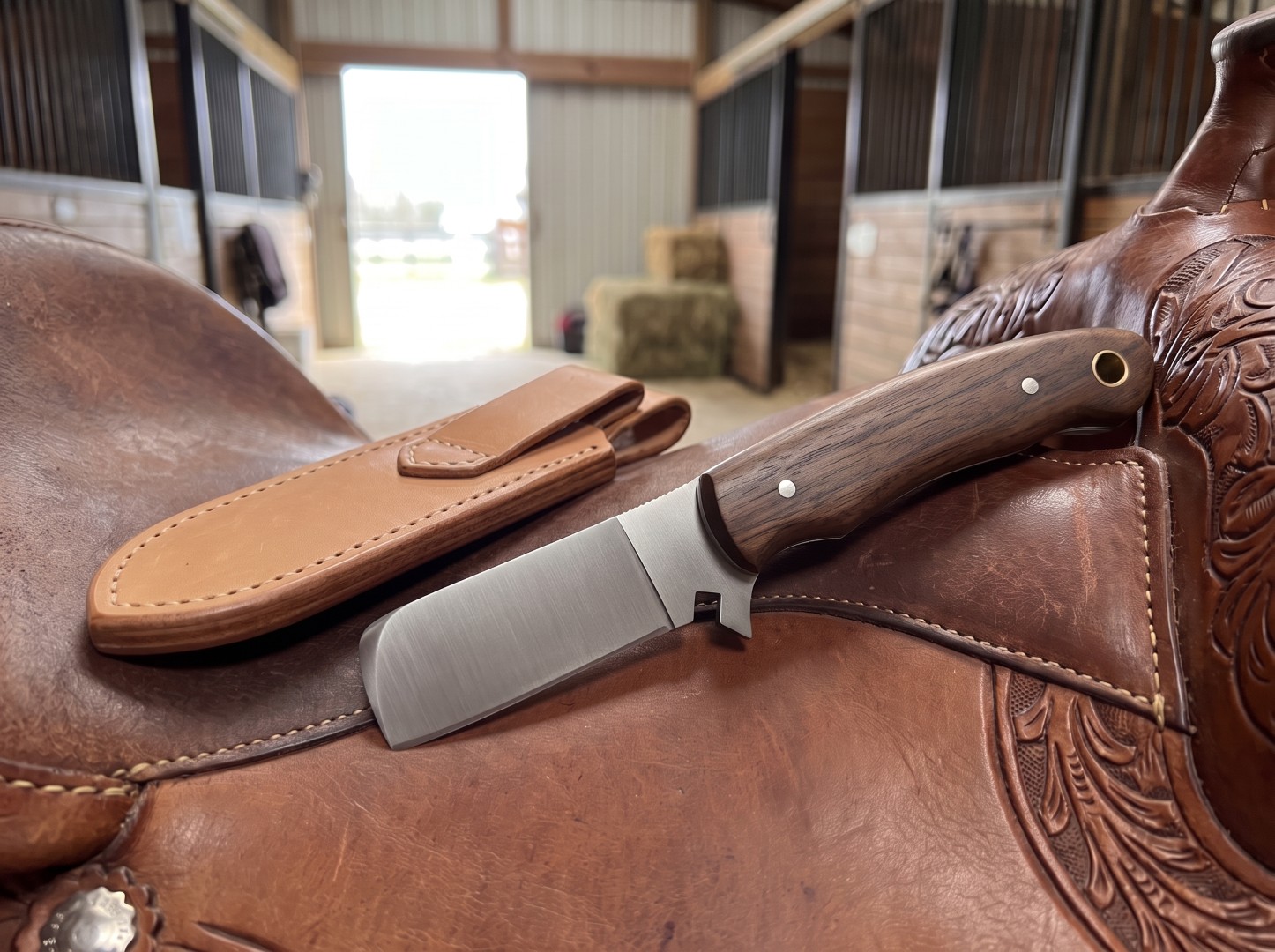
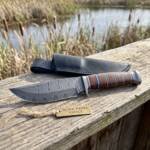
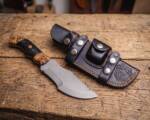
If the rest of this range is a collection of special occasions, the Latigo Ranger is the one you buy to use. Walnut scales, stainless pins, a plain satin blade and an untooled leather sheath. Nothing on it is decorative. It is the version of this knife you would design if you had to carry it every day and did not much care what anyone thought of it.
| Overall Length | 7.5 inches |
|---|---|
| Blade Length | 3.5 inches |
| Handle Length | 4 inches |
| Blade Steel | D2 tool steel |
| Blade Finish | Matte gray satin |
| Blade Style | Sheepsfoot bull cutter with notched choil |
| Handle Material | Walnut wood |
| Fittings | Stainless pins, brass-lined lanyard hole |
| Tang | Full tang |
| Sheath | Handmade leather belt sheath (included) |
D2 tool steel
The choice of steel is where the money went. D2 carries around twelve percent chromium, which is enough to make it markedly more corrosion resistant than the spring steel blades in this family without crossing into true stainless territory. It is a high-carbide steel, so it wears slowly and holds a working edge through a great deal more cutting than a simpler alloy would. The cost is at the stone: those same carbides resist abrasion when you are trying to sharpen just as effectively as they do when you are trying to cut, so a soft natural stone will polish it rather than remove metal. Use diamond or ceramic.
Because D2 stays usable for so long between sharpenings, the skill worth having is knowing when the edge merely needs realigning rather than regrinding. Most edges that feel dull are not; they are rolled. Honing and sharpening are different operations and confusing the two is how people wear knives out.
The bull cutter shape
A straight sheepsfoot edge with a rounded front and no point. Flat ground, satin finished with the grain running lengthwise. Full tang running the entire handle, with stainless pins through the walnut and a brass-lined lanyard hole punched through the butt. The choil is notched so you can index a finger forward for close work.
What the shape gives you is control. Every part of the edge touches down together against a board or a rail, so cuts finish cleanly instead of trailing. The blunt nose means you can hand it to someone without watching where the tip is pointing, which sounds trivial until you have worked around livestock or children.
Walnut and leather
Walnut scales, sanded to a smooth matte and left with the grain visible, contoured with a slight swell at the palm. Walnut is stable, hard enough to survive knocks, and it ages toward a deeper brown rather than fading. The sheath is plain tan leather, hand cut and sewn with a fold-over belt loop, with no tooling because none is needed here. Made from bar stock to finished edge in Memphis, Tennessee.
Practical upkeep
This is the easiest knife in the range to live with. D2 tolerates the damp, but it is not invulnerable, so give the blade a wipe before it goes back in the sheath and do not store it wet. Walnut takes an occasional coat of wax or oil and nothing else. Touch the edge up on a fine ceramic when it stops biting into a fingernail, and take it to a diamond plate perhaps once a year. If you have never set a consistent angle by hand, our whetstone walkthrough is the place to start. For the same steel with a grippier synthetic handle, look at the Olive Sidewinder.
Model: BMK-1151

Christine Reed –
This is exactly what I wanted and then some. Weight and balance make it feel like a real working knife not some cheap import. Can’t wait to see what else this company has to offer.
Ronald Ramirez –
Showed up right on time and looked even better than the photos. Nice to support a Memphis based knife maker, shipping was fast even internationally. Even the small details in the damascus pattern are crisp and clean. Exactly the kind of quality that keeps me coming back.
Barbara Ross –
Everyone who’s seen this knife has asked where I got it. Took it out camping right away and it handled everything I threw at it. This is going straight into my daily rotation.
Alexander Baker –
Stellar craftsmanship on this one. Took it out camping right away and it handled everything I threw at it. If you’re on the fence just get it. You won’t regret it.
Miguel Rodriguez –
This knife is pretty good. Just a couple small things kept it from 5 stars. Handle looks great though it’s a little smaller than I imagined. Minor nitpicks aside, good quality knife. Been ordering from Black Mamba Knives for a while now and this fits the pattern.
Jacob Wood –
I collect knives and this one is amazing. Beyond happy with how this turned out.
Andre Murphy –
Absolutely genuinely surprised by this knife. Blade holds a razor edge right out of the box. Not my first order from Black Mamba Knives and it won’t be my last. Pommel and guard are solid, no wobble anywhere on the knife. Great buy overall.
Sergio Gonzalez –
This is one of those purchases that just makes you smile. Leather sheath is thick and well stitched. Not the cheap stuff you usually get. Sheath snaps shut securely and doesn’t feel flimsy at all. Worth every penny.