
Description
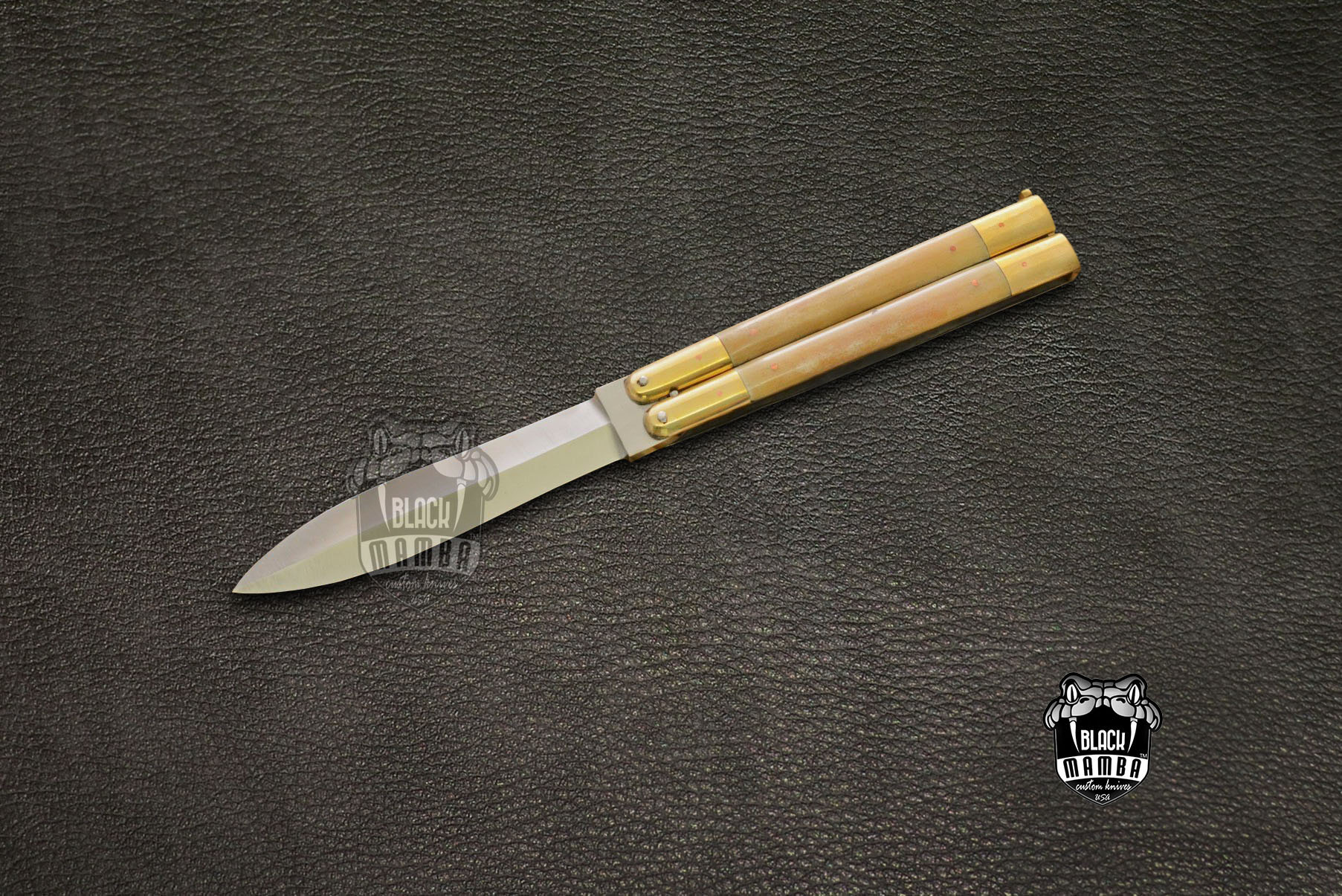
A brass-handled Filipino balisong with dyed bone inserts and a clean spear-point blade ground bright on both sides.
| Overall length | 9.1 inches |
| Blade length | 4.4 inches |
| Handle length | 4.7 inches |
| Steel | High carbon steel |
| Hardness | 58–60 HRC, oil tempered |
| Handle | – Brass with dye Bone Inserts |
Suits: a first serious balisong. Full size, honest materials, nothing on it that you will be afraid to handle.
Brass changes how a balisong swings
Brass is roughly ten percent denser than steel and considerably denser than the wood or bone used for inserts, so a brass-channelled handle puts real mass out at the ends of the knife. You feel that as a slower, heavier rotation with more carry through the turn. Beginners often prefer it, because a heavy handle keeps going where a light one stalls halfway and has to be rescued. It also means the knife lands with authority when the handles close, which is either satisfying or loud depending on where you are practicing.
Dyed bone, and why it looks like that
Bone takes dye unevenly because its density varies through the piece, and that is the point. The inserts here carry a pale cream ground with faint warmer blushes where the material drank more color. Polished flush with the brass and pinned through, they give a smooth handle with no ledge for your fingers to catch on during a rollover. Bone is also stable in a way that untreated wood is not, so the inserts will not swell or shrink noticeably with the seasons.
This blade needs oil, not just a wipe
The blade is high carbon steel, run at 58 to 60 HRC, oil tempered. That is not stainless, and it will spot if you let it. Handling a balisong means putting your fingers on the flat repeatedly, and skin leaves salt and acid behind, so wipe the blade down every time you finish and lay a light oil over it before it goes away in a drawer. If dark speckling appears, deal with it early: a little oil on a cork lifts fresh spots without touching the finish, and our guide to removing rust from a knife covers the stubborn cases. Which oil to use is a common question, answered here. Keep oil off the bone inserts, and clean the brass with a cloth rather than a polish that will run into the seams.
Questions
Will the brass tarnish? Yes, to a warmer, deeper tone. Most owners let it.
Is it heavy for a beginner? Heavier than a stainless-handled knife of the same size, and most people learning find that the extra mass helps rather than hinders, because the handle carries itself through the turn.
Is there another brass one? The BMK-612 is a close relative.
Model: BMK-450
Looking for more styles? Take a look at the full Filipino balisong collection.
Benjamin M. (verified owner) –
I’ve been collecting knives for years, and this store ranks among my favorites. The steel butterfly knife I purchased here is a shining example of craftsmanship and excellence.
Olivia L. (verified owner) –
The steel butterfly knife I received from this store is visually captivating and incredibly functional. It’s now my go-to tool for various tasks. Highly recommended!
Samuel W. (verified owner) –
I recently added a steel butterfly knife from this shop to my collection, and it has quickly become one of my most cherished pieces. The design and quality are exceptional.
Ava C. (verified owner) –
This store is a must-visit for butterfly knife enthusiasts. The knife I received is a masterpiece in steel, and it has quickly become a cherished item in my collection.
Liam S. (verified owner) –
I’m impressed with the meticulous attention to detail on the steel butterfly knife I got from this shop. It’s not just a tool; it’s a piece of art that I’m proud to own.
Mia K. (verified owner) –
The steel butterfly knife I purchased here is visually stunning and incredibly functional. It’s now my preferred tool for various tasks. Highly recommended!
James Martin –
Didn’t think a balisong at this price could feel this premium. Weight is perfectly balanced for flipping. Will definitely order again for another one.
Patrick Collins –
The moment I saw this in person I knew it was a keeper. Blade came shaving sharp straight out of the box. Black Mamba Knives is quickly becoming my go to shop for knives. Can’t recommend this enough.
Margaret Marsh –
My skepticism about ordering online disappeared the second this arrived. Weight is perfectly balanced for flipping. This is going straight into my daily rotation.
Terrell Lewis –
Perfect gift. Perfect quality. No complaints. Cool knowing this was handmade right in Memphis and shipped out fast. Weight is perfectly balanced for flipping. Love it.
George Wilson –
Bought this on a whim and it turned out to be one of my favorite purchases in a long time. Bushings feel buttery smooth after just a bit of use. This is my new favorite in the collection.
Susan Morales –
My husband couldn’t stop talking about this after I unboxed it. Action is smooth right out of the box, no break in needed. Can’t say enough good things about this purchase.