


Description
The dark half is not a coating
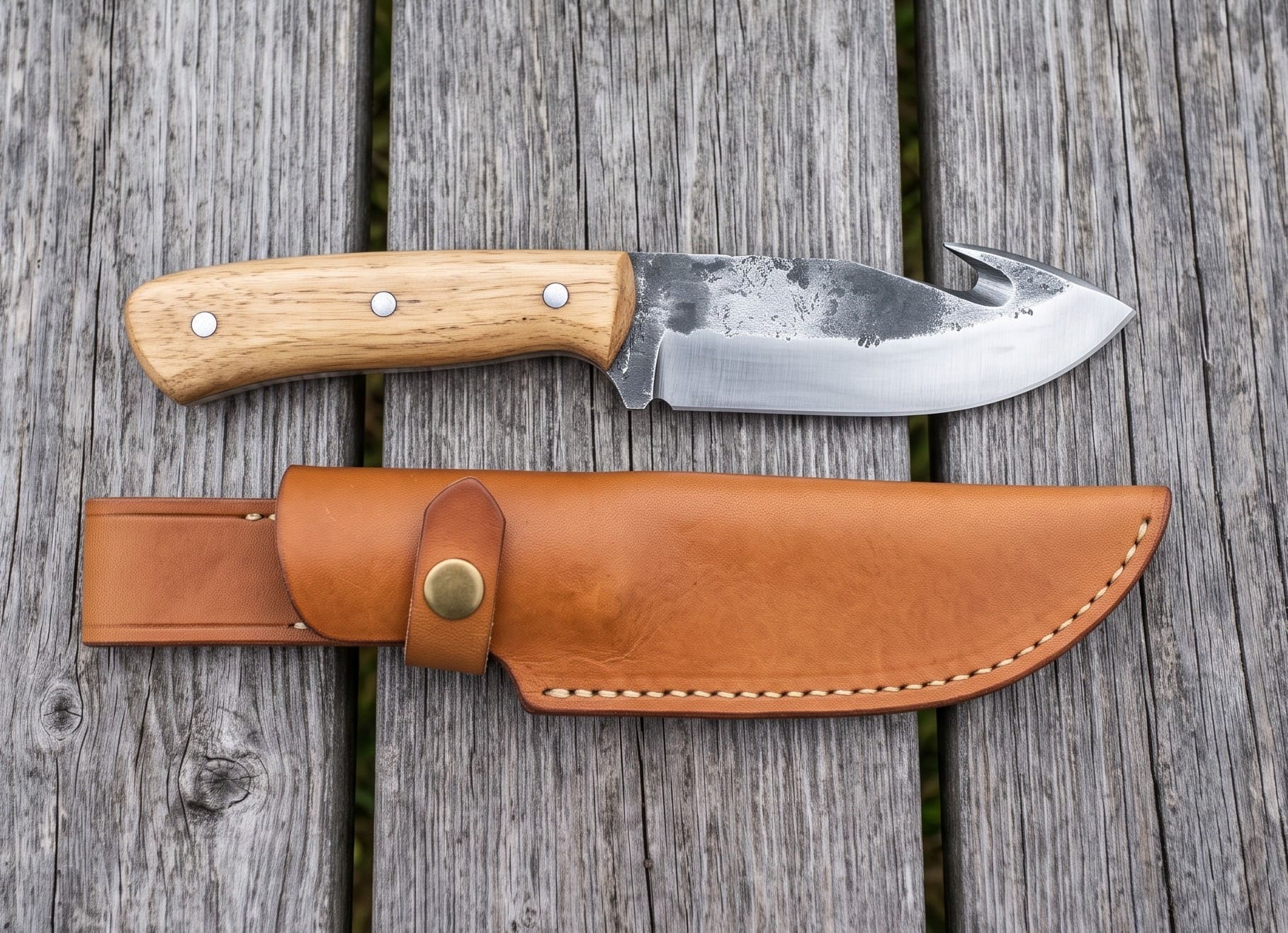
Run a thumb along the upper flat of this blade and you are touching forge scale — the black iron oxide that forms on hot steel in open air and stays welded to the surface as the bar is drawn out. It is not paint, black oxide, or a sprayed finish. When we grind the bevel we take the lower third down to bright steel and stop, so the knife carries a hard visual line between the polished cutting edge and the mottled dark ground above it. The mottling is a record. Where the hammer struck squarely the scale is thin and gray; where the steel folded around a shoulder it built up thicker and darker.
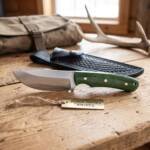
Ashen Oak is a hand-forged gut hook hunting knife measuring nine inches butt to tip, four and a half of them blade, with a crescent hook let into the spine just behind the point. It is the plainest knife in this run and, for a lot of hunters, the most appealing one.
High carbon, forged rather than cut
The blade begins as a bar of high carbon steel and is drawn out under a hammer instead of being profiled from flat plate. Forging lets a smith move mass deliberately — leave the spine thick where a hunting knife takes leverage, taper toward the tip so the front of the blade stays nimble, and thin the belly where skinning happens. It also aligns the grain with the profile rather than cutting across it. After forging comes a sequence of normalizing cycles to refine the structure, then a quench and a temper into a working range that favors toughness. Plain carbon steel at that hardness sharpens beautifully on almost anything, which matters more in a hunting camp than on a bench.
The hook, and how to use it
Slide the tip of the hook beneath the hide where the sternum ends, roll the knife so the hook’s rounded back rides against the body cavity, and pull steadily toward the pelvis. The sharpened inner curve does the cutting while the blunt outside acts as a guard. You are not applying force with the tip at all, which is why the hook exists. For the broader case on choosing a field-dressing blade, our guide to the best hunting knife covers the arguments for and against a hooked spine honestly.
| Overall Length | 9 inches |
|---|---|
| Blade Length | 4.5 inches |
| Handle Length | 4.5 inches |
| Blade Steel | High carbon steel, hand forged |
| Blade Finish | Dark forge scale with polished bevel |
| Blade Style | Drop point with integral gut hook |
| Handle Material | Oak wood |
| Fittings | Three stainless pins |
| Tang | Full tang |
| Sheath | Handmade tan leather belt sheath with stud closure (included) |
Model: BMK-1160
Oak scales, three pins
Straight-grained pale oak, sanded to a satin and shaped with a modest palm swell, held to a full tang by three stainless pins. Oak is stiff, stable, and pleasantly grippy because its open pores give the surface real texture instead of a slick sheen. It is also the easiest handle material in the world to maintain: a rag and a little oil, once a year, at your kitchen table. There is no bolster and no guard, which keeps the balance sitting just behind the ricasso and keeps the knife light in a pocket of a pack.
The sheath
Tan leather, wet-formed to this blade and hand-stitched down the spine side, kept shut by a snapped retention strap, and hung on a full-height belt loop. It will darken as it is carried. If a forged blade in a shorter working outline is more your speed, the Anvil Song bull cutter is the same steel, the same oak, and the same forge finish in a bull cutter profile.
Living with carbon steel
Carbon steel rusts if you ignore it and behaves perfectly if you do not. Scale of that kind is chemically inert and wants no upkeep whatever; it is the polished bevel that needs looking after. Wash the blade the day you use it, pay particular attention to the inside of the hook, and dry it completely before it goes anywhere. A trace of oil on the bright steel before storage is enough. Expect the bevel to darken to a gray-brown patina over a season or two and let it happen — that film is the blade protecting itself. Keep it out of the sheath between hunts. Sharpen at the original angle and finish with a strop or the back of a leather belt.
Forged, ground, fitted, and sharpened in our Memphis, Tennessee shop.


Michelle Sullivan –
This knife is reasonably good but not quite perfect. Still very happy with it and would recommend.
Timothy Ross –
Ended up ordering a second one after how happy I was with the first. Handle has a great grip even with wet or gloved hands. Beyond happy with how this turned out.
Zachary Walker –
Superb craftsmanship on this one. This will not be my last order from this company.