


Description
You can see where the hammer landed
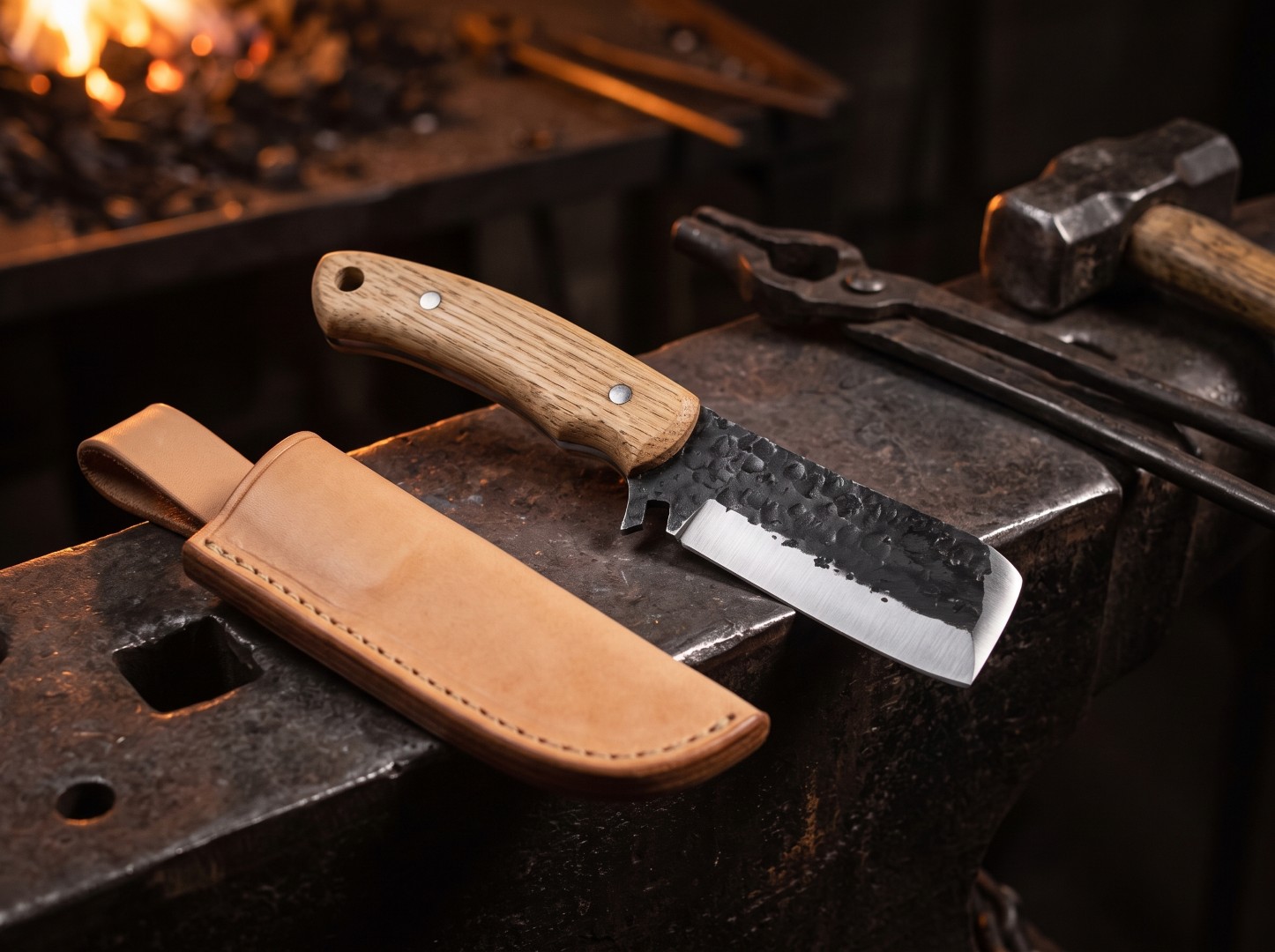
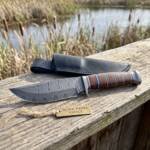
Most blades get ground until every trace of the forging is gone. This one does not. The upper two thirds of Anvil Song keeps its dark scale and the shallow, overlapping dents left by the hammer face, and only the bevel is taken down to bright steel. The line where those two surfaces meet runs the length of the blade like a waterline. It is the most honest thing a knife can show you, because a hammer mark is not a texture you can fake with a stamp — the dents follow the bar, they crowd where the smith worked slowly and stretch where the steel moved fast.
What we forged is a cowboy bull cutter: a compact sheepsfoot with a level edge, a squared-off nose, and a notched choil cut into the ricasso. Cattle outfits carried this shape for generations because there is nothing on it to puncture what you are trying not to puncture. It presses flat, it rocks on a board, it cuts a strap against a knee without the tip getting involved. On a knife this size that is a genuinely versatile arrangement, and it is more comfortable to use one-handed than most people expect until they try it.
Hand forged high carbon
The bar starts as plain high carbon steel and gets drawn out under the hammer rather than cut from plate. Forging to shape moves the grain along the profile instead of severing it, and it lets a smith put mass where the knife needs it — thickness at the spine, distal taper toward the nose. The blade is then normalized in stages so the crystal structure settles, hardened, and tempered back to a working range. High carbon at that temper takes a razor edge on almost anything abrasive and comes back quickly when you touch it up. If the distinction between this and a stamped production blade interests you, we wrote about it at length in hand-forged versus factory made.
| Overall Length | 7.5 inches |
|---|---|
| Blade Length | 3.5 inches |
| Handle Length | 4 inches |
| Blade Steel | High carbon steel |
| Blade Finish | Hammer-stamped forge texture with polished bevel |
| Blade Style | Sheepsfoot bull cutter with notched choil |
| Handle Material | Oak wood |
| Fittings | Stainless pins, lanyard hole |
| Tang | Full tang |
| Sheath | Handmade leather belt sheath (included) |
Model: BMK-1156
Oak, chosen for grain rather than color
Oak is not a fancy handle wood. It is a good one. The open ring-porous grain gives it visible texture that keeps a grip honest, it is stiff and dimensionally stable once dried properly, and it takes an oil finish that you can renew yourself at a kitchen table thirty years from now. These scales are pale and straight-grained, sanded to a satin rather than a gloss so the surface stays matte in the hand, and shaped with a gentle palm swell that fills the base of the fingers. Two stainless pins secure them over a full-length tang, and the pommel is drilled for a lanyard. Nothing on this handle is there for show.
A veg-tan sheath and a Memphis bench
The belt sheath is natural vegetable-tanned leather, molded wet around this exact blade, then saddle-stitched by hand and burnished along every edge. Veg-tan darkens with use, which is the point — in a couple of seasons it will match whatever else you carry. For a blacksmith-finished blade in a hunting outline with the same forge-scale treatment, the Ashen Oak gut hook is the closest thing we make to a companion piece.
Care, plainly stated
Carbon steel wants to be dry. Rinse it when it has cut anything acidic, dry it properly rather than letting it air off, and put a film of oil on the exposed bevel if the knife is going into a drawer for a month. That dark scale is inert and asks for no maintenance at all. Expect the bright bevel to go gray over a season and let it — that dark film is what stops rust from getting a foothold. Store the knife outside the leather. Refresh the oak with a drop of mineral or tung oil whenever it looks thirsty. Sharpen at the angle you received it, take the burr off both sides evenly, and it will keep cutting far longer than the person who bought it expects.
Forged, ground, fitted, and sharpened in Memphis, Tennessee.


Andre Collins –
Was nervous ordering something like this online but so glad I did. Pommel and guard are solid, no wobble anywhere on the knife. Weight and balance make it feel like a real working knife not some cheap import. Exactly the kind of quality that keeps me coming back.
Hannah Kelly –
Impressively made craftsmanship on this one. Black Mamba Knives keeps setting the bar higher with each order. Pommel and guard are solid, no wobble anywhere on the knife. Will definitely order again for another one.
Brian Thomas –
Feels way more premium than the price suggests. Came in a nice gift box which made it feel even more special. Every piece of the fit and finish looks hand checked before it shipped. Exactly the kind of quality that keeps me coming back.
Angela Cox –
Showed up right on time and looked even better than the photos. Handle has a great grip even with wet or gloved hands. Can’t recommend this enough.