


Description
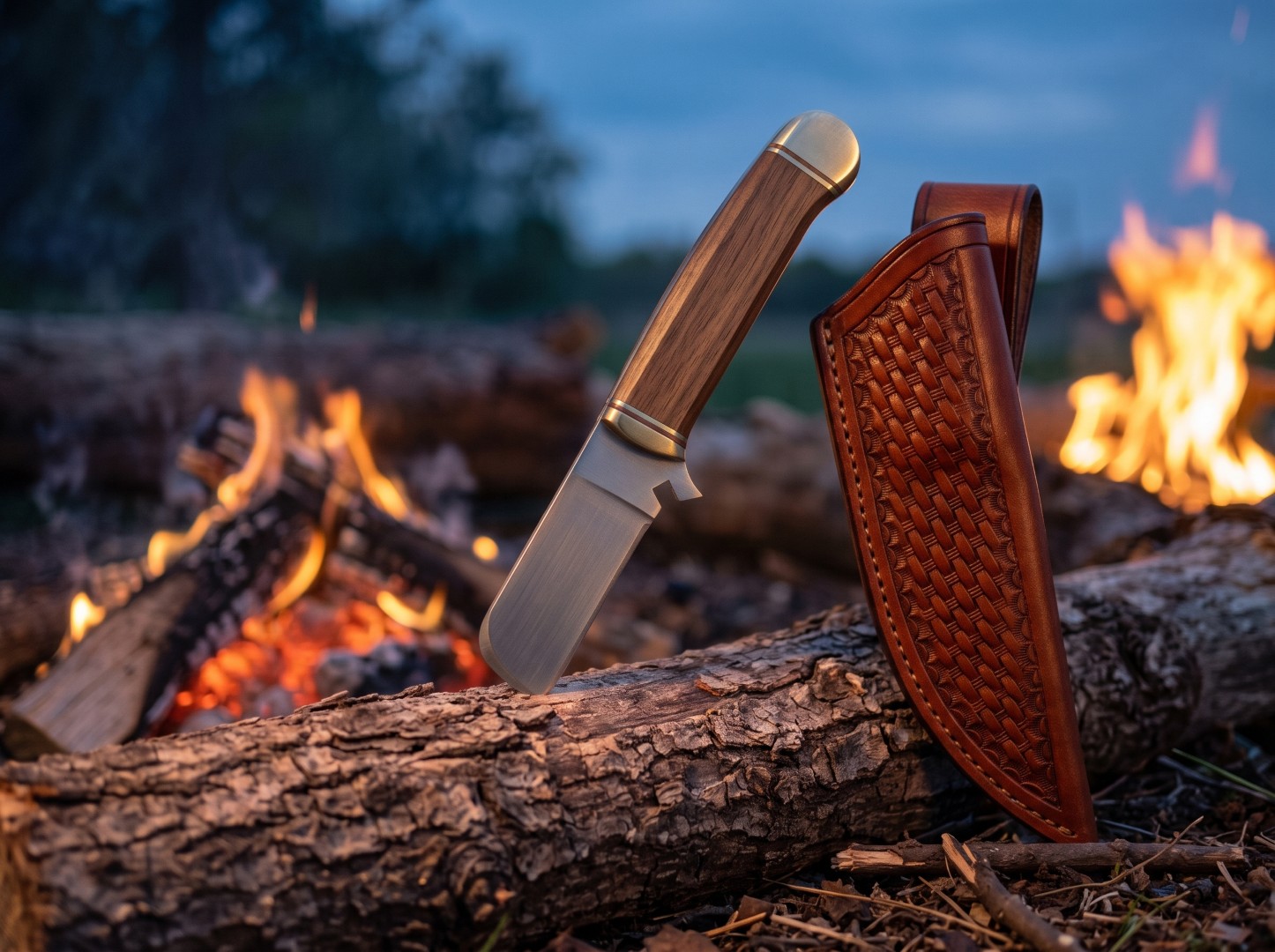
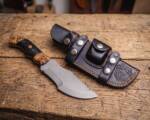
Look at the handle on this one and count the pins. There are none. The Firebrand is built with a concealed tang, which means the walnut is drilled through, the tang is glued and pinned inside where you cannot see it, and the whole assembly is squeezed between a solid brass front bolster and a brass butt cap. It is older and harder construction than a pair of scales on a flat tang, and it produces a handle with an unbroken surface from bolster to cap.
| Overall Length | 7.5 inches |
|---|---|
| Blade Length | 3.5 inches |
| Handle Length | 4 inches |
| Blade Steel | High carbon spring steel |
| Blade Finish | Matte gray satin |
| Blade Style | Sheepsfoot bull cutter with notched choil |
| Handle Material | Walnut wood, pinless |
| Bolsters | Solid brass front bolster and brass butt cap with fiber spacers |
| Tang | Concealed tang, no visible pins |
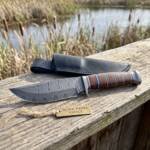
| Sheath | Handmade basketweave tooled leather belt sheath (included) |
Why concealed tang
Nothing interrupts the grip. On a pinned handle your palm crosses two or three pin heads, and however well they are finished you can feel where they are. Here the walnut is continuous, rounded into an oval section that fills the hand, and the only transitions are the two brass fittings and the thin fiber spacers that separate them from the wood. Those spacers do a job as well as look right: they take up the difference between two materials that expand at different rates.
The compromise is honest and worth stating. A concealed tang is not the construction to choose if you plan to baton the knife through a log. For everything a bull cutter is actually asked to do, it is more than strong enough, and it looks considerably better doing it. If the terminology is new, our guide to the parts of a knife names everything on this handle.
Blade and edge
High carbon spring steel, ground to a sheepsfoot with a matte satin finish that runs lengthwise down the flat. The spine is straight and thick, the edge is straight and thin, and the front drops away in a shallow curve to a blunt nose. There is a notched choil where the bevel begins so the edge does not run out into the handle. On the board this shape is decisive; there is no rolling motion to learn, you simply push down and the cut is finished.
Satin rather than mirror is a deliberate choice on a working blade. A mirror polish shows every scratch from the first week of use, whereas a fine satin absorbs the marks and looks better at two years than it did at two days. It is also far easier to refresh at home with nothing more exotic than a worn abrasive pad drawn along the length of the flat, whereas a mirror finish effectively cannot be repaired outside a shop. Our summary of fixed blade grinds and bevels explains why the flat grind used here suits a short straight edge better than a hollow would.
Sheath, origin and upkeep
The knife ships in a hand-stamped basketweave leather belt sheath with a fold-over belt loop. Everything is forged, ground, fitted and stitched in Memphis, Tennessee.
Two materials here need thinking about. The carbon steel wants to be dry, so clean and dry it before it goes away, and give it a wipe of oil if it is going into a drawer for a month. The brass will develop a warm patina, which some people polish off with a rag and a little metal polish and others leave alone; both are correct, and the patina causes no harm. Walnut takes an occasional wax. Since the tang is concealed, never leave the knife soaking, because water finds its way inside a handle far more easily than it finds its way back out. A close relative with the same pinless brass treatment and a rosewood handle is the Cinnabar Rain.
Model: BMK-1147

Sergio Cole –
This ring has already earned a permanent spot in my collection. Not my first order from Black Mamba Knives and it won’t be my last. You can tell it’s real American craftsmanship out of Memphis. Shipping was quick too. This company just earned a repeat customer.
Roger Thompson –
Wanted to like this more than I actually do. Made in the USA supposedly but the fit didn’t reflect that. Finish had some uneven spots. Just an average purchase. Wouldn’t rush to buy again.
Henry Adams –
This exceeded what I pictured in my head before ordering. Pattern in the metal catches the light beautifully. Beyond happy with how this turned out.
Zachary Carter –
Did not expect this level of quality for the price. Made in the USA right in Memphis, and it shipped worldwide without any long wait.
Pamela Hill –
Got this for a birthday gift and now I want one for myself too. Not my first order from Black Mamba Knives and it won’t be my last.