


Description
Put your thumb on the spine of Thicket Warden and you will understand the knife immediately. The jimping filed into the steel at the ricasso is not decoration — it is where your thumb goes when you are working the point around a hip joint or peeling a hide off a shoulder, and it turns a general-purpose hunting blade into something you can steer with precision.
Olive wood in the hand
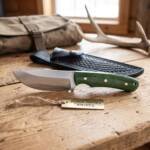
The scales are olive, one of the densest and oiliest woods that will take a polish. The figure runs in restless waves of pale gold and dark brown, and because olive grows slowly and unevenly, no two handles come out the same. It is warm to hold in November, it will not go slick, and its natural oil content means it handles being touched by wet hands far better than an open-grained hardwood. Brass pins hold the scales to a full tang, with a brass-lined lanyard opening at the butt.
| Overall Length | 9 inches |
|---|---|
| Blade Length | 4.5 inches |
| Handle Length | 4.5 inches |
| Blade Steel | D2 tool steel |
| Blade Finish | Polished satin with spine jimping |
| Blade Style | Drop point with integral gut hook |
| Handle Material | Olive wood |
| Fittings | Brass pins, lanyard hole |
| Tang | Full tang |
| Sheath | Handmade brown leather belt sheath with stud closure (included) |
Blade geometry
A drop point puts the tip below the line of the spine, which keeps it out of trouble on the inside of an animal and gives you a wide, sweeping belly to skin with. Add the integral gut hook and you have the classic deer hunter’s profile — read our rundown of blade shapes if you want to see how that compares to a clip point or a trailing point. The blade is flat ground from D2 and finished in a polished satin, so it is bright, easy to keep clean and easy to inspect for nicks after a hard job.
What D2 does differently
It stays sharp. That is the headline, and it comes from a carbide-rich structure that resists abrasion the way a die steel has to. The cost is that D2 is not stainless and it is not quick to sharpen. Use a diamond plate or a good ceramic, take your time, and it will hold that edge through work that would flatten a softer blade twice over.
The hook itself
Ground into the spine, then opened out and polished on the inside curve by hand. Slid under the skin at the sternum, it opens the belly in one steady draw with the blunt back of the hook riding against the hide, so the tip never comes near the stomach. Our gut hook explainer covers technique properly, including how to sharpen the curve.
Sheath and origin
A brown leather belt sheath is cut, wet formed to this exact blade, saddle stitched, edge slicked and closed by a strap and stud, and it ships with the knife. Both are made in our Memphis, Tennessee shop, where blanks are profiled, hardened in our own ovens, ground, fitted and hand finished. You are buying a few hours of somebody’s attention, and it shows in the fit at the front of the scales.
Care
Dry the steel thoroughly after use, including the recess of the hook. A light oil before storage keeps D2 honest. Wipe the olive wood with a damp cloth and, once a year, work in a little food-safe wood oil to keep it from drying — it will darken slightly with age, which is a feature. Do not store the knife in its sheath long term and do not put it near a dishwasher. Sharpen the main edge conventionally; use a round file or a tapered rod inside the hook. If figured wood appeals but you want something brighter, Goldleaf pairs stabilized maple burl with the same blade.
Model: BMK-1175


Samuel Morales –
Ordering again from this seller the second I finish writing this review. Sheath snaps shut securely and doesn’t feel flimsy at all. This is my third order from Black Mamba Knives and they never disappoint. Exactly the kind of quality that keeps me coming back.
Kevin Lee –
Decent buy overall, a couple small nitpicks aside. Nice that it’s US made out of Memphis with solid shipping times. Balance is good, just wish the handle had a bit more grip texture. Would still tell others to give this a try.
Ronald Gomez –
Feels way more premium than the price suggests. If you’re on the fence just get it. You won’t regret it. Black Mamba Knives keeps setting the bar higher with each order.
Christine Jones –
Turned out better than I expected going in. Handle looks great though it’s a little smaller than I imagined. Still very happy with it and would recommend.
Raymond Bishop –
This is the kind of knife you show off without even meaning to. Great buy overall.
Hunter Nguyen –
Feels way more premium than the price suggests. Edge retention has been great even after regular use in the field. Even the small details in the damascus pattern are crisp and clean. This store nailed it with this one.
Eric Walker –
This exceeded what I pictured in my head before ordering. Edge retention has been great even after regular use in the field. Already thinking about what to order next from this seller.
Raymond Taylor –
Was nervous ordering something like this online but so glad I did. Fit and finish is museum quality. You can tell real craftsmen made this by hand. Shipping was fast and everything arrived well packaged.