


Description
Some handle materials are chosen for grip and some are chosen because you cannot stop looking at them. The stabilized maple burl on Goldleaf is firmly the second kind — amber and honey, shot through with the tight swirls and eyes that only form where a tree has grown a burl, and no two scales anywhere in the world matching. It is the knife people buy when the occasion is a fiftieth birthday, a retirement, or a first successful season.
What stabilizing means
Raw burl is beautiful and unreliable: it is full of voids and grain running in a dozen directions, and it will move with humidity. Stabilizing puts the dried wood under vacuum in a bath of liquid acrylic resin, drawing the resin into every pore, then cures it hard. What comes out is a material with the figure of wood and the manners of a polymer — it will not swell, crack or check, it can be sanded to a deep gloss, and it shrugs off blood and water. All the character, none of the drama.
| Overall Length | 9 inches |
|---|---|
| Blade Length | 4.5 inches |
| Handle Length | 4.5 inches |
| Blade Steel | D2 tool steel |
| Blade Finish | Polished satin |
| Blade Style | Drop point with integral gut hook |
| Handle Material | Stabilized maple burl |
| Bolster | Polished stainless steel |
| Fittings | Lanyard hole |
| Tang | Full tang |
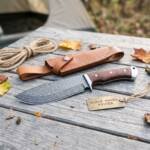
| Sheath | Handmade tan leather belt sheath with stud closure (included) |
A blade that means business
Underneath the good looks this is a working hunting knife. Four and a half inches of D2 tool steel, flat ground, finished in a bright polished satin, shaped as a drop point and carrying an integral gut hook. D2 is genuinely hard and genuinely abrasion resistant, which is why it stays sharp through a whole field dressing when softer stainless does not, and it is worth knowing that the same hardness makes it slow on a soft stone — use diamond or ceramic. The scales are secured with stainless screw hardware over a full tang, with a lanyard opening at the butt. Curious how the primary bevel affects cutting? Our breakdown of fixed blade bevels explains what a flat grind gives you.
The hook
Cut into the spine and opened out by hand, the hook is brought to a polish along its inner face so it glides beneath hide and runs the length of the belly in one pull without dipping toward the paunch. A short run of file work along the spine, just forward of the handle, gives the thumb somewhere firm to press when you are picking your way around a joint in bad light.
Sheath, and the shop it came from
A tan leather belt sheath ships with it, cut around this blade’s outline, formed damp, stitched and secured by a strap and stud. Knife and sheath are both made in Memphis, Tennessee, where the blank is cut, hardened, ground and hand rubbed before the burl is fitted and shaped. Because the figure in burl cannot be predicted or repeated, every one of these is a genuine one-off.
Keeping it looking like this
The blade goes away dry, with particular attention paid to the recess of the hook, and a thin coat of oil before any long stretch in storage. The stabilized burl needs nothing beyond a wipe with a damp cloth; if the gloss ever dulls, a trace of paste wax restores it. Leather traps damp against steel, so park the knife on a shelf between seasons rather than in its scabbard, and keep the whole thing well away from a dishwasher. Sharpen conventionally on the main edge, and use a small round file or tapered ceramic rod inside the hook.
If it is a present
Mention it at checkout and we will pack it accordingly. Every knife leaves here with a lifetime warranty against defects in materials and workmanship. For more ideas along these lines, our gift guide is organised by who you are shopping for, and the Damascus-bladed Vermillion Coil is the step up if you want the blade to be the showpiece too.
Model: BMK-1173


DeShawn Davis –
My skepticism about ordering online disappeared the second this arrived. Handle feels amazing and the balance is perfect. This has quickly replaced my old go to knife for field dressing. Worth every penny.
Christopher Stewart –
This showed up faster than expected and looked incredible. Nice to support a Memphis based knife maker, shipping was fast even internationally.
Elizabeth Long –
Bought this on a whim and it turned out to be one of my favorite purchases recently. Love that this comes out of Memphis and still ships worldwide this quickly. Came in a nice gift box which made it feel even more special. So worth it.
Wayne Gutierrez –
My skepticism about ordering online disappeared the second this arrived. Pommel and guard are solid, no wobble anywhere on the knife. Leather sheath is thick and well stitched. Not the cheap stuff you usually get. Shipping was fast and everything arrived well packaged.