


Description
A feather is the hardest pattern to forge
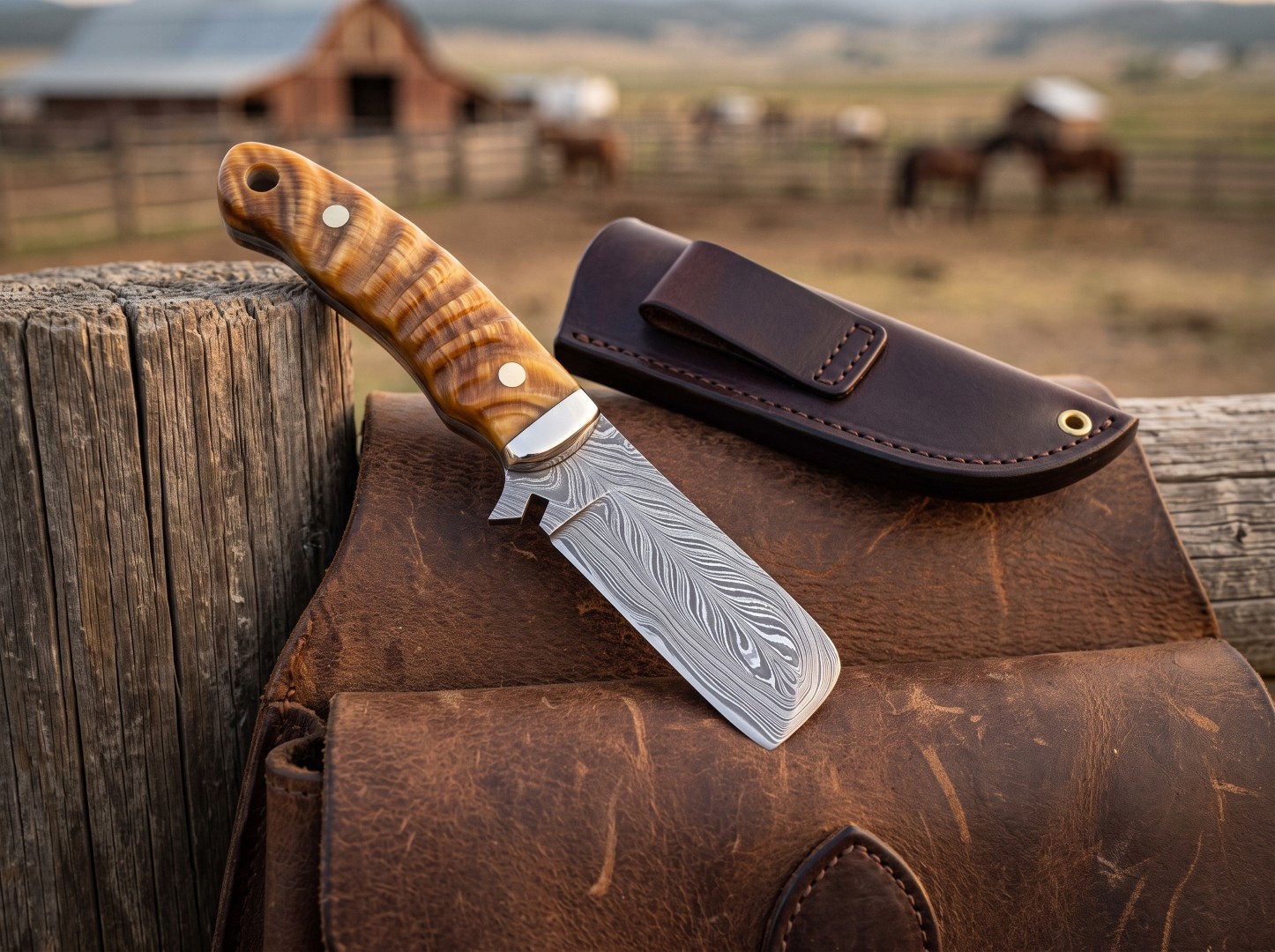
Ask any smith which billet has cost them the most scrap and the answer is usually the feather. The method sounds simple and almost never behaves: build a layered bar, cut it lengthwise most of the way through, fold the two halves back over a wedge, and re-weld the whole thing so the layers splay outward from a central quill. Get the heat wrong by fifty degrees or the pressure uneven across the die and the weld tears, the quill wanders off center, or the barbs collapse into mush. The billet that survived to become this blade has a spine running clean down the middle and plumes sweeping out to both edges in long, unbroken curves. That is the whole reason it is here.
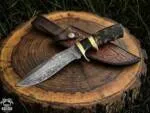
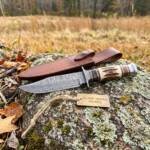
Plume Canyon is a cowboy bull cutter, which is a shape born on working outfits rather than in a showroom. The sheepsfoot profile puts a flat, level edge under your hand with no point to steer, and the notched choil ahead of the scales gives you somewhere to choke up when the job gets small. It is a superb utility outline — opening feed, cutting cord, breaking down a box, trimming leather — and it happens to look extraordinary when the steel underneath it is patterned like this.
Ram horn, and why no two are alike
The scales came off a ram’s horn, cut from the outer wall where the material is densest. Horn grows in seasonal bands, so the finished scale shows curved ridges of translucent amber running through smoky brown — you can read the animal’s winters in it. Stabilized and hand-sanded to a low sheen, it warms in the hand faster than wood and feels closer to bone than to plastic. A polished bolster caps the front of the handle and pins hold each scale to a full-tang blank, with a lanyard hole drilled through the butt. Because horn is a natural material, the pair you receive will be recognizably related to the photograph without being a copy of it. That is the deal with anything grown rather than molded.
| Overall Length | 7.5 inches |
|---|---|
| Blade Length | 3.5 inches |
| Handle Length | 4 inches |
| Blade Steel | Hand-forged feather pattern Damascus, acid etched |
| Blade Style | Sheepsfoot bull cutter with notched choil |
| Handle Material | Ram horn |
| Bolster | Polished stainless steel |
| Fittings | Nickel pins, lanyard hole |
| Tang | Full tang |
| Sheath | Handmade leather belt sheath with stud closure (included) |
Model: BMK-1154
Edge geometry
The grind is a flat bevel taken high on a blade that is only three and a half inches long, which keeps the cross-section thin behind the edge and lets it slice well above its weight. Pattern-welded steel is normalized several times before hardening so the grain refines, then quenched and drawn back to a working temper — hard enough to hold, soft enough to take a burr off cleanly on a stone. Anyone curious about how forge welding differs from a factory blanking press will find our comparison of hand-forged and factory-made knives a useful hour.
Sheath, and what arrives
The belt sheath is cut, wet-formed, stitched, and edge-burnished by hand in dark leather, with a snap strap that closes over the handle and a loop sized for a working belt. Nothing about it is stamped or glued together at speed. If a feather pattern is what drew you here, the Vermillion Coil gut hook carries a different forged pattern in a hunting profile, and it is worth a look side by side.
Care that respects the etch
An acid-etched surface is a controlled oxide layer, and it will keep reacting if you let it sit wet. Dry the blade properly when it has been near moisture, keep an oiled rag in the drawer and use it, and never store the knife inside leather for weeks at a time — tanned hide holds humidity against steel. Ram horn wants the same thing your own hands do: no dishwasher, no long soak, and a little wax once a year if the surface dulls. When the edge stops biting, work it on a whetstone at the bevel angle it was ground to, then take the wire edge off on a strop. Handled that way, a feather-pattern blade only gets deeper and more legible over time.
Forged, ground, etched, fitted, and sharpened in our shop in Memphis, Tennessee.
Lisa Sanders –
This knife is a genuine work of art. Handle has a great grip even with wet or gloved hands. Love that this comes out of Memphis and still ships worldwide this quickly. Black Mamba Knives has earned a repeat customer with this one. If you’re on the fence just get it. You won’t regret it.
Matthew Wood –
My skepticism about ordering online disappeared the second this arrived. Even the small details in the damascus pattern are crisp and clean. Worth every penny.
Jeffrey Brown –
This maker clearly knows what they’re doing with quality like this. Definitely bookmarking this shop for future orders.
Paul Turner –
Did not expect this level of quality for the price. Even the small details in the damascus pattern are crisp and clean. This is my third order from Black Mamba Knives and they never disappoint. This is going straight into my daily rotation.