

Description
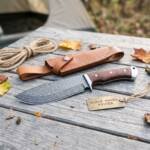
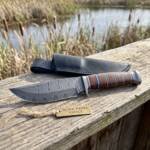
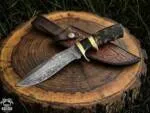
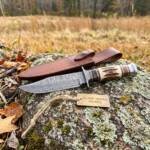
Honey Vein is the one people pick up first at a table. Its blade is forged from pattern-welded stock and etched down until tight concentric rings surface, the bolster is polished stainless, and the handle is a grown material full of translucent amber and smoked brown — not a wood grain, not a resin pour, but the seasonal banding of something that came off an animal and was stabilized and shaped rather than manufactured. It photographs well. It also field dresses a deer, which is the part that matters.
The blade
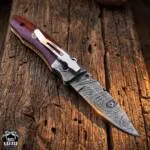
Nine inches overall, four and a half of it blade, ground as a drop point whose spine opens into a sharpened crescent an inch or so back from the tip. The pattern comes from stacking two steels of different alloy content, forge-welding them into a bar, folding and drawing that bar until the layer count is in the hundreds, and then working the surface so the internal geometry surfaces when the flats are ground. Acid finishes the job by etching one alloy darker than the other. What you end up with here is a field of rings and long looping veins that runs the whole length of the blade and around the hook.
Pattern-welded steel is not a gimmick and it is not automatically better than a good monosteel — it is high carbon steel with a picture in it, and it lives or dies on heat treatment. Ours gets multiple normalizing cycles before the quench so the grain refines, then a temper into a range that holds an edge through hide and hair without going brittle at the tip. If you are trying to decide whether a forged pattern is worth the premium over a plain blade, our honest take on whether Damascus knives are worth it is not a sales pitch.
Why a gut hook earns its place
The hook is a sharpened crescent set into the spine with a rounded, unsharpened back. Slipped under the hide at the brisket and drawn toward the pelvis, it opens the abdominal wall from beneath while the blunt outer curve slides along the paunch and holds the point clear of trouble. It converts the most delicate cut in field dressing into the easiest one. The remaining blade is a conventional drop point with a generous belly for skinning and enough flat behind the tip for caping.
| Overall Length | 9 inches |
|---|---|
| Blade Length | 4.5 inches |
| Handle Length | 4.5 inches |
| Blade Steel | Hand-forged Damascus, acid etched |
| Blade Finish | Acid etched Damascus |
| Blade Style | Drop point with integral gut hook |
| Handle Material | Ram horn |
| Bolster | Polished stainless steel |
| Fittings | Stainless pin, lanyard hole |
| Tang | Full tang |
| Sheath | Handmade brown leather belt sheath with stud closure (included) |
Model: BMK-1163
The handle
These scales show curved growth ridges running across the handle in bands, translucent honey giving way to charcoal and back again, with a low satin polish that lets the light travel a little way into the material before it comes back. It warms to the hand within a minute, faster than wood and far faster than steel, and it has a slight natural tack when your palms are damp. Because it is grown rather than milled from a sheet, the pair on your knife will be recognizably from the same family as the photograph without being identical to it — the banding, the color balance, and the depth of the dark streaks are all individual. A polished stainless bolster fronts the handle, the tang runs full length, and a lined hole at the butt takes a lanyard.
Sheath, and a near relation
Brown leather, hand-cut and pressed to shape around the blade while still wet, saddle-stitched in a contrasting thread and fastened by a press stud across the handle. Hunters who want the same forged pattern with a synthetic handle for hard weather should compare the Coyote Ripple gut hook, and there is a wider discussion of the category in our Damascus hunting knife guide.
Care
Two rules cover almost everything. First, an etched blade does not like sitting wet — wash it the day you use it, get a brush into the hook, dry it completely, and put a thin film of oil on the flats before it goes away for the off season. Second, a natural handle does not like extremes: no dishwasher, no soaking, no radiator, and a trace of clear wax buffed off once a year if the surface loses its glow. Store the knife outside the leather sheath. Return the primary bevel to a stone at the angle you received it on, run a rat-tail ceramic or a dowel wrapped in fine abrasive inside the hook, and strop afterward. Built in Memphis, Tennessee, from forging to final edge.
Cynthia Martin –
Perfect gift. Perfect quality. No complaints. Weight and balance make it feel like a real working knife not some cheap import. If you’re on the fence just get it. You won’t regret it.
Paul Alvarez –
This is one of those purchases that just makes you smile. Pommel and guard are solid, no wobble anywhere on the knife. This maker nailed it with this one. This is my third order from Black Mamba Knives and they never disappoint.
Sandra Adams –
This knife has already earned a permanent spot in my collection. Beyond happy with how this turned out.
Jeffrey Freeman –
Ended up ordering a second one after how happy I was with the first. Even the small details in the damascus pattern are crisp and clean. Handle feels amazing and the balance is perfect. Would send this as a gift again in a heartbeat.